• Produktbild: Games and Mathematics
  • Produktbild: Games and Mathematics

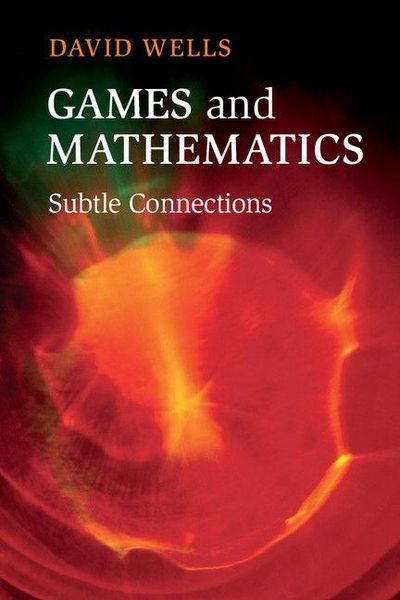
Games and Mathematics

43,99 €

inkl. gesetzl. MwSt., Versandkostenfrei


Beschreibung

Produktdetails

Einband

Taschenbuch

Erscheinungsdatum

18.10.2012

Abbildungen

160 b/w illus.

Verlag

Cambridge University Press

Seitenzahl

258

Maße (L/B/H)

22,9/15,2/1,4 cm

Gewicht

379 g

Sprache

Englisch

ISBN

978-1-107-69091-2

Beschreibung

Rezension

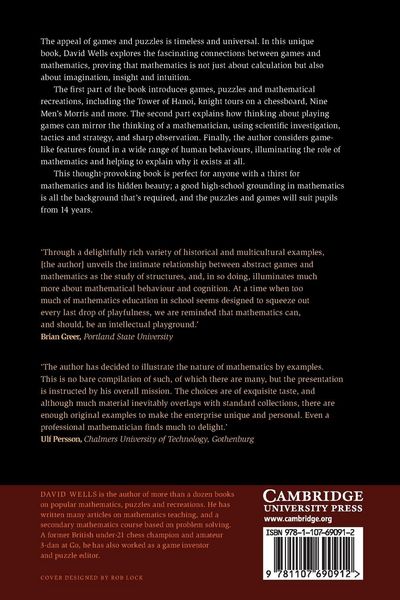
'One of the wellsprings out of which the discipline of mathematics has developed is human delight in intellectual play, manifest in the ubiquity of abstract games across millennia and cultures. The author of this fascinating book is expert in both domains, and in the art of clearly explaining significant aspects of mathematics in ways both accessible to non-experts and illuminating to experts. Through a delightfully rich variety of historical and multicultural examples, he unveils the intimate relationship between abstract games and mathematics as the study of structures, and, in so doing, illuminates much more about mathematical behaviour and cognition. At a time when too much of mathematics education in school seems designed to squeeze out every last drop of playfulness, we are reminded that mathematics can, and should, be an intellectual playground.' Brian Greer, Portland State University

Produktdetails

Einband

Taschenbuch

Erscheinungsdatum

18.10.2012

Abbildungen

160 b/w illus.

Verlag

Cambridge University Press

Seitenzahl

258

Maße (L/B/H)

22,9/15,2/1,4 cm

Gewicht

379 g

Sprache

Englisch

ISBN

978-1-107-69091-2

Noch keine Bewertungen vorhanden

Verfassen Sie die erste Bewertung zu diesem Artikel

Helfen Sie anderen Kundinnen und Kunden durch Ihre Meinung.

Kundinnen und Kunden meinen

Bewertungen (0)

Die Leseprobe wird geladen.
  • Produktbild: Games and Mathematics
  • Produktbild: Games and Mathematics
  • Introduction; Part I. Mathematical recreations and abstract games: 1. Recreations from Euler to Lucas; 2. Four abstract games; 3. Mathematics and games: mysterious connections; 4. Why chess is not mathematics; 5. Proving versus checking; Part II. Mathematics: game-like, scientific and perceptual: 6. Game-like mathematics; 7. Euclid and the rules of his geometrical game; 8. New concepts and new objects; 9. Convergent and divergent series; 10. Mathematics becomes game-like; 11. Maths as science; 12. Numbers and sequences; 13. Computers and mathematics; 14. Mathematics and the sciences; 15. Minimum paths from Heron to Feynmann; 16. The foundations: perception, imagination and insight; 17. Structure; 18. Hidden structure, common structure; 19. Mathematics and beauty; 20. Origins: formality in the everyday world; Bibliography; Index.