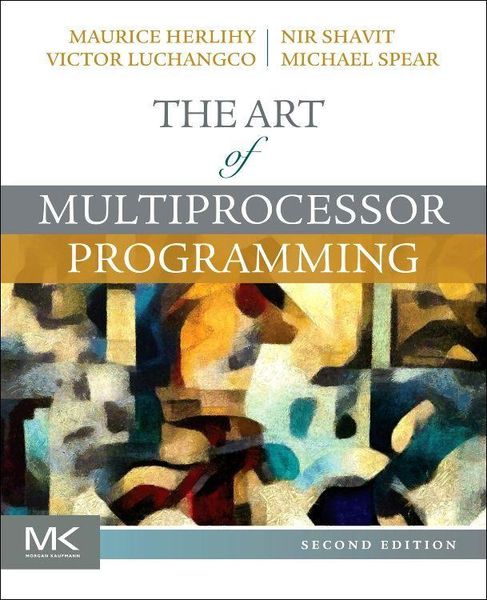
Produktbild: The Art of Multiprocessor Programming

The Art of Multiprocessor Programming

74,99 €

inkl. gesetzl. MwSt., Versandkostenfrei


Beschreibung

Produktdetails

Einband

Taschenbuch

Erscheinungsdatum

01.11.2020

Verlag

Elsevier LTD

Seitenzahl

553

Maße (L/B/H)

23,6/19,2/2,7 cm

Gewicht

1130 g

Auflage

2nd edition

Sprache

Englisch

ISBN

978-0-12-415950-1

Beschreibung

Rezension

"The book is largely self-contained, has countless examples, and focuses on what really matters. As such, it is very well suited for both a teaching environment and for practitioners looking for an opportunity to learn about this topic...The book is written in a way that makes multiprocessor programming accessible. This updated version will further confirm its status as a classic." --ComputingReviews.com, 2013

Produktdetails

Einband

Taschenbuch

Erscheinungsdatum

01.11.2020

Verlag

Elsevier LTD

Seitenzahl

553

Maße (L/B/H)

23,6/19,2/2,7 cm

Gewicht

1130 g

Auflage

2nd edition

Sprache

Englisch

ISBN

978-0-12-415950-1

Herstelleradresse

Libri GmbH
Europaallee 1
36244 Bad Hersfeld
DE

Email: gpsr@libri.de

Kundinnen und Kunden meinen

0 Bewertungen

Informationen zu Bewertungen

Zur Abgabe einer Bewertung ist eine Anmeldung im Konto notwendig. Die Authentizität der Bewertungen wird von uns nicht überprüft. Wir behalten uns vor, Bewertungstexte, die unseren Richtlinien widersprechen, entsprechend zu kürzen oder zu löschen.

Die Bewertungen sind nach Format, Anzahl Sterne und Datum sortiert.

Verfassen Sie die erste Bewertung zu diesem Artikel

Helfen Sie anderen Kund*innen durch Ihre Meinung

Kundinnen und Kunden meinen

0 Bewertungen filtern

Die Leseprobe wird geladen.
  • Produktbild: The Art of Multiprocessor Programming
  • 1. Introduction
    2. Mutual exclusion
    3. Concurrent objects
    4. Foundations of shared memory
    5. The relative power of synchronization operations
    6. Universality of consensus
    7. Spin locks and contention
    8. Monitors and blocking synchronization
    9. Linked lists: The role of locking
    10. Queues, memory management, and the ABA problem
    11. Stacks and elimination
    12. Counting, sorting and distributed coordination
    13. Concurrent hashing and natural parallelism
    14. Skiplists and balanced search
    15. Priority queues
    16. Scheduling and work distribution
    17. Data parallelism
    18. Barriers
    19. Optimism and manual memory management
    20. Transactional programming

    Appendix A: Software basics
    Appendix B: Hardware basics