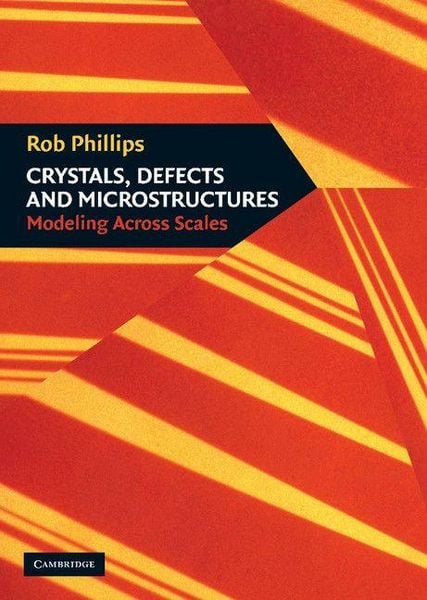
Crystals, Defects and Microstructures Modeling Across Scales
-
- Hardcover ausgewählt
- Taschenbuch
- eBook
-
Sprache:Englisch
281,99 €
inkl. gesetzl. MwSt.,
Beschreibung
Produktdetails
Einband
Gebundene Ausgabe
Erscheinungsdatum
15.03.2012
Verlag
Cambridge AcademicSeitenzahl
808
Maße (L/B/H)
25/17,5/4,7 cm
Gewicht
1738 g
Sprache
Englisch
ISBN
978-0-521-79005-5
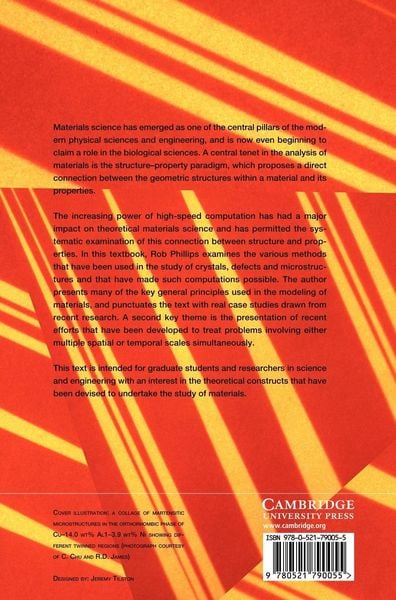
A central tenet of materials analysis is the structure-property paradigm, which proposes a direct connection between the geometric structures within a material and its properties. The increasing power of high-speed computation has had a major impact on theoretical materials science and has permitted the systematic examination of this connection between structure and properties. In this textbook, Rob Phillips examines various methods for studying crystals, defects, and microstructures, techniques that have made such computations possible. He also presents recent efforts to treat problems involving either multiple spatial or temporal scales simultaneously. Detailed case studies illustrate general principles as well as their applications to current research problems.
Kundinnen und Kunden meinen
Verfassen Sie die erste Bewertung zu diesem Artikel
Helfen Sie anderen Kund*innen durch Ihre Meinung
Kurze Frage zu unserer Seite
Vielen Dank für Ihr Feedback
Wir nutzen Ihr Feedback, um unsere Produktseiten zu verbessern. Bitte haben Sie Verständnis, dass wir Ihnen keine Rückmeldung geben können. Falls Sie Kontakt mit uns aufnehmen möchten, können Sie sich aber gerne an unseren Kund*innenservice wenden.
zum Kundenservice