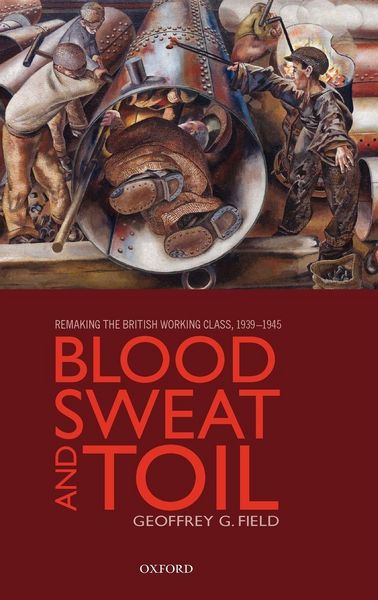
Blood, Sweat, and Toil Remaking the British Working Class, 1939-1945
202,99 €
inkl. gesetzl. MwSt.,
Beschreibung
Produktdetails
Einband
Gebundene Ausgabe
Erscheinungsdatum
03.11.2011
Abbildungen
10 black and white illustrations
Verlag
Oxford AcademicSeitenzahl
416
Maße (L/B/H)
24/16,1/2,7 cm
Gewicht
787 g
Sprache
Englisch
ISBN
978-0-19-960411-1
Blood, Sweat, and Toil is the first scholarly history of the British working class in the Second World War. It integrates social, political, and labour history, and reflects the most recent scholarship and debates on social class, gender, and the forging of identities.
Geoffrey G. Field examines the war's impact on workers in the varied contexts of the family, military service, the workplace, local communities, and the nation. Previous studies of the Home Front have analysed the lives of civilians, but they have neglected the importance of social class in defining popular experience and its centrality in public attitudes, official policy, and the politics of the war years. Contrary to accounts that view the war as eroding class divisions and creating a new sense of social unity in Britain, Field argues that the 1940s was a crucial decade in which the deeply fragmented working class of the interwar decades was "remade," achieving new collective status, power, and solidarity. He criticizes recent revisionist scholarship that has downplayed the significance of class in British society.
Extensively researched, using official documents, diaries and letters, the records of trade unions, and numerous other institutions, Blood, Sweat, and Toil traces the rapid growth of trade unionism, joint consultation, and strike actions in the war years. It also analyses the mobilization of women into factories and the uniformed services and the lives of men conscripted into the army, showing how these experiences shaped their social attitudes and aspirations. Using opinion polls and other evidence, Field traces the evolution of popular political attitudes from the evacuation of 1939 and the desperate months of late 1940 to the election of 1945, opposing recent claims that the electorate was indifferent or apathetic at the war's end but also eschewing blanket assumptions about popular radicalization. Labour was an active agent in fashioning itself as both a national progressive party and the representative of working-class interests in 1945; far from a mere passive beneficiary of anti-Tory feeling, it gave organizational form to the idealism and the demand for significant change that the war had generated.
Noch keine Bewertungen vorhanden
Verfassen Sie die erste Bewertung zu diesem Artikel
Helfen Sie anderen Kundinnen und Kunden durch Ihre Meinung.
Kurze Frage zu unserer Seite
Vielen Dank für Ihr Feedback
Wir nutzen Ihr Feedback, um unsere Produktseiten zu verbessern. Bitte haben Sie Verständnis, dass wir Ihnen keine Rückmeldung geben können. Falls Sie Kontakt mit uns aufnehmen möchten, können Sie sich aber gerne an unseren Kund*innenservice wenden.
zum Kundenservice