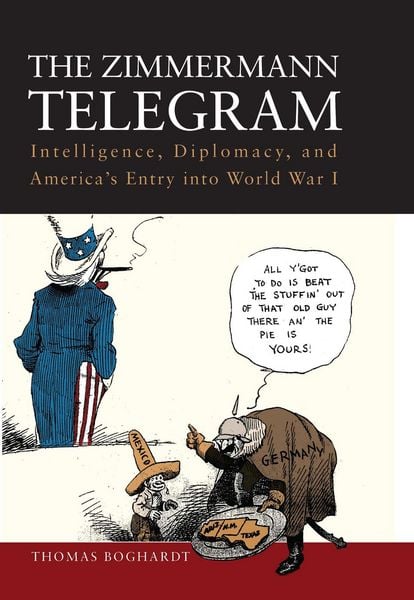
The Zimmermann Telegram Intelligence, Diplomacy, and America's Entry Into World War I
-
- Hardcover ausgewählt
- Taschenbuch
- eBook
-
Sprache:Englisch
35,99 €
inkl. gesetzl. MwSt.,
Beschreibung
Produktdetails
Einband
Gebundene Ausgabe
Erscheinungsdatum
15.10.2012
Verlag
Naval Institute PressSeitenzahl
320
Maße (L/B/H)
24,1/15,9/3,2 cm
Gewicht
639 g
Sprache
Englisch
ISBN
978-1-61251-148-1
By the winter of 1916/17, World War I had reached a deadlock. While the Allies commanded greater resources and fielded more soldiers than the Central Powers, German armies had penetrated deep into Russia and France, and tenaciously held on to their conquered empire. Hoping to break the stalemate on the western front, the exhausted Allies sought to bring the neutral United States into the conflict. A golden opportunity to force American intervention seemed at hand when British naval intelligence intercepted a secret telegram detailing a German alliance offer to Mexico. In it, Berlin's foreign secretary, Arthur Zimmermann, offered his country's support to Mexico for re-conquering "the lost territory in Texas, New Mexico, and Arizona" in exchange for a Mexican attack on the United States, should the latter enter the war on the side of the Allies. The British handed a copy of the Telegram to the American government, which in turn leaked it to the press. On March 1, 1917, the Telegram made headline news across the United States, and five weeks later, America entered World War I. Based on an examination of virtually all available German, British, and U.S. government records, this book presents the definitive account of the Telegram and questions many traditional views on the origins, cryptanalysis, and impact of the German alliance scheme. While the Telegram has often been described as the final step in a carefully planned German strategy to gain a foothold in the western hemisphere, this book argues that the scheme was a spontaneous initiative by a minor German foreign office official, which gained traction only because of a lack of supervision and coordination at the top echelon of the German government. On the other hand, the book argues, American and British secret services had collaborated closely since 1915 to bring the United States into the war, and the Telegram's interception and disclosure represented the crowning achievement of this clandestine Anglo-American intelligence alliance. Moreover, the book explicitly challenges the widely accepted notion that the Telegram's publication in the U.S. press rallied Americans for war. Instead, it contends that the Telegram divided the public by poisoning the debate over intervention, and by failing to offer peace-minded Americans a convincing rationale for supporting the war. The book also examines the Telegram's effect on the memory of World War I through the twentieth century and beyond.
Kundinnen und Kunden meinen
Verfassen Sie die erste Bewertung zu diesem Artikel
Helfen Sie anderen Kund*innen durch Ihre Meinung
Kurze Frage zu unserer Seite
Vielen Dank für Ihr Feedback
Wir nutzen Ihr Feedback, um unsere Produktseiten zu verbessern. Bitte haben Sie Verständnis, dass wir Ihnen keine Rückmeldung geben können. Falls Sie Kontakt mit uns aufnehmen möchten, können Sie sich aber gerne an unseren Kund*innenservice wenden.
zum Kundenservice