Produktbild: Dynamicity in Emotion Concepts
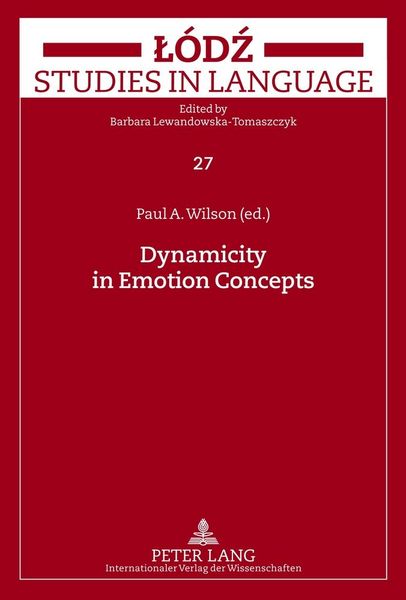
Band 27

Dynamicity in Emotion Concepts

Aus der Reihe Lodz Studies in Language

98,55 €

inkl. gesetzl. MwSt., Versandkostenfrei


Beschreibung

Produktdetails

Einband

Gebundene Ausgabe

Erscheinungsdatum

09.04.2012

Herausgeber

Paul Wilson

Verlag

Peter Lang GmbH, Internationaler Verlag der Wissenschaften

Seitenzahl

425

Maße (L/B/H)

21,6/15,1/3 cm

Gewicht

650 g

Sprache

Englisch

ISBN

978-3-631-63692-3

Beschreibung

Portrait

Paul A. Wilson is Visiting Professor in the Department of English Language & Applied Linguistics at the University of Łódź (Poland). He received his PhD in Psychology from Birkbeck (University of London), where he is an Honorary Research Fellow. His research interests include the conceptual representation of emotion, and the influence of emotion on metaphor and blending.

Produktdetails

Einband

Gebundene Ausgabe

Erscheinungsdatum

09.04.2012

Herausgeber

Paul Wilson

Verlag

Peter Lang GmbH, Internationaler Verlag der Wissenschaften

Seitenzahl

425

Maße (L/B/H)

21,6/15,1/3 cm

Gewicht

650 g

Sprache

Englisch

ISBN

978-3-631-63692-3

EU-Ansprechpartner

Zeitfracht Medien GmbH
Ferdinand-Jühlke-Straße 7
99095 Erfurt
DE
produktsicherheit@zeitfracht.de

Herstelleradresse

Peter Lang
Avenue du Théâtre 7
1005 Lausanne
CH
orders@peterlang.com

Noch keine Bewertungen vorhanden

Verfassen Sie die erste Bewertung zu diesem Artikel

Helfen Sie anderen Kundinnen und Kunden durch Ihre Meinung.

Kundinnen und Kunden meinen

Bewertungen (0)

  • Produktbild: Dynamicity in Emotion Concepts
  • Contents: Paul A. Wilson: A Multi-disciplinary Approach to Emotion Research – Paul A. Wilson/Barbara Lewandowska-Tomaszczyk: The Nature of Emotions – Rainer Reisenzein/Martin Junge: Language and Emotion from the Perspective of the Computational. Belief-Desire Theory of Emotion – Eva-Maria Engelen: Meaning and Emotion – Larry A. Herzberg: To Blend or to Compose: a Debate about Emotion Structure – Heli Tissari: Integrating Naming, Claiming and Story-Telling: Towards a Broader Cognitive Linguistic Understanding of Emotion – Svend Brinkmann/Peter Musaeus: Emotions and the Moral Order – Liam C. Kavanagh/Paula M. Niedenthal/Piotr Winkielman: Embodied Simulation as Grounds for Emotion Concepts – Zoltán Kövecses: Emotion Concepts in Cultural Context: the Case of Happiness – Ayako Omori: Conventional Metaphors for Antonymous Emotion Concepts – Mohammed S. Al-Hadlaq/Zouheir A. Maalej: Conceptualization of Anger in Saudi and Tunisian Arabic Dialects – Christie Napa Scollon/William Tov: Cultural Similarities and Differences in the Conceptualization of Emotion – Anna Ogarkova/Cristina Soriano/Caroline Lehr: Naming Feeling: Exploring the Equivalence of Emotion Terms in Five European Languages – Mustafa Aksan/Yeşim Aksan: To Emote a Feeling or to Feel an Emotion: a View from Turkish – Cristina Casado-Lumbreras: The Meaning of Emotions: a Cross-cultural Study of the Spanish, English, Arabic and Japanese Languages – Agnieszka Mikołajczuk: A Cross-Linguistic Perspective (Polish versus English) on the Conceptualization of ‘Zadowolenie’ (Satisfaction/Being Glad, Contentment, Pleasure) – W. Q. Elaine Perunovic/Mihailo Perunovic: Language and Emotion: the Case of Bicultural Individuals – C. L. Caldwell-Harris/M. Staroselsky/S. Smashnaya/N. Vasilyeva: Emotional Resonances of Bilinguals’ Two Languages Vary with Age of Arrival: the Russian-English Bilingual Experience in the U.S – Paul A. Wilson: Emotion, Approach-Avoidance Motivation, and Breadth of Conceptual Scope.