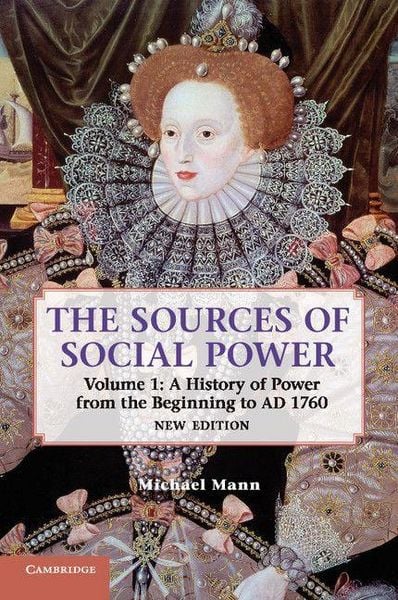

The Sources of Social Power Beginning to Ad 176
-
- Hardcover
- Taschenbuch ausgewählt
- eBook
-
Sprache:Englisch
-
Verlag:KNV Besorgung
- KNV Besorgung 51,99 € ausgewählt
- Cambridge Academic 59,99 €
51,99 €
inkl. gesetzl. MwSt.,
Beschreibung
Produktdetails
Einband
Taschenbuch
Erscheinungsdatum
11.08.2012
Verlag
KNV BesorgungSeitenzahl
578
Maße (L/B/H)
22,9/15,2/3,1 cm
Gewicht
826 g
Auflage
2. Auflage
Sprache
Englisch
ISBN
978-1-107-63597-5
Distinguishing four sources of power in human societies - ideological, economic, military and political - The Sources of Social Power traces their interrelations throughout human history. In this first volume, Michael Mann examines interrelations between these elements from neolithic times, through ancient Near Eastern civilizations, the classical Mediterranean age and medieval Europe, up to just before the Industrial Revolution in England. It offers explanations of the emergence of the state and social stratification; of city-states, militaristic empires and the persistent interaction between them; of the world salvation religions; and of the particular dynamism of medieval and early modern Europe. It ends by generalizing about the nature of overall social development, the varying forms of social cohesion and the role of classes and class struggle in history. First published in 1986, this new edition of Volume 1 includes a new preface by the author examining the impact and legacy of the work.
Kundinnen und Kunden meinen
Verfassen Sie die erste Bewertung zu diesem Artikel
Helfen Sie anderen Kund*innen durch Ihre Meinung
Kurze Frage zu unserer Seite
Vielen Dank für Ihr Feedback
Wir nutzen Ihr Feedback, um unsere Produktseiten zu verbessern. Bitte haben Sie Verständnis, dass wir Ihnen keine Rückmeldung geben können. Falls Sie Kontakt mit uns aufnehmen möchten, können Sie sich aber gerne an unseren Kund*innenservice wenden.
zum Kundenservice