Rezension
«This stimulating collection of original essays embodies Stephen Toulmin’s observation that ‘moral reasoning is so complex, and has to cover such a variety of situations, that no logical test...can be expected to meet every case.’ These diverse theorists are counterpoints to the dominant traditional ethical theories of categorical imperatives,
prima facie
duties, justice as fairness and utilitarianism. The authors of these twelve essays have done a superb job of illuminating the ethical implications of each theorist’s work.» (Richard L. Johannesen, Professor of Communication, Northern Illinois University)
«In times of cruel misunderstandings, this book offers ways of reshaping our world into a place where people try to understand and respect each other. The prominent thinkers who are thoroughly introduced here point out that we have no other alternative than to maintain humanity by stimulating communication beyond the borders of political power, historical narrowness, and our emotional home cultures. This book orients the reader in this urgent project.» (Bart Pattyn, Director, European Centre for Ethics, Katholieke Universiteit Leuven)
«Whoever studies or practices social communication, even someone (like me) whose interest lies in media accountability systems, feels the need for a philosophical foundation. Here is a remarkable contribution to it. Twelve thinkers – ancient and contemporary – from different regions of the planet; what they say about ethical communication is presented in clear and concise language. Aristotle, Habermas, and Foucault could be expected to be present but Confucius, Levinas, and Freire less so. And perhaps the most interesting, if controversial, are five contemporary champions of social and feminist ethics.» (Claude-Jean Bertrand, Professor Emeritus, Université de Paris-2)
«This book contains a thoughtfully selected and important set of essays that will prove to be an important resource for all those whose teaching and research link ethics and public life. It will be especially useful as the pace of corporate amalgamation, globalization, and technological change continues to challenge the academic knowledge base of applied ethics. The range and depth of theoretical reflection are impressive and the implications for public life are significant.» (Edmund B. Lambeth, Professor of Journalism, University of Missouri)
Portrait
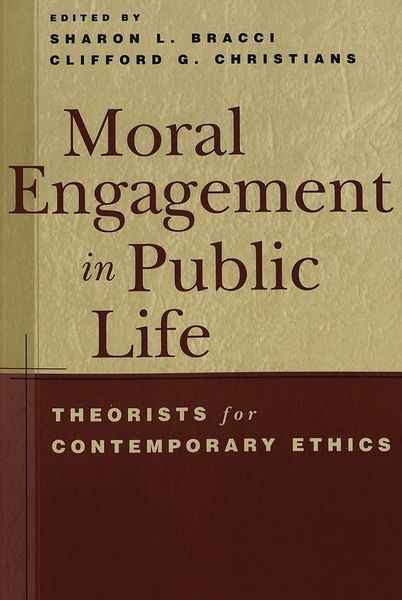
The Editors: Sharon L. Bracci is Assistant Professor in the Department of Communication at the University of North Carolina, Greensboro. She has published numerous journal articles on intersections among communication ethics, public argument, and practical moral reasoning in media and health care contexts. She is currently Chair of the Communication Ethics Commission of the National Communication Association.
Clifford G. Christians is Research Professor in the Institute of Communications Research at the University of Illinois, Urbana-Champaign. He is co-author of Responsibility in Mass Communications (Third Edition, 1980), Good News: Social Ethics and the Press (1993), and Media Ethics: Cases and Moral Reasoning (Sixth Edition, 2001). He is coeditor of Jacques Ellul: Interpretative Essays (1981) and Communication Ethics and Universal Values (1997).