
• Produktbild: German Poetry from the Beginnings to 1750
  • Produktbild: German Poetry from the Beginnings to 1750

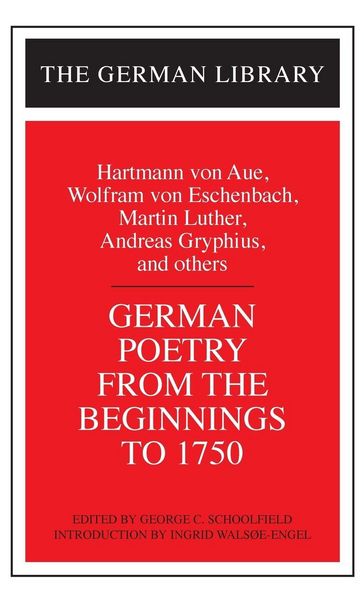
German Poetry from the Beginnings to 1750 Hartmann von Aue, Wolfram von Eschenbach, Martin Luther

216,99 €

inkl. gesetzl. MwSt., Versandkostenfrei


Produktdetails

Einband

Gebundene Ausgabe

Erscheinungsdatum

01.10.1992

Herausgeber

Ingrid Walsøe-Engel

Verlag

Continuum

Seitenzahl

382

Maße (L/B/H)

22,2/14,5/2,4 cm

Gewicht

611 g

Sprache

Englisch

ISBN

978-0-8264-0337-7

Produktdetails

Einband

Gebundene Ausgabe

Erscheinungsdatum

01.10.1992

Herausgeber

Ingrid Walsøe-Engel

Verlag

Continuum

Seitenzahl

382

Maße (L/B/H)

22,2/14,5/2,4 cm

Gewicht

611 g

Sprache

Englisch

ISBN

978-0-8264-0337-7

Herstelleradresse

Libri GmbH
Europaallee 1
36244 Bad Hersfeld
DE

Email: gpsr@libri.de

Noch keine Bewertungen vorhanden

Verfassen Sie die erste Bewertung zu diesem Artikel

Helfen Sie anderen Kundinnen und Kunden durch Ihre Meinung.

Kundinnen und Kunden meinen

Bewertungen (0)

  • Produktbild: German Poetry from the Beginnings to 1750
  • Produktbild: German Poetry from the Beginnings to 1750
  • Foreword: George C. Schoolfield Introduction: Ingrid Walsoe-Engel   ANONYMOUS Erster Merseburger Zauberspruch/First Merseburg Spell (Carroll Hightower) Zweiter Merseburger Zauberspruch/Second Merseburg Spell (Carroll Hightower) Muspilli* (ninth century)/Muspilli (Carroll Hightower) Weingartner Reisesegen* (tenth century)/The Weingarten Travel Blessing (tenth century) (Carroll Hightower) From Carmina Burana*/From Carmina Burana (Sylvia Stevens)   ANONYMOUS (twelfth century) Du bist min, ich bin din/I have thee, thou hast me (Alexander Gode) Mich dunket niht so guotes, noch so lobesam/To me nothing seems as splendid nor as praiseworthy (Sylvia Stevens)   DER VON KURENBERG (c. 1150-70) Ich stuont mir nehtint spate an einer zinnen/Late at night I stood on a battlement (Frederick Goldin) Ich zoch mir einen valken mere danne ein jar/I trained me a falcon, for more than a year
    (Frederick Goldin) Der tunkele sterne/The Morning Star (Frederick Goldin) Wip unde vederspil diu werdent lihte zam/Woman and falcons-they are easily tamed (Frederick Goldin)   PSEUDO-DIETMAR VON EIST (c. 1150) Ez stuont ein frouwe alleine/A lady stood alone (J.W. Thomas) So wol dir, sumerwunne!/Gay summer's bliss, good-bye! (J.W. Thomas)   MEINLOH VON SEVELINGEN (writing c. 1170-80) Mir erwelten miniu ougen/My eyes have seen and chosen (J.W. Thomas) So we den merkaeren!/Woe then to the gossips! (J.W. Thomas)   DIETMAR VON EIST (?-1171?) Uf der linden obene da sanc ein kleinez vogellin/Yonder on the linden tree there sang a merry little bird (J.W. Thomas) Wie mohte mir min herze werden iemer rehte fruot/How can I hope a wise heart to attain (Carroll Hightower)   FRIEDRICH VON HAUSEN (?-1190) Deich von der guoten schiet/When I parted from my Good (Frederick Goldin) Wafena, wie hat mich Minne gelazen!/Help! How Minne has deserted me
    (Frederick Goldin) Ich denke under wilen/I think sometimes about what i would tell her (Frederick Goldin) Si darf mich des zihen niet/She may not accuse me (Sylvia Stevens) Min herze und min lip diu wellent scheiden/My heart and my body want to separate (Frederick Goldin)   HEINRICH VON VELDEKE (1140/50-1200/1210) We mich scade ane miner vrouwen/Whoever hurts my favor with my lady (Frederick Goldin) Tristrant muste ane sinen danc/Tristan had no choice (Frederick Goldin) In den aprillen, so di blumen springen/In April when the flowers spring (Frederick Goldin)   ALBRECHT VON JOHANNSDORF (late twelfth century) Wie sich minne hebt, daz weiz ich wol/This I know, how love begins to be (M.L. Richey) Ich vant ane huote/I discovered the sweet lovely lady (Sylvia Stevens) Guote liute, holt die gabe/Good folk, go gain the gifts (F.C. Nicholson)   HEINRICH VON MORUNGEN (?-1222) Hete ich tugende niht so vil von ir vernomen/Had I not perceived so much of worth in her (F.C. Nicholson) Von den elben/Many a man gets bewitched by the elves (Frederick Goldin) Ich wene, nieman lebe der minen kumber weine/I believe there is no one alive who weeps for my sorrow (Frederick Goldin) Ich hort uf der heide/I heard on the meadow (Frederick Goldin) Owe, sol aber mir iemer me?/Alas, shall I not see again? (Frederick Goldin) Mirst geschen als eime kindeline/It has gone with me as with a child (Frederick Goldin) Vil sueziu senftiu toterinne/You sweet soft murderess (Frederick Goldin)   HARTMANM VON AUE (1160/65-after 1210) Ich sprach, ich wolte ir iemer leben/I said I would always live for her (Frederick Goldin) Manger gruezet mich also/Often a friend will greet me thus (Frederick Goldin) Ich var mit iuweren hulden/I go with your good grace (Frederick Goldin)
    REINMAR DER ALTE (1160/65-c.1205)
    Waz ich nu niuwer maere sage/No one needs to ask
    (Frederick Goldin)
    Lieber bote, nu wirp also/Messenger, hear what I say
    (J.W. Thomas)

    WALTHER VON DER VOGELWEIDE (c.1170-c.1230)
    Ich saz uf eime steine/I sat down on a rock
    (Frederick Goldin)
    Ir sult sprechen willekomen/You should bid me welcome
    (Frederick Goldin)
    Lange swigen des hat ich gedaht/To be long silent was my thought
    (Frederick Goldin)
    Saget mir ieman, waz ist minne/Will anyone tell me what Minne is?
    (Frederick Goldin)
    Under der linden/Under the lime tree
    (Frederick Goldin)
    Nemt, frowe, disen kranz/Lady, take this garland
    (Frederick Goldin)
    Herzeliebez frowelin/Dearly beloved gentle girl
    (Frederick Goldin)
    Ir reinen wip, ir werden man/You excellent women, you valient men
    (Frederick Goldin)
    Allererst lebe ich mir werde/Now my life has gained some meaning
    (J.W. Thomas)
    Ouwe, war sint verswunden alliu miniu jar!/Alas, all my years, where have they disappeared!
    (Frederick Goldin)
    Owe, daz wizheit unde jugent/Alas, that wisdom, and youth
    (Frederick Goldin)

    WOLFRAM VON ESCHENBACH (1170/75-1220)
    Sine klawen/Its claws have struck through the clouds
    (Frederick Goldin)
    Der helnden minne ir klage/You always sang at break of day
    (Frederick Goldin)
    NEIDHART VON REUENTHAL (1185/90-c.1245) Frout iuch, junge unde alte!/Young and old, rejoice (Frederick Goldin) Sumer, diner suezen weter muezen wir uns anen/Summer, now we must live without your sweet weather (Frederick Goldin) Sinc an, guldin huon! ichgibe dir weize!/Sing, my golden cock, I'll give thee grain! (J.W. Thomas) Mirst von herzen leide/There is pain in my heart (Frederick Goldin)   STEINMAR (late thirteenth century) Ein knecht der lag verborgen/A farmhand lay all hidden (James J. Wilhelm) Sit si mir niht lonen wil/Since she gives so little pay (J.W. Thomas)   OSWALD VON WOLKENSTEIN (1377-1445) Simm Gredlin, Gret, mein Gredelein/O Margie, Marge, dear Margaret (J.W. Thomas)   MARTIN LUTHER (1483-1546) Ein feste Burg ist unser Gott/A mighty fortress is our God (Lutheran Book of Worship, 1978) Aus tiefer Not schrei ich zu dir/From depths of woe I cry to you (F. Samuel Janow) Von Himmel hoch da komm ich her/From heaven above to earth I come (Lutheran Book of Worship, 1978) Mitten wyr ym leben sind/In the very midst of life (F. Samuel Janow)   ULRICH VON HUTTEN (1488-1523) Ein neu Lied Herr Ulrichs von Hutten/Ulrich von Hutten's Song (Catherine Winkworth)   HANS SACHS (1494-1576) Ein schone Taqweis: von dem Wort Gottes/A Fair Melody: To Be Sung by Good Christians (Catherine Winkworth)<