Gutscheinbedingungen

Gültig bis 19.08.2026 | Gültig für Spielzeug, Filme, Musik, Software, Games, Elektronik, Geschenke & Trends, Schreibwaren, Hörbücher und Hörbuch-Downloads (außer Abo & Shelfies), gebrauchte Bücher, nicht preisgebundene Bücher und Kalender | Einlösbar unter osiander.de und in der Osiander App | Click & Collect nur mit Online-Zahlung (Paypal/Kreditkarte) vorab | Einzelne Artikel können ausgeschlossen sein | Nicht kombinierbar mit anderen Gutscheinen oder Preisaktionen | Nur einmal pro Einkauf einlösbar | Gutschein wird auf max. 500€ Bestellwert angerechnet | Keine Barauszahlung | Digitale Hörbücher nur für Android  | Nicht gültig für preisgebundene Artikel (aufgrund der Buchpreisbindung sind Gutscheine nicht auf Bücher, eBooks, Presse einlösbar), tolino eReader & Zubehör, Abonnements & Flatrates, Geschenkkarten, Versandkosten und Services

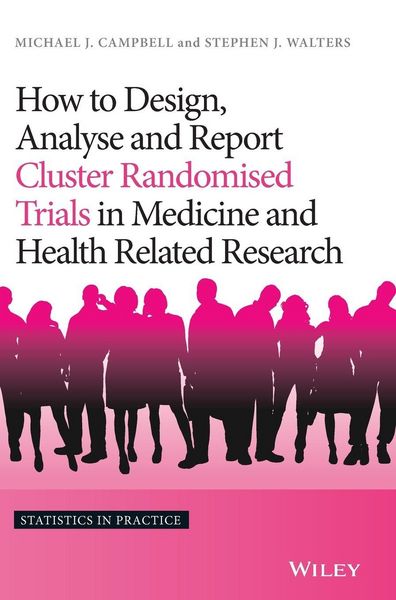
Produktbild: How to Design, Analyse and Report Cluster Randomised Trials in Medicine and Health Related Research

How to Design, Analyse and Report Cluster Randomised Trials in Medicine and Health Related Research

Aus der Reihe Statistics in Practice

118,99 €

inkl. gesetzl. MwSt., Versandkostenfrei


Beschreibung

Produktdetails

Einband

Gebundene Ausgabe

Erscheinungsdatum

02.05.2014

Verlag

John Wiley & Sons Inc

Seitenzahl

268

Maße (L/B/H)

25,1/17,2/2,2 cm

Gewicht

571 g

Auflage

1. Auflage

Sprache

Englisch

ISBN

978-1-119-99202-8

Beschreibung

Produktdetails

Einband

Gebundene Ausgabe

Erscheinungsdatum

02.05.2014

Verlag

John Wiley & Sons Inc

Seitenzahl

268

Maße (L/B/H)

25,1/17,2/2,2 cm

Gewicht

571 g

Auflage

1. Auflage

Sprache

Englisch

ISBN

978-1-119-99202-8

Herstelleradresse

Libri GmbH
Europaallee 1
36244 Bad Hersfeld
DE

Email: GPSR Kontakt

Noch keine Bewertungen vorhanden

Verfassen Sie die erste Bewertung zu diesem Artikel

Helfen Sie anderen Kundinnen und Kunden durch Ihre Meinung.

Kundinnen und Kunden meinen

Bewertungen (0)

Die Leseprobe wird geladen.
  • Produktbild: How to Design, Analyse and Report Cluster Randomised Trials in Medicine and Health Related Research
  • Preface xiii
     
    Acronyms and abbreviations xv
     
    1 Introduction 1
     
    1.1 Randomised controlled trials 1
     
    1.1.1 A-Allocation at random 1
     
    1.1.2 B-Blindness 2
     
    1.1.3 C-Control 2
     
    1.2 Complex interventions 3
     
    1.3 History of cluster randomised trials 4

    1.4 Cohort and field trials 4
     
    1.5 The field/community trial 5
     
    1.5.1 The REACT trial 5
     
    1.5.2 The Informed Choice leaflets trial 6
     
    1.5.3 The Mwanza trial 7
     
    1.5.4 The paramedics practitioner trial 7
     
    1.6 The cohort trial 8
     
    1.6.1 The PoNDER trial 8
     
    1.6.2 The DESMOND trial 9
     
    1.6.3 The Diabetes Care from Diagnosis trial 10
     
    1.6.4 The REPOSE trial 11
     
    1.6.5 Other examples of cohort cluster trials 11
     
    1.7 Field versus cohort designs 11
     
    1.8 Reasons for cluster trials 12
     
    1.9 Between- and within-cluster variation 14
     
    1.10 Random-effects models for continuous outcomes 15
     
    1.10.1 The model 15
     
    1.10.2 The intracluster correlation coefficient 16
     
    1.10.3 Estimating the intracluster correlation (ICC) coefficient 16
     
    1.10.4 Link between the Pearson correlation coefficient and the intraclass correlation coefficient 17
     
    1.11 Random-effects models for binary outcomes 18
     
    1.11.1 The model 18
     
    1.11.2 The ICC for binary data 19
     
    1.11.3 The coefficient of variation 19
     
    1.11.4 Relationship between cvc and for binary data 20
     
    1.12 The design effect 20
     
    1.13 Commonly asked questions 21
     
    1.14 Websources 21
     
    Exercise 22
     
    Appendix 1.A 22
     
    2 Design issues 27
     
    2.1 Introduction 27
     
    2.2 Issues for a simple intervention 28
     
    2.2.1 Phases of a trial 28
     
    2.2.2 'Pragmatic' and 'explanatory' trials 29
     
    2.2.3 Intention-to-treat and per-protocol analyses 29
     
    2.2.4 Non-inferiority and equivalence trials 30
     
    2.3 Complex interventions 30
     
    2.3.1 Design of complex interventions 30
     
    2.3.2 Phase I modelling/qualitative designs 32
     
    2.3.3 Pilot or feasibility studies 33
     
    2.3.4 Example of pilot/feasibility studies in cluster trials 33
     
    2.4 Recruitment bias 34
     
    2.5 Matched-pair trials 34
     
    2.5.1 Design of matched-pair studies 34
     
    2.5.2 Limitations of matched-pairs designs 36
     
    2.5.3 Example of matched-pair design: The Family Heart Study 36
     
    2.6 Other types of designs 37
     
    2.6.1 Cluster factorial designs 37
     
    2.6.2 Example cluster factorial trial 38
     
    2.6.3 Cluster crossover trials 38
     
    2.6.4 Example of a cluster crossover trial 39
     
    2.6.5 Stepped wedge 39
     
    2.6.6 Pseudorandomised trials 40
     
    2.7 Other design issues 41
     
    2.8 Strategies for improving precision 41
     
    2.9 Randomisation 42
     
    2.9.1 Reasons for randomisation 42
     
    2.9.2 Simple randomisation 43
     
    2.9.3 Stratified randomisation 43
     
    2.9.4 Restricted randomisation 43
     
    2.9.5 Minimisation 44
     
    Exercise 45
     
    Appendix 2.A 48
     
    3 Sample size: How many subjects/clusters do I need for my cluster randomised controlled trial? 50
     
    3.1 Introduction 51
     
    3.1.1 Justification of the requirement for a sample size 51
     
    3.1.2 Significance tests, P-values and power 51
     
    3.1.3 Sample size and cluster trials 53
     
    3.2 Sample size for continuous data - comparing two means 53
     
    3.2.1 Basic formulae 53
     
    3.2.2 The design effect (DE) in cluster RCTs 54
     
    3.2.3 Exam