
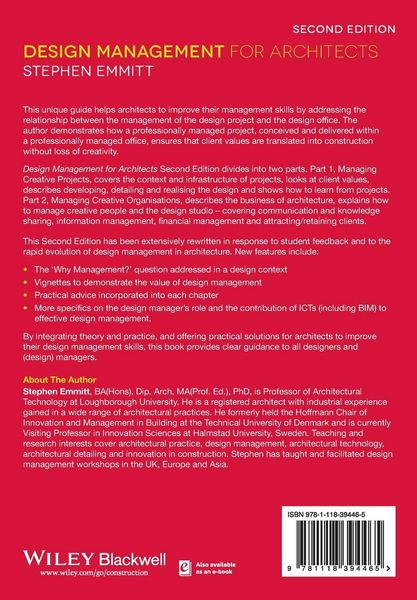
• Produktbild: Design Management for Architects
  • Produktbild: Design Management for Architects

Design Management for Architects

65,99 €

inkl. gesetzl. MwSt., Versandkostenfrei


Beschreibung

Produktdetails

Einband

Taschenbuch

Erscheinungsdatum

14.03.2014

Verlag

Wiley

Seitenzahl

302

Maße (L/B/H)

24,4/17/1,6 cm

Gewicht

525 g

Auflage

2. Auflage

Sprache

Englisch

ISBN

978-1-118-39446-5

Beschreibung

Produktdetails

Einband

Taschenbuch

Erscheinungsdatum

14.03.2014

Verlag

Wiley

Seitenzahl

302

Maße (L/B/H)

24,4/17/1,6 cm

Gewicht

525 g

Auflage

2. Auflage

Sprache

Englisch

ISBN

978-1-118-39446-5

Herstelleradresse

Libri GmbH
Europaallee 1
36244 Bad Hersfeld
DE

Email: gpsr@libri.de

Noch keine Bewertungen vorhanden

Verfassen Sie die erste Bewertung zu diesem Artikel

Helfen Sie anderen Kundinnen und Kunden durch Ihre Meinung.

Kundinnen und Kunden meinen

Bewertungen (0)

Die Leseprobe wird geladen.
  • Produktbild: Design Management for Architects
  • Produktbild: Design Management for Architects
  • Preface ix

    About the Author xiii

    1 Why? 1

    Why management? 1
    Vignette A - why apply management? 6

    Why design management? 7

    The role of the design manager 9
    Vignette B - why employ a design manager? 12

    Taking on the role 14

    Scope of the book 16

    Part One Managing Creative Projects 19

    2 The Business of Projects 21

    Understanding projects 21

    Quality 24

    Time control 25

    Cost control 27

    Design control 28

    Assessing value and risk 30

    Procurement and influence 33

    Interaction within projects 35

    Project frameworks 37

    The project-to-office interface 41

    3 Establishing the System Architecture 42

    Starting as you mean to go on 42

    Team assembly 46

    Selection criteria 48

    Communicating to achieve objectives 52

    Managing meetings effectively 56

    The project-to-office interface 59

    4 Exploring Client Value 60

    Understanding the briefing phase 60

    Approaches to briefing 62

    Understanding the client 65

    Establishing value parameters 69

    The written brief 74

    Reviewing the brief 79

    The project-to-office interface 80

    5 Creating Design Value 82

    Collaborative design 83

    Detailing the design 84

    Design conversations 87

    Design critiques, charettes and reviews 90

    Programming and coordinating design work 93

    Approvals and compliance 97

    Coordination of production information 100

    The project-to-office interface 101

    6 Realising Design Value 103

    Getting involved 104

    Working with the contractor's design manager 107

    Programming 109

    Interaction during construction 111

    Misunderstanding and conflict 114

    Requests for information and design changes 116

    Closing out projects 118

    The project-to-office interface 119

    7 Evaluation and Learning 120

    Lifelong learning 121

    Learning from projects 124

    Learning from the product 128

    Evidence-based learning 131

    Reflection in action 133

    Action research and learning 136

    The project-to-office interface 138

    Part Two Managing Creative Organisations 141

    8 The Business of Architecture 143

    Architectural practice 144

    The professional service firm 145

    Clients and the market for services 149

    Management of the business 152

    Market analysis 162

    The office-to-project interface 167

    9 Managing Creative People 168

    Getting the balance correct 169

    Office culture 173

    Psychological wellbeing 175

    Recruitment and retention 178

    Skills development 185

    The office-to-project interface 191

    10 Managing the Design Studio 192

    A creative space 192

    The project portfolio 194

    The design manager's role 196

    Models of design management 199

    The traditional model 203

    The sequential model 205

    Managing design effort 208

    Identifying good habits and eliminating inefficiencies 215

    The office-to-project interface 218

    11 Communication, Knowledge Sharing and Information Management 219

    Communication within the office 219

    Communication with other organisations 222

    Effective communication strategies 224

    Knowledge retention and sharing 226

    Information management 230

    Preparation of information 233

    Implementing and IT strategy 236

    The office-to-project interface 238

    12 Financial Management 239

    Cash flow and profitability 239

    Sources of income 243

    Fee bidding and negotiation 246

    Invoicing and cash flow 248

    Controlling expenditure 250

    Financial monitoring and evaluation 253

    Crisis management 258

    The office-to-project interface 259

    13 Attracting and Retaining Clients 261

    Promoting a brand image 261

    The client's perspective 263

    The architect's perspective 265

    Communicating with clients 266

    Promotional tools 269

    Architects' signboards 272

    Managing marketing activities 274

    The office-to-project interface 278

    Further Reading 280

    Index 284