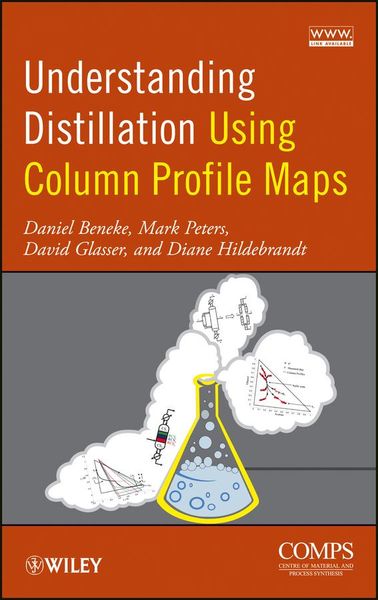
Understanding Distillation Using Column Profile Maps
205,99 €
inkl. gesetzl. MwSt.,
Beschreibung
Produktdetails
Einband
Gebundene Ausgabe
Erscheinungsdatum
10.12.2012
Verlag
John Wiley & Sons IncSeitenzahl
384
Maße (L/B/H)
24/16,4/3 cm
Gewicht
667 g
Auflage
1. Auflage
Sprache
Englisch
ISBN
978-1-118-14540-1
Developed by the authors in collaboration with other researchers at the Centre of Material and Process Synthesis, column profile maps (CPMs) enable chemical engineers to design almost any distillation structure using novel graphical techniques. The CPM method offers tremendous advantages over other design methods because it is generalized and not constrained to a particular piece of equipment.
Understanding Distillation Using Column Profile Maps enables readers to understand, analyze, and design distillation structures to solve common distillation problems, including distillation by simple columns, side rectifiers and strippers, multiple feed columns, and fully thermally coupled columns. In addition, the book presents advanced topics such as reactive distillation, membrane permeation, and validation of thermodynamic models. For all these processes, the authors set forth easy-to-follow design techniques, solution strategies, and insights gained using CPMs.
This book offers everything needed to fully understand and use CPMs as a design tool:
* Figures help readers understand how to use CPMs as design and optimization tools
* Examples clearly illustrate how to solve specific problems using CPMs
* Tutorials allow readers to explore key concepts through experimentation
* Design and Optimization of Distillation Systems software package, developed for this book, enables readers to reproduce the examples in the book, follow the tutorials, and begin designing their own distillation systems
With its many examples and step-by-step tutorials, Understanding Distillation Using Column Profile Maps is recommended for students in chemical engineering in advanced undergraduate and graduate courses. The book also provides new practical techniques that can be immediately applied by chemical engineering professionals in industry.
Noch keine Bewertungen vorhanden
Verfassen Sie die erste Bewertung zu diesem Artikel
Helfen Sie anderen Kundinnen und Kunden durch Ihre Meinung.
Kurze Frage zu unserer Seite
Vielen Dank für Ihr Feedback
Wir nutzen Ihr Feedback, um unsere Produktseiten zu verbessern. Bitte haben Sie Verständnis, dass wir Ihnen keine Rückmeldung geben können. Falls Sie Kontakt mit uns aufnehmen möchten, können Sie sich aber gerne an unseren Kund*innenservice wenden.
zum Kundenservice