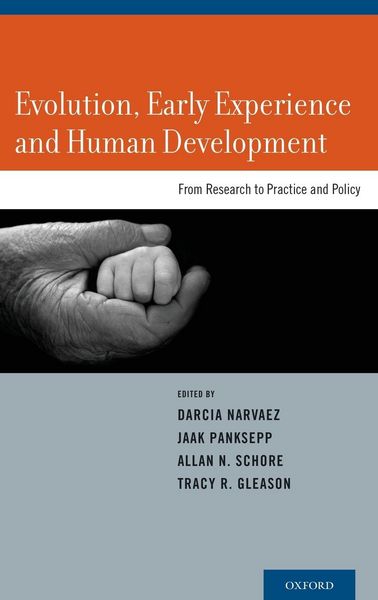
Evolution, Early Experience and Human Development From Research to Practice and Policy
-
- Englisch ausgewählt
187,99 €
inkl. gesetzl. MwSt.,
Beschreibung
Produktdetails
Einband
Gebundene Ausgabe
Erscheinungsdatum
06.11.2012
Herausgeber
Narvaez Darcia + weitereVerlag
Oxford University PressSeitenzahl
508
Maße (L/B/H)
24/16,1/3,2 cm
Gewicht
922 g
Sprache
Englisch
ISBN
978-0-19-975505-9
The field of cognitive psychology has expanded rapidly in recent years, with experts in affective and cognitive neuroscience revealing more about mammalian brain function than ever before. In contrast, psychological problems such as ADHD, autism, anxiety, and depression are on the rise, as are medical conditions such as diabetes, obesity, and autoimmune disorders. Why, in this era of unprecedented scientific self-knowledge, does there seem to be so much uncertainty about what human beings need for optimal development? Evolution, Early Experience and Human Development asserts that human development is being misshaped by government policies, social practices, and public beliefs that fail to consider basic human needs. In this pioneering volume, scientists from a range of disciplines theorize that the increase in conditions such as depression and obesity can be partially attributed to a disparity between the environments and conditions under which our mammalian brains currently develop and our evolutionary heritage. For example, healthy brain and emotional development depends to a significant extent upon caregiver availability and quality of care. These include practices such as breastfeeding, co-sleeping, and parental social support, which have waned in modern society, but nevertheless may be integral to healthy development. As the authors argue, without a more informed appreciation of the ideal conditions under which human brains/minds develop and function, human beings will continue to struggle with suboptimal mental and physical health, and as problems emerge psychological treatments alone will not be effective. The best approach is to recognize these needs at the outset so as to optimize child development. Evolution, Early Experience and Human Development puts forth a logical, empirically based argument regarding human mammalian needs for optimal development, based on research from anthropology, neurobiology, animal science, and human development. The result is a unique exploration of evolutionary approaches to human behavior that will support the advancement of new policies, new attitudes towards health, and alterations in childcare practices that will better promote healthy human development.
Noch keine Bewertungen vorhanden
Verfassen Sie die erste Bewertung zu diesem Artikel
Helfen Sie anderen Kundinnen und Kunden durch Ihre Meinung.
Kurze Frage zu unserer Seite
Vielen Dank für Ihr Feedback
Wir nutzen Ihr Feedback, um unsere Produktseiten zu verbessern. Bitte haben Sie Verständnis, dass wir Ihnen keine Rückmeldung geben können. Falls Sie Kontakt mit uns aufnehmen möchten, können Sie sich aber gerne an unseren Kund*innenservice wenden.
zum Kundenservice