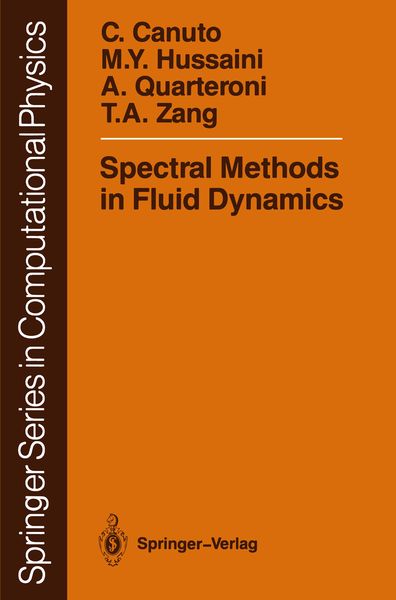
Produktbild: Spectral Methods in Fluid Dynamics

Spectral Methods in Fluid Dynamics

Aus der Reihe Scientific Computation

87,99 €

inkl. gesetzl. MwSt., Versandkostenfrei


Beschreibung

Produktdetails

Einband

Taschenbuch

Erscheinungsdatum

15.03.1991

Verlag

Springer Berlin

Seitenzahl

568

Maße (L/B/H)

23,5/15,5/3,2 cm

Gewicht

873 g

Auflage

1st ed. 1988. Corr. 2nd printing

Sprache

Englisch

ISBN

978-3-540-52205-8

Beschreibung

Produktdetails

Einband

Taschenbuch

Erscheinungsdatum

15.03.1991

Verlag

Springer Berlin

Seitenzahl

568

Maße (L/B/H)

23,5/15,5/3,2 cm

Gewicht

873 g

Auflage

1st ed. 1988. Corr. 2nd printing

Sprache

Englisch

ISBN

978-3-540-52205-8

Herstelleradresse

Springer-Verlag KG
Sachsenplatz 4-6
1201 Wien
AT

Email: ProductSafety@springernature.com

Kundinnen und Kunden meinen

0 Bewertungen

Informationen zu Bewertungen

Zur Abgabe einer Bewertung ist eine Anmeldung im Konto notwendig. Die Authentizität der Bewertungen wird von uns nicht überprüft. Wir behalten uns vor, Bewertungstexte, die unseren Richtlinien widersprechen, entsprechend zu kürzen oder zu löschen.

Die Bewertungen sind nach Format, Anzahl Sterne und Datum sortiert.

Verfassen Sie die erste Bewertung zu diesem Artikel

Helfen Sie anderen Kund*innen durch Ihre Meinung

Kundinnen und Kunden meinen

0 Bewertungen filtern

  • Produktbild: Spectral Methods in Fluid Dynamics
  • 1. Introduction.- 1.1. Historical Background.- 1.2. Some Examples of Spectral Methods.- 1.2.1. A Fourier Galerkin Method for the Wave Equation.- 1.2.2. A Chebyshev Collocation Method for the Heat Equation.- 1.2.3. A Legendre Tau Method for the Poisson Equation.- 1.2.4. Basic Aspects of Galerkin, Tau and Collocation Methods.- 1.3. The Equations of Fluid Dynamics.- 1.3.1. Compressible Navier-Stokes.- 1.3.2. Compressible Euler.- 1.3.3. Compressible Potential.- 1.3.4. Incompressible Flow.- 1.3.5. Boundary Layer.- 1.4. Spectral Accuracy for a Two-Dimensional Fluid Calculation.- 1.5. Three-Dimensional Applications in Fluids.- 2. Spectral Approximation.- 2.1. The Fourier System.- 2.1.1. The Continuous Fourier Expansion.- 2.1.2. The Discrete Fourier Expansion.- 2.1.3. Differentiation.- 2.1.4. The Gibbs Phenomenon.- 2.2. Orthogonal Polynomials in ( — 1, 1).- 2.2.1. Sturm—Liouville Problems.- 2.2.2. Orthogonal Systems of Polynomials.- 2.2.3. Gauss-Type Quadratures and Discrete Polynomial Transforms.- 2.3. Legendre Polynomials.- 2.3.1. Basic Formulas.- 2.3.2. Differentiation.- 2.4. Chebyshev Polynomials.- 2.4.1. Basic Formulas.- 2.4.2. Differentiation.- 2.5. Generalizations.- 2.5.1. Jacobi Polynomials.- 2.5.2. Mapping.- 2.5.3. Semi-Infinite Intervals.- 2.5.4. Infinite Intervals.- 3. Fundamentals of Spectral Methods for PDEs.- 3.1. Spectral Projection of the Burgers Equation.- 3.1.1. Fourier Galerkin.- 3.1.2. Fourier Collocation.- 3.1.3. Chebyshev Tau.- 3.1.4. Chebyshev Collocation.- 3.2. Convolution Sums.- 3.2.1. Pseudospectral Transform Methods.- 3 2 2 Aliasing Removal by Padding or Truncation.- 3.2.3. Aliasing Removal by Phase Shifts.- 3.2.4. Convolution Sums in Chebyshev Methods.- 3.2.5. Relation Between Collocation and Pseudospectral Methods.- 3.3. Boundary Conditions.- 3.4. Coordinate Singularities.- 3.4.1. Polar Coordinates.- 3.4.2. Spherical Polar Coordinates.- 3.5. Two-Dimensional Mapping.- 4. Temporal Discretization.- 4.1. Introduction.- 4.2. The Eigenvalues of Basic Spectral Operators.- 4.2.1. The First-Derivative Operator.- 4.2.2. The Second-Derivative Operator.- 4.3. Some Standard Schemes.- 4.3.1. Multistep Schemes.- 4.3.2. Runge—Kutta Methods.- 4.4. Special Purpose Schemes.- 4.4.1. High Resolution Temporal Schemes.- 4.4.2. Special Integration Techniques.- 4.4.3. Lerat Schemes.- 4.5. Conservation Forms.- 4.6. Aliasing.- 5. Solution Techniques for Implicit Spectral Equations.- 5.1. Direct Methods.- 5.1.1. Fourier Approximations.- 5.1.2. Chebyshev Tau Approximations.- 5.1.3. Schur-Decomposition and Matrix-Diagonalization.- 5.2. Fundamentals of Iterative Methods.- 5.2.1. Richardson Iteration.- 5.2.2. Preconditioning.- 5.2.3. Non-Periodic Problems.- 5.2.4. Finite-Element Preconditioning.- 5.3. Conventional Iterative Methods.- 5.3.1. Descent Methods for Symmetric, Positive-Definite Systems.- 5.3.2. Descent Methods for Non-Symmetric Problems.- 5.3.3. Chebyshev Acceleration.- 5.4. Multidimensional Preconditioning.- 5.4.1. Finite-Difference Solvers.- 5.4.2. Modified Finite-Difference Preconditioners.- 5.5. Spectral Multigrid Methods.- 5.5.1. Model Problem Discussion.- 5.5.2. Two-Dimensional Problems.- 5.5.3. Interpolation Operators.- 5.5.4. Coarse-Grid Operators.- 5.5.5. Relaxation Schemes.- 5.6. A Semi-Implicit Method for the Navier—Stokes Equations.- 6. Simple Incompressible Flows.- 6.1. Burgers Equation.- 6.2. Shear Flow Past a Circle.- 6.3. Boundary-Layer Flows.- 6.4. Linear Stability.- 7. Some Algorithms for Unsteady Navier—Stokes Equations.- 7.1. Introduction.- 7.2. Homogeneous Flows.- 7.2.1. A Spectral Galerkin Solution Technique.- 7.2.2. Treatment of the Nonlinear Terms.- 7.2.3. Refinements.- 7.2.4. Pseudospectral and Collocation Methods.- 7.3. Inhomogeneous Flows.- 7.3.1. Coupled Methods.- 7.3.2. Splitting Methods.- 7.3.3. Galerkin Methods.- 7.3.4. Other Confined Flows.- 7.3.5. Unbounded Flows.- 7.3.6. Aliasing in Transition Calculations.- 7.4. Flows with Multiple Inhomogeneous Directions.- 7.4.1. Choice of Mesh.- 7.4.2. Coupled Methods.- 7.4.3. Splitting Methods.- 7.4.4. Other Methods.- 7.5. Mixed Spectral/Finite-Difference Methods.- 8. Compressible Flow.- 8.1. Introduction.- 8.2. Boundary Conditions for Hyperbolic Problems.- 8.3. Basic Results for Scalar Nonsmooth Problems.- 8.4. Homogeneous Turbulence.- 8.5. Shock-Capturing.- 8.5.1. Potential Flow.- 8.5.2. Ringleb Flow.- 8.5.3. Astrophysical Nozzle.- 8.6. Shock-Fitting.- 8.7. Reacting Flows.- 9. Global Approximation Results.- 9.1. Fourier Approximation.- 9.1.1. Inverse Inequalities for Trigonometric Polynomials.- 9.1.2. Estimates for the Truncation and Best Approximation Errors.- 9.1.3. Estimates for the Interpolation Error.- 9.2. Sturm—Liouville Expansions.- 9.2.1. Regular Sturm—Liouville Problems.- 9.2.2. Singular Sturm—Liouville Problems.- 9.3. Discrete Norms.- 9.4. Legendre Approximations.- 9.4.1. Inverse Inequalities for Algebraic Polynomials.- 9.4.2. Estimates for the Truncation and Best Approximation Errors.- 9.4.3. Estimates for the Interpolation Error.- 9.5. Chebyshev Approximations.- 9.5.1. Inverse Inequalities for Polynomials.- 9.5.2. Estimates for the Truncation and Best Approximation Errors.- 9.5.3. Estimates for the Interpolation Error.- 9.5.4. Proofs of Some Approximation Results.- 9.6. Other Polynomial Approximations.- 9.6.1. Jacobi Polynomials.- 9.6.2. Laguerre and Hermite Polynomials.- 9.7. Approximation Results in Several Dimensions.- 9.7.1. Fourier Approximations.- 9.7.2. Legendre Approximations.- 9.7.3. Chebyshev Approximations.- 9.7.4. Blended Fourier and Chebyshev Approximations.- 10. Theory of Stability and Convergence for Spectral Methods.- 10.1. The Three Examples Revisited.- 10.1.1. A Fourier Galerkin Method for the Wave Equation.- 10.1.2. A Chebyshev Collocation Method for the Heat Equation.- 10.1.3. A Legendre Tau Method for the Poisson Equation.- 10.2. Towards a General Theory.- 10.3. General Formulation of Spectral Approximations to Linear Steady Problems.- 10.4. Galerkin, Collocation and Tau Methods.- 10.4.1. Galerkin Methods.- 10.4.2. Tau Methods.- 10.4.3. Collocation Methods.- 10.5. General Formulation of Spectral Approximations to Linear Evolution Equations.- 10.5.1. Conditions for Stability and Convergence: The Parabolic Case.- 10.5.2. Conditions for Stability and Convergence: The Hyperbolic Case.- 10.6. The Error Equation.- 11. Steady, Smooth Problems.- 11.1. The Poisson Equation.- 11.1.1. Legendre Methods.- 11.1.2. Chebyshev Methods.- 11.1.3. Other Boundary Value Problems.- 11.2. Advection-Diffusion Equation.- 11.2.1. Linear Advection-Diffusion Equation.- 11.2.2. Steady Burgers Equation.- 11.3. Navier—Stokes Equations.- 11.3.1. Compatibility Conditions Between Velocity and Pressure.- 11.3.2. Direct Discretization of the Continuity Equation: The “inf-sup” Condition.- 11.3.3. Discretizations of the Continuity Equation by an Influence-Matrix Technique: The Kleiser—Schumann Method.- 11.3.4. Navier—Stokes Equations in Streamfunction Formulation.- 11.4. The Eigenvalues of Some Spectral Operators.- 11.4.1. The Discrete Eigenvalues for Lu = ? uxx.- 11.4.2. The Discrete Eigenvalues for Lu = ? vuxx + bux.- 11.4.3. The Discrete Eigenvalues for Lu = ux.- 12. Transient, Smooth Problems.- 12.1. Linear Hyperbolic Equations.- 12.1.1. Periodic Boundary Conditions.- 12.1.2. Non-Periodic Boundary Conditions.- 12.1.3. Hyperbolic Systems.- 12.1.4. Spectral Accuracy for Non-Smooth Solutions.- 12.2. Heat Equation.- 12.2.1. Semi-Discrete Approximation.- 12.2.2. Fully Discrete Approximation.- 12.3. Advection-Diffusion Equation.- 12.3.1. Semi-Discrete Approximation.- 12.3.2. Fully Discrete Approximation.- 13. Domain Decomposition Methods.- 13.1. Introduction.- 13.2. Patching Methods.- 13.2.1. Notation.- 13.2.2. Discretization.- 13.2.3. Solution Techniques.- 13.2.4. Examples.- 13.3. Variational Methods.- 13.3.1. Formulation.- 13.3.2. The Spectral-Element Method.- 13.4. The Alternating Schwarz Method.- 13.5. Mathematical Aspects of Domain Decomposition Methods.- 13.5.1. Patching Methods.- 13.5.2. Equivalence Between Patching and Variational Methods.- 13.6. Some Stability and Convergence Results.- 13.6.1. Patching Methods.- 13.6.2. Variational Methods.- Appendices.- A. Basic Mathematical Concepts.- B. Fast Fourier Transforms.- C. Jacobi—Gauss—Lobatto Roots.- References.