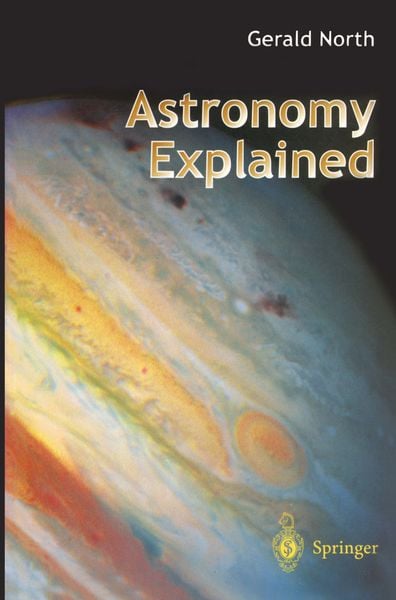
• Produktbild: Astronomy Explained
  • Produktbild: Astronomy Explained
- 12%

Astronomy Explained

12% sparen

46,99 € UVP 53,49 €

inkl. gesetzl. MwSt., Versandkostenfrei


Beschreibung

Produktdetails

Einband

Taschenbuch

Erscheinungsdatum

20.06.1997

Abbildungen

174 schwarzweisse Abbildungen

Verlag

Springer Berlin

Seitenzahl

330

Maße (L/B/H)

23,5/15,5/2 cm

Gewicht

540 g

Auflage

1997

Sprache

Englisch

ISBN

978-3-540-76136-5

Beschreibung

Rezension

"Since this book has been on my shelf, I have used it as a first port of call when I needed a concise explanation of a topic. I have yet to have to put it down and use another text." Astronomy Now

Produktdetails

Einband

Taschenbuch

Erscheinungsdatum

20.06.1997

Abbildungen

174 schwarzweisse Abbildungen

Verlag

Springer Berlin

Seitenzahl

330

Maße (L/B/H)

23,5/15,5/2 cm

Gewicht

540 g

Auflage

1997

Sprache

Englisch

ISBN

978-3-540-76136-5

Herstelleradresse

Springer-Verlag KG
Sachsenplatz 4-6
1201 Wien
AT

Email: GPSR Kontakt

Noch keine Bewertungen vorhanden

Verfassen Sie die erste Bewertung zu diesem Artikel

Helfen Sie anderen Kundinnen und Kunden durch Ihre Meinung.

Kundinnen und Kunden meinen

Bewertungen (0)

  • Produktbild: Astronomy Explained
  • Produktbild: Astronomy Explained
  • 1 The Celestial Sphere.- 1.1 The Concept of the Celestial Sphere.- 1.2 Latitude and Longitude.- 1.3 Declination and Right Ascension.- 1.4 The Altitude of the Celestial Equator and Poles.- 1.5 The Starry Vault.- 1.6 A Better Definition of Right Ascension.- 1.7 To Calculate the Maximum Altitude of a Star.- 1.8 Circumpolar Stars.- 1.9 Stars that Never Rise.- 1.10 Azimuth.- 1.11 The Earth in Space.- 1.12 The Seasons.- 1.13 The Moon and the Celestial Sphere.- 1.14 The Solar System and the Celestial Sphere.- 1.15 Stellar Motions.- 1.16 Precession.- Questions.- 2 The Earth and Time.- 2.1 The Shape and Size of the Earth.- 2.2 The Earth in the Solar System.- 2.3 The Structure of the Earth.- 2.4 The Surface Conditions on the Earth.- 2.5 The Atmosphere of the Earth.- 2.6 The Ionosphere.- 2.7 The Terrestrial Magnetosphere.- 2.8 The Van Allen Radiation Zones.- 2.9 The Aurorae.- 2.10 The Need for Time Measurement.- 2.11 Calendars.- 2.12 The Solar Day.- 2.13 Universal Time.- 2.14 Time Zones.- 2.15 Hour Angle.- 2.16 The Sidereal Day.- 2.17 A Fundamental Equation.- 2.18 The Measurement of Time.- Questions.- 3 The Telescope.- 3.1 Chromatic Aberration.- 3.2 The Achromatic Objective.- 3.3 Light Grasp and Resolving power.- 3.4 Eyepieces and Magnification.- 3.5 The Effects of Magnification on the Image.- 3.6 The Limitations Caused by the Earth’s Atmosphere.- 3.7 The Reflecting Telescope.- 3.8 Spherical Aberration.- 3.9 The Development of the Reflector.- 3.10 Telescope Mountings.- 3.11 The Schmidt Camera.- Questions.- 4 Modern Developments in Instrumentation.- 4.1 The Photographic Plate.- 4.2 The Photomultiplier.- 4.3 Electronic Imaging.- 4.4 Getting More Resolution.- 4.5 The Latest Generation of Optical Telescopes.- 4.6 The Radio Telescope.- 4.7 Astronomy at Other Wavelengths.- 4.8 Astronomy Above the Ground.- Questions.- 5 Gravitation.- 5.1 Kepler’s Laws of Planetary Motion.- 5.2 Newton’s Law of Gravitation.- 5.3 Circular Motion.- 5.4 Mathematical Derivation of Kepler’s Third law.- 5.5 Two-Body Orbiting Systems.- 5.6 The Tides.- 5.7 The Measurement of the Astronomical Unit.- 5.8 The Earth’s Gravitational Field.- 5.9 The Acceleration Due to Gravity.- 5.10 Rockets and Satellites.- Questions.- 6 The Moon.- 6.1 The Nature and Origin of the Moon.- 6.2 The Orbit and Phases of the Moon.- 6.3 Lunar Eclipses.- 6.4 The Saros.- 6.5 Libration.- 6.6 The Measurement of the Moon’s Distance.- 6.7 The Selenographers.- 6.8 Lunar Probes and Man on the Moon.- 6.9 The Moon’s Appearance.- 6.10 Surface Conditions.- 6.11 The Structure and Evolution of the Moon.- 6.12 Transient Lunar Phenomena.- Questions.- 7 The Inferior Planets.- 7.1 Stellar and Planetary Brightnesses.- 7.2 The Orbit and Phases of Mercury.- 7.3 Mercury’s Telescopic Appearance.- 7.4 The Rotation Rate of Mercury.- 7.5 Mariner 10.- 7.6 Comparison Between Mercury and the Moon.- 7.7 The Caloris Basin.- 7.8 The Surface Conditions on Mercury.- 7.9 The Orbit and Phases of Venus.- 7.10 Venus’s Telescopic Appearance.- 7.11 The Size and Nature of Venus.- 7.12 Spacecraft to Venus.- 7.13 Venus — a Volcanic Planet.- 7.14 Magellan and Yet More Mysteries.- 7.15 The Earth and Venus — Worlds Apart.- 7.16 The Greenhouse Effect — a Difference in Evolution.- Questions.- 8 The Planet Mars.- 8.1 Oppositions.- 8.2 The Path of Mars Across the Celestial Sphere.- 8.3 The Telescopic Appearance of Mars.- 8.4 The Martian Atmosphere.- 8.5 The Canals of Mars.- 8.6 Early Space Probes to Mars.- 8.7 Later Space Probes to Mars.- 8.8 Vikings to Mars.- 8.9 Life on Mars.- 8.10 Phobos and Deimos.- Questions.- 9 The Planet Jupiter.- 9.1 The Telescopic Appearance of Jupiter.- 9.2 Transient Features.- 9.3 The Great Red Spot.- 9.4 Pioneers 10 and 11.- 9.5 The Voyager Missions.- 9.6 Collision with a Comet.- 9.7 Galileo Enters the Jovian Atmosphere.- 9.8 The Structure of Jupiter.- 9.9 Jupiter’s Magnetosphere.- 9.10 Radiation Belts.- 9.11 Radio Emissions.- 9.12 The Satellites.- 9.13 Io.- 9.14 Europa.- 9.15 Ganymede.- 9.16 Callisto.- 9.17 The Rings of Jupiter.- Questions.- 10 The Planet Saturn.- 10.1 The Telescopic Appearance of Saturn.- 10.2 Spacecraft to Saturn.- 10.3 The Atmosphere of Saturn.- 10.4 The Structure of Saturn.- 10.5 Saturn’s Magnetosphere.- 10.6 The Rings of Saturn.- 10.7 Voyager — a Detailed Look at the Rings.- 10.8 The Formation of Planetary Rings.- 10.9 The Satellites of Saturn.- 10.10 Titan.- Questions.- 11 The Twilight Zone of the Solar System.- 11.1 The Planet Uranus.- 11.2 Voyager to Uranus.- 11.3 The Satellites of Uranus.- 11.4 The Planet Neptune.- 11.5 Voyager at Neptune.- 11.6 Neptune’s Rings and Satellites.- 11.7 The Planet Pluto.- Questions.- 12 The Debris of the Solar System.- 12.1 The Formation of the Solar System.- 12.2 Planetary Cratering.- 12.3 Bode’s Law.- 12.4 The Celestial Police.- 12.5 The Asteroids.- 12.6 Meteors.- 12.7 Meteorites.- 12.8 The Breakdown of Bode’s Law.- Questions.- 13 The Comets.- 13.1 Comet Orbits.- 13.2 The Structure of a Comet.- 13.3 A Comet’s tail.- 13.4 The Hydrogen Cloud.- 13.5 A Comet’s Coma.- 13.6 A Comet’s Nucleus.- 13.7 Cometary Debris.- 13.8 Spacecraft to Halley’s Comet.- 13.9 The Origins of the Comets.- Questions.- 14 The Sun.- 14.1 The Size and Composition of the Sun.- 14.2 The Absolute Scale of Temperature.- 14.3 The Structure of the Sun.- 14.4 Solar Eclipses.- 14.5 The Photosphere.- 14.6 The Solar Magnetosphere.- 14.7 The Sun’s Internal Rotation.- 14.8 Sunspots and Faculae.- 14.9 The Chromosphere.- 14.10 Prominences and Filaments.- 14.11 The Solar Corona.- 14.12 Solar Flares and the Solar Wind.- 14.13 The Sun’s Energy Source.- Questions.- 15 Electromagnetic Radiation.- 15.1 The Electromagnetic Spectrum.- 15.2 Black-Body Radiation.- 15.3 The Beginnings of Spectroscopy.- 15.4 The Production of Spectra.- 15.5 Types of Spectra.- 15.6 The Development of Astronomical Spectroscopy.- 15.7 Modern Spectroscopy.- Questions.- 16 The Star.- 16.1 The Natures and Brightnesses of the Stars.- 16.2 The Distances of the Stars.- 16.3 Absolute Magnitude and Distance Modulus.- 16.4 Star Colours.- 16.5 The Constellations.- 16.6 Stellar Spectra.- 16.7 The Sun — a Star Among Stars.- 16.8 The Hertzsprung-Russell Diagram.- 16.9 The Motions of the Stars.- 16.10 Binary Stars and Stellar Masses.- Questions.- 17 Gas, Dust, Stars and Variable Stars.- 17.1 When Astronomers Got It Wrong.- 17.2 The Interstellar Medium.- 17.3 Gaseous Nebulae.- 17.4 Stellar Birthplaces.- 17.5 Stellar Birth and Infancy.- 17.6 Extrinsic Variable Stars.- 17.7 Intrinsic Variable Stars.- 17.8 Shells Around Stars.- Questions.- 18 Stellar Evolution.- 18.1 The Main Sequence Phase.- 18.2 The Fate of a Low-Mass Star.- 18.3 The Evolution of a Star Like the Sun.- 18.4 The Evolution of a Massive Star.- 18.5 Neutron Stars.- 18.6 The Evolution of Binary Star Systems.- Questions.- 19 Brown Dwarfs and Extra-solar Planets.- 19.1 Early Mistakes.- 19.2 HD.- 19.3 A Definite Brown Dwarf.- 19.4 PSR.- 19.5 51 Pegasi.- 19.6 47 Ursae Majoris.- 19.7 70 Virginis.- 19.8 Rho Cancri.- 19.9 Lalande.- Questions.- >20 Violent Stars.- 20.1 Novae.- 20.2 Supernovae.- 20.3 Stellar Populations.- 20.4 Black Holes.- Questions.- 21 The Galaxies.- 21.1 The Shape and Size of Our Galaxy.- 21.2 Other Galaxies.- 21.3 The Structure of Our Galaxy.- 21.4 Galactic, Morphology.- 21.5 The Formation and Evolution of Galaxies.- 21.6 Groups of Galaxies.- 21.7 The Expansion of the Universe.- Questions.- 22 Quasars, Active Galaxies and Cosmology.- 22.1 Quasars.- 22.2 Active Galaxies.- 22.3 Black Holes, Accretion Disks, Jets and Cosmic Chameleons.- 22.4 Cosmology.- 22.5 Where Will It All End.- Questions.- Glossary of Terms.- Answers to the Numerical 1.1 Questions.