• Produktbild: Intelligent Information Agents
  • Produktbild: Intelligent Information Agents

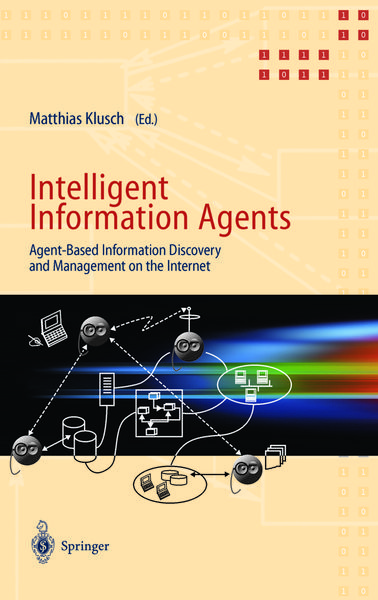
Intelligent Information Agents Agent-Based Information Discovery and Management on the Internet

98,99 €

inkl. gesetzl. MwSt., Versandkostenfrei


Beschreibung

Produktdetails

Einband

Taschenbuch

Erscheinungsdatum

28.12.2011

Herausgeber

Matthias Klusch

Verlag

Springer Berlin

Seitenzahl

498

Maße (L/B/H)

23,5/15,5/2,9 cm

Gewicht

791 g

Auflage

Softcover reprint of the original 1st ed. 1999

Sprache

Englisch

ISBN

978-3-642-64223-4

Beschreibung

Produktdetails

Einband

Taschenbuch

Erscheinungsdatum

28.12.2011

Herausgeber

Matthias Klusch

Verlag

Springer Berlin

Seitenzahl

498

Maße (L/B/H)

23,5/15,5/2,9 cm

Gewicht

791 g

Auflage

Softcover reprint of the original 1st ed. 1999

Sprache

Englisch

ISBN

978-3-642-64223-4

Herstelleradresse

Springer-Verlag GmbH
Tiergartenstr. 17
69121 Heidelberg
DE

Email: ProductSafety@springernature.com

Kundinnen und Kunden meinen

0 Bewertungen

Informationen zu Bewertungen

Zur Abgabe einer Bewertung ist eine Anmeldung im Konto notwendig. Die Authentizität der Bewertungen wird von uns nicht überprüft. Wir behalten uns vor, Bewertungstexte, die unseren Richtlinien widersprechen, entsprechend zu kürzen oder zu löschen.

Die Bewertungen sind nach Format, Anzahl Sterne und Datum sortiert.

Verfassen Sie die erste Bewertung zu diesem Artikel

Helfen Sie anderen Kund*innen durch Ihre Meinung

Kundinnen und Kunden meinen

0 Bewertungen filtern

  • Produktbild: Intelligent Information Agents
  • Produktbild: Intelligent Information Agents
  • I. Cooperative Information Systems and Agents.- 1. From Business Processes to Cooperative Information Systems: An Information Agents Perspective.- 1.1 Introduction.- 1.2 The Enterprise Framework.- 1.3 The Business Support Facilities.- 1.4 The Advanced Middleware Infrastructure.- 1.5 Concluding Remarks.- 2. Social Abstractions for Information Agents.- 2.1 Introduction.- 2.2 Key Concepts.- 2.3 Social Abstractions.- 2.4 Commitments for Interoperation.- 2.5 Applications.- 2.6 Conclusions and Future Work.- 3. Integration of Information from Multiple Sources of Textual Data.- 3.1 Introduction.- 3.2 The TSIMMIS Project.- 3.3 The MOMIS Project.- 3.4 Discussion and Final Remarks.- 4. In-Context Information Management through Adaptive Collaboration of Intelligent Agents.- 4.1 Introduction.- 4.2 Brief Overview of RETSINA.- 4.3 Automated Information Context Refinement by an Interface Agent.- 4.4 Learning of Information Retrieval Context.- 4.5 Explicit Context Representation in Task Schemas.- 4.6 Conclusion and Future Research.- 5. A Framework for a Scalable Agent Architecture of Cooperating Heterogeneous Knowledge Sources.- 5.1 Introduction and Objectives.- 5.2 A Conceptual Framework for SCOPES.- 5.3 Current State of Knowledge in Semantic Interoperability.- 5.4 Semantic Interoperability in SCOPES.- 5.5 Conclusion and Extensions to SCOPES.- II. Rational Information Agents and Electronic Commerce.- 6. Agents as Mediators in Electronic Commerce.- 6.1 Introduction.- 6.2 Roles of Agents as Mediators in Electronic Commerce.- 6.3 Agent Technologies for Electronic Commerce.- 6.4 AmEC at the MIT Media Laboratory.- 6.5 Conclusion and Future Directions.- 7. Auctions and Multi-agent Systems.- 7.1 Introduction.- 7.2 The Fishmarket.- 7.3 Towards a Formal Model.- 7.4 Institutions.- 7.5 Closing Remarks.- 8. Strategic Reasoning and Adaptation in an Information Economy.- 8.1 Introduction.- 8.2 The Service Market Society.- 8.3 The UMDL Ontology.- 8.4 The UMDL Auctions.- 8.5 Simple Market Scenario — Price Takers.- 8.6 Strategic Agents.- 8.7 Learning Agents.- 8.8 System-Wide Adaptation.- 8.9 Conclusion.- 9. SharedPlans in Electronic Commerce.- 9.1 Introduction.- 9.2 The SharedPlan Model.- 9.3 The Benefits of Using SharedPlans in Electronic Commerce.- 9.4 The General SharedPlan System.- 9.5 Conclusion.- 10. Dynamic Supply Chain Structuring for Electronic Commerce Among Agents.- 10.1 Introduction.- 10.2 The LCT Supply Chain Model.- 10.3 LCT in Inventory Models with Constant Demand Rates.- 10.4 LCT in Periodic Review Stochastic Inventory Model.- 10.5 Computing Inventory Policies with Multiple Leadtime Options.- 10.6 Concluding Remarks.- III. Adaptive Information Agents.- 11. Adaptive Choice of Information Sources.- 11.1 Introduction.- 11.2 A Categorization of Approaches to Developing Adaptive Information Agents.- 11.3 A State-Based Approach to Load Balancing.- 11.4 A Model-Based Approach to Load Balancing.- 11.5 Learning to Select Information Sources.- 11.6 Observations.- 12. Personal Assistants for the Web: A MIT Perspective.- 12.1 Introduction.- 12.2 Intelligent Information Agents Can Break the Knowledge Bottleneck.- 12.3 Intelligent Information Agents and Conventional Information Retrieval.- 12.4 From Information Retrieval to Information Reconnaissance.- 12.5 Information Agents Can Help People Find Common Interests.- 12.6 Information Agents as Matchmakers.- 12.7 Agents for Electronic Commerce.- 12.8 Agents for Visualization of Information Spaces.- 12.9 Information Agents Can Be Controversial.- 13. Amalthaea and Histos: MultiAgent Systems for WWW Sites and Reputation Recommendations.- 13.1 Introduction.- 13.2 Background and Related Work.- 13.3 Amalthaea.- 13.4 Histos.- 13.5 Conclusion and Future Work.- 14. Scalable Web Search by Adaptive Online Agents: An InfoSpiders Case Study.- 14.1 Introduction.- 14.2 Search Engines and Agents.- 14.3 Scalability.- 14.4 InfoSpiders.- 14.5 Case Study.- 14.6 Discussion.- IV. Mobile Information Agents and Security.- 15. Mobile Agents for Distributed Information Retrieval.- 15.1 Introduction.- 15.2 Motivation.- 15.3 Survey of Mobile-Agent Systems.- 15.4 Application: The Technical-Report Searcher.- 15.5 Planning.- 15.6 Conclusion.- 16. On Coordinating Information Agents and Mobility.- 16.1 Introduction.- 16.2 Coordination and Mobility in Information Systems.- 16.3 Software Engineering for Multi Agent Systems.- 16.4 A Coordination Language for Mobility.- 16.5 Simple Coordination Patterns.- 16.6 Related Work and Conclusion.- 17. Spawning Information Agents on the Web.- 17.1 Introduction.- 17.2 Why Is Spawning Necessary?.- 17.3 Requirements for Spawning.- 17.4 The Algorithm.- 17.5 Simulation: The Cloning Case.- 17.6 Spawning: Information Requirements Analysis.- 17.7 Related Work.- 17.8 Conclusion.- 18. Mobile Agent Security.- 18.1 Motivation.- 18.2 Is Code Mobility Dangerous?.- 18.3 Protecting the Host.- 18.4 Run-Time Checks and How To Avoid (Some of) Them.- 18.5 Authentication, Authorization, Allocation.- 18.6 Protecting the Mobile Agents.- 18.7 Detecting Agent Tampering.- 18.8 Preventing Agent Tampering.- 18.9 Secure or Open, Is This the Question?.- 18.10 Outlook.- References.- About the Authors.- List of Contributors.