• Produktbild: Hardware Evolution
  • Produktbild: Hardware Evolution
- 13%

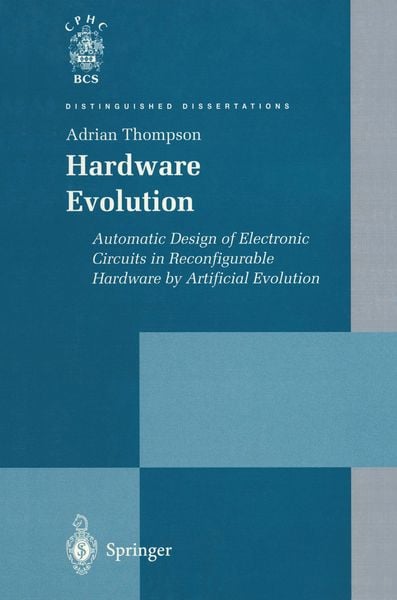
Hardware Evolution Automatic Design of Electronic Circuits in Reconfigurable Hardware by Artificial Evolution

13% sparen

92,99 € UVP 106,99 €

inkl. gesetzl. MwSt., Versandkostenfrei


Beschreibung

Produktdetails

Einband

Taschenbuch

Erscheinungsdatum

13.02.2012

Verlag

Springer London

Seitenzahl

117

Maße (L/B/H)

23,5/15,5/0,8 cm

Gewicht

219 g

Auflage

Softcover reprint of the original 1st ed. 1998

Sprache

Englisch

ISBN

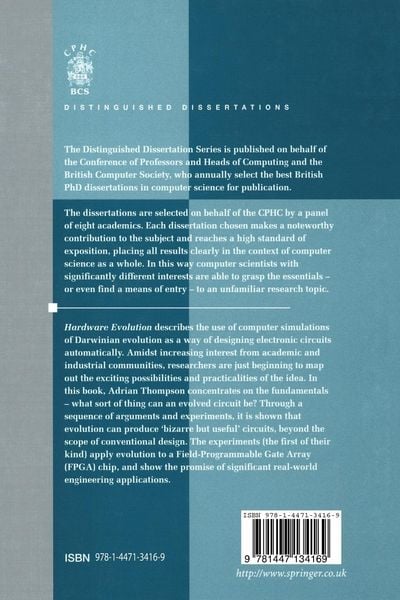
978-1-4471-3416-9

Beschreibung

Produktdetails

Einband

Taschenbuch

Erscheinungsdatum

13.02.2012

Verlag

Springer London

Seitenzahl

117

Maße (L/B/H)

23,5/15,5/0,8 cm

Gewicht

219 g

Auflage

Softcover reprint of the original 1st ed. 1998

Sprache

Englisch

ISBN

978-1-4471-3416-9

Herstelleradresse

Springer-Verlag KG
Sachsenplatz 4-6
1201 Wien
AT

Email: GPSR Kontakt

Noch keine Bewertungen vorhanden

Verfassen Sie die erste Bewertung zu diesem Artikel

Helfen Sie anderen Kundinnen und Kunden durch Ihre Meinung.

Kundinnen und Kunden meinen

Bewertungen (0)

  • Produktbild: Hardware Evolution
  • Produktbild: Hardware Evolution
  • 1. Introduction.- 1.1 Topic.- 1.2 Hardware Evolution.- 1.2.1 An Example of Reconfigurable Hardware.- 1.2.2 Evolving the Circuit Configuration.- 1.2.3 Intrinsic/Extrinsic.- 1.3 Motivation.- 1.4 The Thesis.- 2. Context.- 2.1 Inspiration.- 2.1.1 Mead et al.: Analog neural VLSI.- 2.1.2 Pulse-stream Neural Networks.- 2.1.3 Other Neural Hardware.- 2.1.4 Reconfigurable Hardware.- 2.1.5 Self-Timed Digital Design.- 2.1.6 Analogies with Software: Ray’s Tierra.- 2.1.7 A Dynamical Systems Perspective.- 2.2 Evolutionary Algorithms for Electronic Design: Other approaches.- 2.2.1 ETL.- 2.2.2 deGaris.- 2.2.3 EPFL & CSEM: ‘Embryonics’.- 2.2.4 A Sophisticated Extrinsic Approach: Hemmi et al.- 2.2.5 Evolving Analogue Circuits.- 2.2.6 A Silicon Neuromorph — The First Intrinsic Hardware Evolution?.- 2.2.7 Loosely Related Evolutionary Hardware Projects.- 2.3 Multi-Criteria EAs: Area, Power, Speed and Testability.- 2.4 A Philosophy of Artificial Evolutionx.- 2.4.1 Domain Knowledge, Morphogenesis, Encoding Schemes and Evolvability.- 2.4.2 Species Adaptation Genetic Algorithms (SAGA).- 2.5 The Position of this Book Within the Field.- 3. Unconstrained Structure and Dynamics.- 3.1 The Relationship Between Intrinsic Hardware Evolution and Conventional Design Techniques.- 3.2 Unconstrained Structure.- 3.3 Unconstrained Dynamics.- 3.3.1 Unconstrained Evolutionary Manipulation of Timescales I: Simulation study.- 3.3.2 II: Using a real FPGA.- 3.3.3 A Showpiece for Unconstrained Dynamics: An Evolved Hardware Sensorimotor Control Structure.- 3.4 The Relationship Between Intrinsic Hardware Evolution and Natural Evolution.- 4. Parsimony and Fault Tolerance.- 4.1 Insensitivity to Genetic Mutations.- 4.2 Engineering Consequences of Mutation-Insensitivity.- 4.3 Explicitly Specifying Fault-Tolerance Requirements.- 4.4 Adaptation to Faults.- 4.5 Fault Tolerance Through Redundancy.- 4.6 Summary.- 5. Demonstration.- 5.1 The Experiment.- 5.2 Results.- 5.3 Analysis.- 5.4 Interpretation.- 6. Future Work.- 6.1 Engineering Tolerances.- 6.2 Applications.- 7. Conclusion.- Appendix A. Circuit Diagram of the DSM Evolvable Hardware Robot Controller.- Appendix B. Details of the Simulations used in the ‘Mr Chips’ Robot Experiment.- B.1 The Motor Model.- B.2 The Movement Model.- B.3 The Sonar Model.- References.