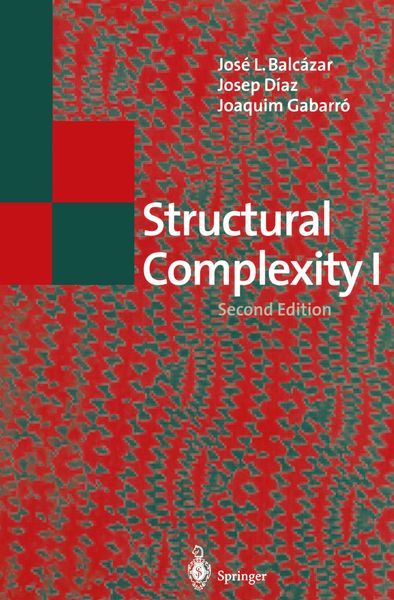
Structural Complexity I
Aus der Reihe
Texts in Theoretical Computer Science. An EATCS Series
48,99 €
inkl. gesetzl. MwSt.,
Beschreibung
Produktdetails
Einband
Taschenbuch
Erscheinungsdatum
09.12.2011
Verlag
Springer BerlinSeitenzahl
208
Maße (L/B/H)
23,5/15,5/1,3 cm
Gewicht
353 g
Auflage
Second Edition 1995
Sprache
Englisch
ISBN
978-3-642-79237-3
In the six years since the first edition of this book was published, the field of Structural Complexity has grown quite a bit. However, we are keeping this volume at the same basic level that it had in the first edition, and the only new result incorporated as an appendix is the closure under complementation of nondeterministic space classes, which in the previous edition was posed as an open problem. This result was already included in our Volume II, but we feel that due to the basic nature of the result, it belongs to this volume. There are of course other important results obtained during these last six years. However, as they belong to new areas opened in the field they are outside the scope of this fundamental volume. Other changes in this second edition are the update of some Bibliograph ical Remarks and references, correction of many mistakes and typos, and a renumbering of the definitions and results. Experience has shown us that this new numbering is a lot more friendly, and several readers have confirmed this opinion. For the sake of the reader of Volume II, where all references to Volume I follow the old numbering, we have included here a table indicating the new number corresponding to each of the old ones.
Kundinnen und Kunden meinen
Verfassen Sie die erste Bewertung zu diesem Artikel
Helfen Sie anderen Kund*innen durch Ihre Meinung
Kurze Frage zu unserer Seite
Vielen Dank für Ihr Feedback
Wir nutzen Ihr Feedback, um unsere Produktseiten zu verbessern. Bitte haben Sie Verständnis, dass wir Ihnen keine Rückmeldung geben können. Falls Sie Kontakt mit uns aufnehmen möchten, können Sie sich aber gerne an unseren Kund*innenservice wenden.
zum Kundenservice