• Produktbild: Programming with Sets
  • Produktbild: Programming with Sets

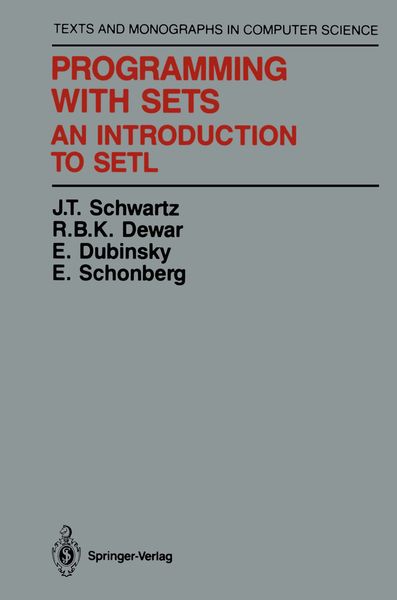
Programming with Sets An Introduction to SETL

97,99 €

inkl. gesetzl. MwSt., Versandkostenfrei


Beschreibung

Produktdetails

Einband

Taschenbuch

Erscheinungsdatum

04.01.2012

Abbildungen

XV, 493 p.

Verlag

Springer Us

Seitenzahl

493

Maße (L/B/H)

23,5/15,5/2,8 cm

Gewicht

768 g

Auflage

Softcover reprint of the original 1st ed. 1986

Sprache

Englisch

ISBN

978-1-4613-9577-5

Beschreibung

Produktdetails

Einband

Taschenbuch

Erscheinungsdatum

04.01.2012

Abbildungen

XV, 493 p.

Verlag

Springer Us

Seitenzahl

493

Maße (L/B/H)

23,5/15,5/2,8 cm

Gewicht

768 g

Auflage

Softcover reprint of the original 1st ed. 1986

Sprache

Englisch

ISBN

978-1-4613-9577-5

Herstelleradresse

Springer-Verlag KG
Sachsenplatz 4-6
1201 Wien
AT

Email: GPSR Kontakt

Noch keine Bewertungen vorhanden

Verfassen Sie die erste Bewertung zu diesem Artikel

Helfen Sie anderen Kundinnen und Kunden durch Ihre Meinung.

Kundinnen und Kunden meinen

Bewertungen (0)

  • Produktbild: Programming with Sets
  • Produktbild: Programming with Sets
  • 1 Programming Concepts.- 1.1 An Informal Overview of SETL.- 1.2 Advice to the Would-Be Programmer.- 1.3 Programming Steps: How to Run Your Program and Read Its Results.- 1.4 How to Type a Program: Character Sets.- 1.5 Appendix: More on How to Read Your Output Listing.- 2 Simple Data Types, Expressions, and Operations.- 2.1 The Main Classes of Data Objects.- 2.2 Simple Types and Their Constants.- 2.3 Variable Identifiers.- 2.4 Expressions and Statements.- 2.5 Operations with Simple Data Types.- 3 Compound Data Types and Operators.- 3.1 Sets and Set Denotations.- 3.2 Tuples.- 3.3 Maps.- 3.4 The Size of Composite Objects: The # Operator.- 3.5 Set Operations and Set Formers.- 3.6 Tuple Operations and Tuple Formers.- 3.7 Tuple Formers; Simple Tuple and String Iterators.- 3.8 Map Operations.- 3.9 Compound Operators.- 3.10 Types and Type-Testing Operators.- 3.11 The? Operator.- 3.12 General Form of the SETL Assignment: The Operators from, frome, and fromb.- 3.13 Operator Precedence Rules.- 3.14 Om and Errors.- 4 Control Structures.- 4.1 The if Statement.- 4.2 The case Statement.- 4.3 Loops.- 4.4 The goto Statement.- 4.5 The stop Statement.- 4.6 The assert Statement.- 4.7 Programming Examples.- 4.8 Reading and Writing Data.- 5 Procedures.- 5.1 Writing and Using Procedures.- 5.2 Name Scopes; Local and Global Variable Names: The var Declaration.- 5.3 Programming Examples 177 5.3.1 The buckets and well problem: a simple artificial intelligence example.- 5.4 Recursive Procedures.- 5.5 Procedures that Modify Their Parameters.- 5.6 Other Procedure-Related Facilities.- 5.7 Rules of Style in the Use of Procedures.- 5.8 String Scanning Primitives.- 5.9 Use of Atoms.- 6 Program Development, Testing, and Debugging.- 6.1 Bugs: How to Minimize Them.- 6.2 Finding Bugs.- 6.3 A Checklist of Common Bugs.- 6.4 Program Testing.- 6.5 Analysis of Program Efficiency.- 6.6 Formal Verification of Programs.- 6.7 Formative Influences on Program Development.- 6.8 References to Material on Alternative Data Structures: References for Additional Material on Algorithms.- 7 Backtracking.- 7.1 Backtracking.- 8 Structuring Large SETL Programs.- 8.1 The const Declaration.- 8.2 Macros.- 8.3 Programming Examples.- 8.4 Programs, Modules, Libraries, and Directories: Structuring Constructs for Large SETL Programs.- 9 Input/Output and Communication with the Environment.- 9.1 Input-Output Facilities.- 9.2 Use of Inclusion Libraries.- 9.3 Listing-Control Commands.- 9.4 Environment Operators and SETL Command Parameters.- 10 The Data Representation Sublanguage.- 10.0 Implementation of the SETL Primitives.- 10.1 The Standard Representation for Tuples.- 10.2 The Standard Representation for Sets.- 10.3 Type Declarations.- 10.4 Basing Declarations.- 10.5 Base Sets Consisting of Atoms Only.- 10.6 Constant Bases.- 10.7 The Packed Representations.- 10.8 Guidelines for the Effective Use of the Data Representation Sublanguage.- 11 The Language in Action: A Gallery of Programming Examples.- 11.1 Eulerian Paths in a Graph.- 11.2 Topological Sorting.- 11.3 The Stable Assignment Problem.- 11.4 A Text Preparation Program.- 11.5 A Simplified Financial Record-Keeping System.- 11.6 A Turing-Machine Simulator.- 11.7 Huffman Coding of Text Files.- 11.8 A Game-Playing Program.- 11.9 Implementation of a Macroprocessor.- Appendix A SETL Reserved Words.- Appendix B Syntax Diagrams.- B.1 Lexical Structure.- B.2 Program Structure.- B.3 Declarative Forms.- B.4 Statement Forms.- B.5 Expressions.