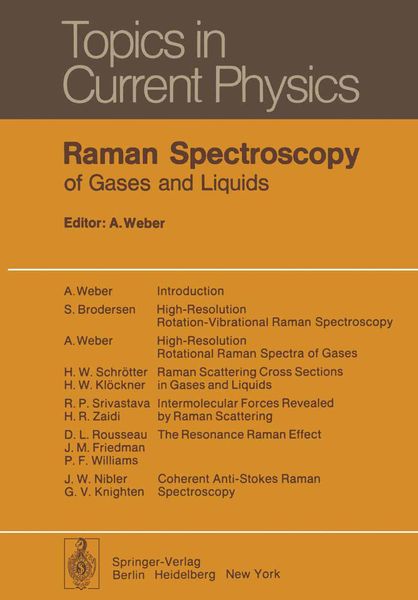
Produktbild: Raman Spectroscopy of Gases and Liquids
Band 11

Raman Spectroscopy of Gases and Liquids

97,99 €

inkl. gesetzl. MwSt., Versandkostenfrei


Beschreibung

Produktdetails

Einband

Taschenbuch

Erscheinungsdatum

13.12.2011

Herausgeber

A. Weber

Verlag

Springer Berlin

Seitenzahl

320

Maße (L/B/H)

24,4/17/1,9 cm

Gewicht

576 g

Auflage

Softcover reprint of the original 1st ed. 1979

Sprache

Englisch

ISBN

978-3-642-81281-1

Beschreibung

Produktdetails

Einband

Taschenbuch

Erscheinungsdatum

13.12.2011

Herausgeber

A. Weber

Verlag

Springer Berlin

Seitenzahl

320

Maße (L/B/H)

24,4/17/1,9 cm

Gewicht

576 g

Auflage

Softcover reprint of the original 1st ed. 1979

Sprache

Englisch

ISBN

978-3-642-81281-1

Herstelleradresse

Springer-Verlag KG
Sachsenplatz 4-6
1201 Wien
AT

Email: GPSR Kontakt

Noch keine Bewertungen vorhanden

Verfassen Sie die erste Bewertung zu diesem Artikel

Helfen Sie anderen Kundinnen und Kunden durch Ihre Meinung.

Kundinnen und Kunden meinen

Bewertungen (0)

  • Produktbild: Raman Spectroscopy of Gases and Liquids
  • 1. Introduction.- References.- 2. High-Resolution Rotation-Vibrational Raman Spectroscopy.- 2.1 Theory.- 2.1.1 Intensity Expressions.- 2.1.2 Selection Rules.- 2.1.3 The Vibrational Matrix Element.- 2.1.4 Linear Molecules.- 2.1.5 Symmetric Top Molecules.- 2.1.6 Asymmetric Top Molecules.- 2.1.7 Spherical Top Molecules.- 2.1.8 Comparison with the Theory of Infrared Spectra.- 2.2 Experimental Technique.- 2.2.1 General Features of Instrumentation and Technique.- 2.2.2 Details of Present Instruments.- 2.2.3 Comparison to Infrared Experimental Techniques.- 2.3 Results.- 2.3.1 General Remarks.- 2.3.2 Linear Molecules.- 2.3.3 C3v Molecules.- 2.3.4 Other Symmetric Top Molecules.- 2.3.5 Asymmetric Top Molecules.- 2.3.6 Spherical Top Molecules.- 2.3.7 Conclusion.- References.- 3. High-Resolution Rotational Raman Spectra of Gases.- 3.1 Instrumentation and Techniques.- 3.1.1 The Raman Source Unit.- a) The Laser System.- b) The Scattering Cell.- c) The Illuminating Optics.- d) The Transfer Optics.- 3.1.2 Filters.- 3.1.3 The Spectrograph.- 3.1.4 Recording Materials.- 3.1.5 Wavelength Standards.- 3.1.6 Determination of Raman Shifts.- 3.1.7 Photoelectric Spectrometers.- 3.1.8 Interferometric Techniques.- 3.2 Observed Rotational Spectra.- 3.2.1 Diatomic Molecules.- 3.2.2 Linear Polyatomic Molecules.- 3.2.3 Symmetric Top Molecules.- 3.2.4 Asymmetric Top Molecules.- 3.2.5 “Forbidden” Pure Rotational Spectra.- a) Spherical Top Molecules — Td Symmetry.- b) Symmetric Top Molecules — C3V Symmetry.- 3.3 Summary.- References.- 4. Raman Scattering Cross Sections in Gases and Liquids.- 4.1 Raman Scattering Cross Sections in Gases.- 4.1.1 Theoretical Considerations.- 4.1.2 Determination of the Absolute Scattering Cross Section of Nitrogen.- 4.1.3 Measurement of Relative Scattering Cross Sections.- a) Experimental Procedure.- b) Results.- c) Influence of the Resonance Raman Effect.- 4.2 Raman Scattering Cross Sections in Liquids.- 4.2.1 Internal Field Effect and Intermolecular Interactions.- 4.2.2 Absolute Scattering Cross Sections.- 4.2.3 Relative Scattering Coefficients.- 4.3 Ratio of the Raman Scattering Cross Section in the Liquid and in the Gaseous State.- 4.4 Conclusion.- References.- 5. Intermolecular Forces Revealed by Raman Scattering.- 5.1 Introductory Remarks.- 5.2 Spectral Function for Raman Scattering.- 5.3 Impact Theory.- 5.4 Isolated Lines.- 5.4.1 Calculation of Line Widths and Shifts.- a) Non-Perturbative Approaches.- b) Perturbative Approaches.- c) Line Shift.- 5.4.2 Comparison of Theory with Experiment and Information Obtained about Intermolecular Potentials.- 5.5 Overlapping Lines and Band Shapes.- 5.6 Statistical Theories.- 5.7 Liquids.- 5.8 Conclusion.- References.- 6. The Resonance Raman Effect.- 6.1 Resonance Raman Scattering.- 6.2 Diatomic Molecules.- 6.2.1 Discrete Resonance Raman Scattering.- 6.2.2 Continuum Resonance Raman Scattering.- 6.2.3 Perturbed Diatomic Molecules.- 6.3 Polyatomic Molecules.- 6.4 Porphyrin Compounds.- 6.4.1 Porphyrin Absorption Spectrum.- 6.4.2 Helpful Diagrams.- 6.4.3 Scattering from Q0, Q1, and B.- 6.4.4 Anomalous Polarization.- 6.4.5 Interference Effects.- 6.4.6 Non-Adiabatic Effects.- 6.4.7 Influence of Jahn-Teller Distortion.- 6.5 Concluding Remarks.- References.- 7. Coherent Anti-Stokes Raman Spectroscopy.- 7.1 Theory.- 7.1.1 Maxwell’s Equations for Macroscopic Samples.- 7.1.2 Symmetry Properties of ?(3)258.- 7.1.3 CARS Amplitudes.- 7.1.4 Raman Amplitudes.- 7.1.5 Microscopic Third-Order Susceptibilities.- 7.2 Comparison of CARS and Raman Spectroscopy.- 7.2.1 Signal Strengths.- 7.2.2 Lineshapes and Maxima.- 7.2.3 Selection Rules.- 7.2.4 Orientation Averaging and Polarization Behavior.- 7.3 Experimental Aspects of CARS.- 7.4 Survey of CARS Experimental Results.- 7.4.1 Solids.- 7.4.2 Liquids.- 7.4.3 Gases.- a) Combustion and Gas Diagnostics.- b) Plasma Diagnostics.- c) Photochemical, Kinetic and Excited State Studies.- d) High-Resolution Spectroscopy.- 7.4.4 Solutions.- 7.4.5 Background Suppression in CARS.- 7.5 Summary.- References.- Additional References with Titles.