
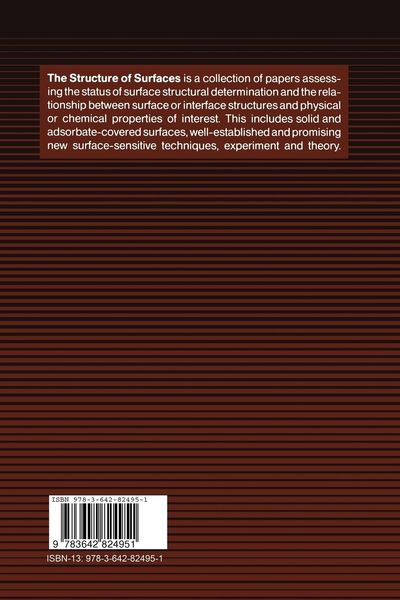
The Structure of Surfaces
-
- Englisch ausgewählt
49,99 €
inkl. gesetzl. MwSt.,
Beschreibung
Produktdetails
Einband
Taschenbuch
Erscheinungsdatum
18.02.2012
Herausgeber
Van Hove + weitereVerlag
Springer BerlinSeitenzahl
438
Maße (L/B/H)
23,5/15,5/2,5 cm
Gewicht
686 g
Auflage
Softcover reprint of the original 1st ed. 1985
Sprache
Englisch
ISBN
978-3-642-82495-1
I Theory of Surface Structure.- I. 1 General Discussion.- 1. Theory of Surface Reconstruction.- 2. Electronic and Magnetic Properties of Transition-Metal Surfaces, Interfaces and Overlayers.- 3. The Binding of Adsorbates to Metal Surfaces.- I.2 Specific Applications.- 4. Energy Minimization Calculations for Diamond (111) Surface Reconstructions.- 5. Ttal Energies and Atom Locations at Solid Surfaces.- 6. Theory of Hydrogen on Metal Surfaces.- II New Surface Structure Techniques.- II. 1 Techniques Based on Electrons.- 7. The Surface Topography of a Pd(100) Single Crystal and Glassy Pd81Si19 Studied by Scanning Tunneling Microscopy.- 8. Theory of the Scanning Tunneling Microscope.- 9. Reflection Electron Microscopy Studies of Crystal Lattice Termination at Surfaces.- II. 2 Techniques Based on Photons and Other Probes.- 10. Surface Structure by X-Ray Diffraction.- 11. Optical Transitions and Surface Structure.- 12. High-Resolution Infrared Spectroscopy and Surface Structure.- 13. Optical Second Harmonic Generation for Surface Studies.- 14. NMR and Surface Structure.- III Developments in Existing Techniques.- III. 1 LEED and Electron Propagation.- 15. Determination of Surface Structure by LEED.- 16. Structure Determination of Molecular Adsorbates with Dynamical LEED and HREELS.- 17. Computer Controlled LEED Intensity and Spot Profile Determination.- 18. On the Role of Space Inhomogeneity of Electron Damping in LEED.- 19. Attenuation of Isotropically Emitted Electron Beams.- III. 2 Diffuse LEED, NEXAFS/XANES and SEXAF5.- 20. LEED, XANES and the Structure of Disordered Surfaces.- 21. The Structure of Organic Adsorbates from Elastic Diffuse LEED.- 22. Multiple Scattering Effects in Near-Edge X-Ray Absorption Spectra.- 23. NEXAFS and SEXAFS Studies of Chemisorbed Molecules: Bonding, Structure and Chemical Transformations.- 24. Current Status and New Applications of SEXAFS: Reactive Chemisorption and Clean Surfaces.- III. 3 High-Resolution Electron Energy Loss Spectroscopy (HREELS).- 25. Electron-Phonon Scattering and Structure Analysis.- 26. Shape Resonances in OH Groups Chemisorbed on the (100) Surface of Ge-Si Alloys.- 27. Structure and Temperature-Dependent Polaron Shifts on Si(111) (2 × 1).- III. 4 Atom and Ion Scattering.- 28. Surface Structure Analysis by Atomic Beam Diffraction.- 29. Structure Analysis of a Semiconductor Surface by Impact Collision Ion Scattering Spectroscopy (ICISS): Si(111) R30°$$\sqrt{3} \times \sqrt{3}$$ Ag.- III. 5 Photoemission.- 30. Surface Structure Determination with ARPEFS.- 31. Angle Resolved XPS of the Epitaxial Growth of Cu on Ni(100).- 32. Evidence for Diffusion at 80K of Gold Atoms Through Thin, Defective Oxide Layers.- III. 6 Neutron Scattering.- 33. Surface Characterization by the Inelastic Scattering of Neutrons from Adsorbates.- 34. Infrared and Neutron-Scattering Studies of Ethene Adsorbed onto Partially Exchanged Zinc A Zeolite.- IV Clean and Adsorbate-Covered Metals.- IV. 1 Clean Metal Surfaces.- 35. Theoretical Study of the Structural Stability of the Reconstructed (110) Surfaces of Ir, Pt and Au.- 36. The Structure and Surface Energy of Au(llO) Studied by Monte Carlo Method.- 37. Long- and Short-Range Order Fluctuations in the H/W(100) System.- IV. 2 Atomic Adsorption on Metal Surfaces.- 38. Synchrotron X-Ray Scattering Study of a Chemisorption System: Oxygen on Cu(llO) Surface.- 39. Helium Diffraction from Oxygen-Covered Nickel Surfaces.- 40. Competing Reconstruction Mechanisms in H/Ni(110).- IV. 3 Molecular Adsorption on Metal Surfaces.- 41. The Uses and Limitations of ESDIAD for Determiningthe Structure of Surface Molecules.- 42. The Study of Simple Reactions at Surfaces by High-Resolution Electron Energy Loss Spectroscopy.- V Semiconductors.- V. 1 Elemental Semiconductors.- 43. Triangle-Dimer Stacking-Fault Model of the Si(111)7x7 Surface Bonding Configuration.- 44. Structure of the Si(111)2x1 Surface.- 45. Refinement of the Buckled-Dimer Model for Si(001)2x1.- 46. Surface Relaxati
Noch keine Bewertungen vorhanden
Verfassen Sie die erste Bewertung zu diesem Artikel
Helfen Sie anderen Kundinnen und Kunden durch Ihre Meinung.
Kurze Frage zu unserer Seite
Vielen Dank für Ihr Feedback
Wir nutzen Ihr Feedback, um unsere Produktseiten zu verbessern. Bitte haben Sie Verständnis, dass wir Ihnen keine Rückmeldung geben können. Falls Sie Kontakt mit uns aufnehmen möchten, können Sie sich aber gerne an unseren Kund*innenservice wenden.
zum Kundenservice