
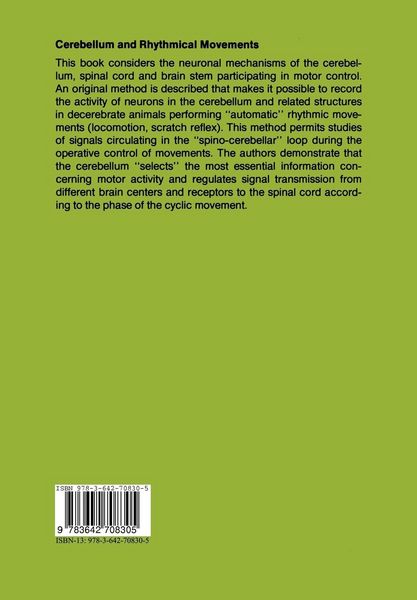
• Produktbild: Cerebellum and Rhythmical Movements
  • Produktbild: Cerebellum and Rhythmical Movements
Band 13

Cerebellum and Rhythmical Movements

49,99 €

inkl. gesetzl. MwSt., Versandkostenfrei


Beschreibung

Produktdetails

Einband

Taschenbuch

Erscheinungsdatum

17.11.2011

Verlag

Springer Berlin

Seitenzahl

166

Maße (L/B/H)

24,4/17/1,1 cm

Gewicht

329 g

Auflage

Softcover reprint of the original 1st edition 1986

Sprache

Englisch

ISBN

978-3-642-70830-5

Beschreibung

Produktdetails

Einband

Taschenbuch

Erscheinungsdatum

17.11.2011

Verlag

Springer Berlin

Seitenzahl

166

Maße (L/B/H)

24,4/17/1,1 cm

Gewicht

329 g

Auflage

Softcover reprint of the original 1st edition 1986

Sprache

Englisch

ISBN

978-3-642-70830-5

Herstelleradresse

Springer-Verlag GmbH
Tiergartenstr. 17
69121 Heidelberg
DE

Email: ProductSafety@springernature.com

Kundinnen und Kunden meinen

0 Bewertungen

Informationen zu Bewertungen

Zur Abgabe einer Bewertung ist eine Anmeldung im Konto notwendig. Die Authentizität der Bewertungen wird von uns nicht überprüft. Wir behalten uns vor, Bewertungstexte, die unseren Richtlinien widersprechen, entsprechend zu kürzen oder zu löschen.

Die Bewertungen sind nach Format, Anzahl Sterne und Datum sortiert.

Verfassen Sie die erste Bewertung zu diesem Artikel

Helfen Sie anderen Kund*innen durch Ihre Meinung

Kundinnen und Kunden meinen

0 Bewertungen filtern

  • Produktbild: Cerebellum and Rhythmical Movements
  • Produktbild: Cerebellum and Rhythmical Movements
  • I Spinal Mechanisms of Stepping and Scratching Movements.- 1. Crucial Role of the Spinal Cord in Control of Stepping and Scratching Movements.- 2. Preparations and Evoking of Movements.- 3. Hindlimb Movements and Muscle Activity.- 4. Role of Central Mechanisms and Afferent Signals in Generating Rhythmic Movements.- 5. Afferent Signals.- 6. Localization of the Rhythm Generator. Activity of Neurons of the “Leading” Region of the Lumbo-Sacral Spinal Cord.- 7. Conclusion.- II Signals Coming to the Cerebellum.- 1. Cerebellar Cortex and its Afferent Connections.- 2. Dorsal Spino-Cerebellar Tract.- 3. Ventral Spino-Cerebellar Tract.- 4. Spino-Reticulo-Cerebellar Pathway.- 5. VSCT and SRCP convey Messages about Activity in the “Leading” Region of Lumbo-Sacral Cord.- 6. Spino-Olivo-Cerebellar Pathway.- 7. Conclusion.- III Signals Conveyed by Descending Tracts.- 1. Vestibulo-Spinal Tract.- 2. Reticulo-spinal Tract.- 3. Rubro-Spinal Tract.- 4. Influences of Descending Tracts upon Motor Activity.- 5. Conclusion.- IV Role of Different Input Signals for Generating Cerebellar Output Signals.- 1. Role of Signals Concerning Peripheral and Central Processes During Locomotion.- 2. Role of Signals Concerning Peripheral and Central Processes During Scratching.- 3. Role of Signals Coming via VSCT and SRCP.- 4. Conclusion.- V Activity of Cerebellar Neurons.- 1. Purkinje Cells.- 2. Fastigial Nucleus.- 3. Interpositus Nucleus.- 4. Lateral Nucleus.- 5. Conclusion.- VI External Inputs of the Spino-Cerebellar Loop.- VII Role of the Cerebellum in the Control of Locomotion and Scratch Reflex.- References.