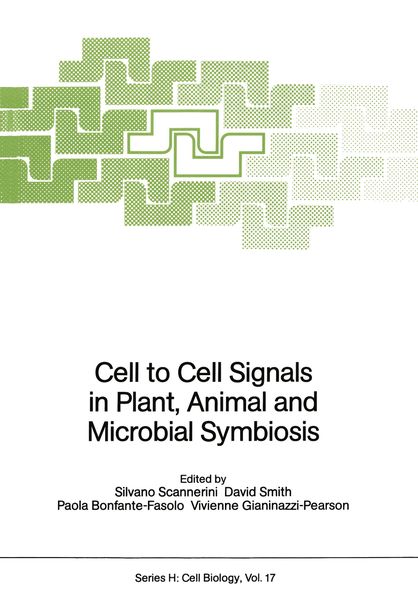
Produktbild: Cell to Cell Signals in Plant, Animal and Microbial Symbiosis
Band 17

Cell to Cell Signals in Plant, Animal and Microbial Symbiosis

Aus der Reihe Nato ASI Subseries H:

97,99 €

inkl. gesetzl. MwSt., Versandkostenfrei


Beschreibung

Produktdetails

Einband

Taschenbuch

Erscheinungsdatum

27.12.2011

Herausgeber

Silvano Scannerini + weitere

Verlag

Springer Berlin

Seitenzahl

414

Maße (L/B/H)

24,4/17/2,4 cm

Gewicht

748 g

Auflage

Softcover reprint of the original 1st ed. 1988

Sprache

Englisch

ISBN

978-3-642-73156-3

Beschreibung

Produktdetails

Einband

Taschenbuch

Erscheinungsdatum

27.12.2011

Herausgeber

Verlag

Springer Berlin

Seitenzahl

414

Maße (L/B/H)

24,4/17/2,4 cm

Gewicht

748 g

Auflage

Softcover reprint of the original 1st ed. 1988

Sprache

Englisch

ISBN

978-3-642-73156-3

Herstelleradresse

Springer-Verlag GmbH
Tiergartenstr. 17
69121 Heidelberg
DE

Email: GPSR Kontakt

Noch keine Bewertungen vorhanden

Verfassen Sie die erste Bewertung zu diesem Artikel

Helfen Sie anderen Kundinnen und Kunden durch Ihre Meinung.

Kundinnen und Kunden meinen

Bewertungen (0)

  • Produktbild: Cell to Cell Signals in Plant, Animal and Microbial Symbiosis
  • I. Physiology and Morphology of Cell-to-Cell Interactions.- Cellular interactions between host and endosymbiont in dinitrogen-fixing root nodules of woody plants.- Recognition mechanisms in the Azolla-Anabaena symbiosis.- The functional morphology of cell-to-cell interactions in lichens.- Host-fungus interactions in ectomycorrhizae.- Morphological integration and functional compatibility between symbionts in vesicular arbuscular endomycorrhizal associations.- Cell to cell interactions in insect endocytobiosis.- Luminescent bacteria: symbionts of nematodes and pathogens of insects.- Cell-to-cell interactions during the establishment of the Hydra-Chlorella symbiosis.- Specificity in the Convoluta roscoffensis/Tetraselmis symbiosis.- The cell structures of plant, animal and microbial symbionts, their differences and similarities.- Symbiosis and evolution: a brief guide to recent literature.- II. Signals in Plants.- Molecular signals in plant cell recognition.- Early recognition signals in the Rhizobium trifolii-white clover symbiosis.- Flavonoid compounds as molecular signals in Rhizobium-legume symbiosis.- Soredia formation of compatible and incompatible lichen symbionts.- The role of the cell wall as a signal in mycorrhizal associations.- III. Signals in Animals.- Peptide and carbohydrate moieties as molecular signals in animal cell recognition.- Genetical and biochemical interactions between the host and its endocytobiotes in the weevils Sitophilus (Coleoptere, Curculionidae) and other related species.- Signals in the Paramecium Bursaria — Chlorella Sp. association.- Nutritional interactions as signals in the green hydra symbiosis.- The establishment of algal/hydra symbioses — A case of recognition or preadaptation?.- Factors produced by symbiotic marine invertebrates which affect translocation between the symbionts.- Specificity in dinomastigote-marine invertebrate symbioses: an evaluation of hypotheses of mechanisms involved in producing specificity.- IV. Recommendations for Future Research and Applications.- Applications of genetic engineering to “Symbiontology” in agriculture.- The application of monoclonal antibody technology to the study of cell-cell interactions.- The use of monoclonal antibodies to investigate plant-microbe interactions in pea root nodules containing Rhizobium leguminosarum.- Immunocytochemical studies of symbiotic development and metabolism in nitrogen-fixing root nodules.- Concepts leading to an understanding of recognition and signalling between hosts and symbionts.