• Produktbild: Surface Crystallography by LEED
  • Produktbild: Surface Crystallography by LEED
Band 2

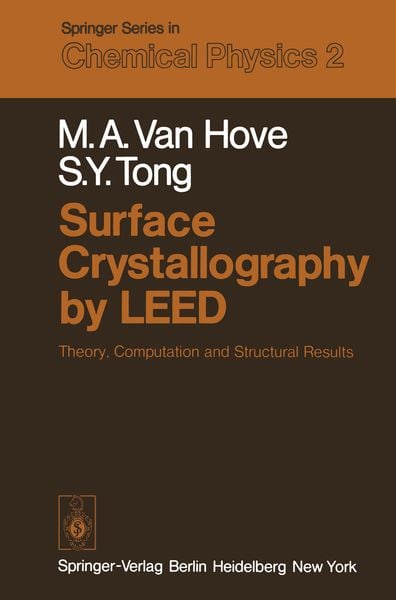
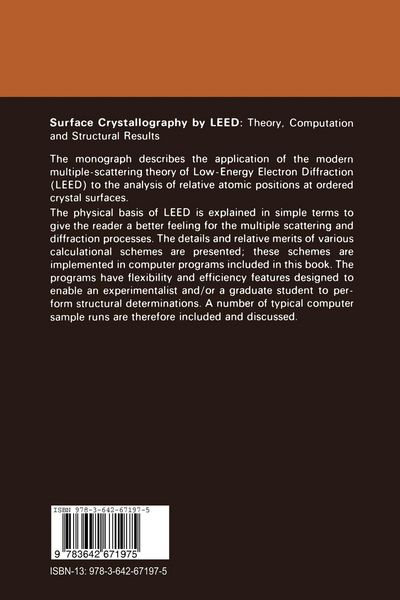
Surface Crystallography by LEED Theory, Computation and Structural Results

54,99 €

inkl. gesetzl. MwSt., Versandkostenfrei


Beschreibung

Produktdetails

Einband

Taschenbuch

Erscheinungsdatum

18.10.2011

Verlag

Springer Berlin

Seitenzahl

288

Maße (L/B/H)

23,5/15,5/1,7 cm

Gewicht

464 g

Auflage

Softcover reprint of the original 1st ed. 1979

Sprache

Englisch

ISBN

978-3-642-67197-5

Beschreibung

Produktdetails

Einband

Taschenbuch

Erscheinungsdatum

18.10.2011

Verlag

Springer Berlin

Seitenzahl

288

Maße (L/B/H)

23,5/15,5/1,7 cm

Gewicht

464 g

Auflage

Softcover reprint of the original 1st ed. 1979

Sprache

Englisch

ISBN

978-3-642-67197-5

Herstelleradresse

Springer-Verlag GmbH
Tiergartenstr. 17
69121 Heidelberg
DE

Email: ProductSafety@springernature.com

Kundinnen und Kunden meinen

0 Bewertungen

Informationen zu Bewertungen

Zur Abgabe einer Bewertung ist eine Anmeldung im Konto notwendig. Die Authentizität der Bewertungen wird von uns nicht überprüft. Wir behalten uns vor, Bewertungstexte, die unseren Richtlinien widersprechen, entsprechend zu kürzen oder zu löschen.

Die Bewertungen sind nach Format, Anzahl Sterne und Datum sortiert.

Verfassen Sie die erste Bewertung zu diesem Artikel

Helfen Sie anderen Kund*innen durch Ihre Meinung

Kundinnen und Kunden meinen

0 Bewertungen filtern

  • Produktbild: Surface Crystallography by LEED
  • Produktbild: Surface Crystallography by LEED
  • 1. Introduction.- 1.1 LEED as a Tool for Surface Studies.- 1.2 Purpose of the Computational Programs.- 1.3 Physical Processes Included in the Programs.- 1.4 Capabilities of the Programs.- 1.5 Size, Speed and Limitations of the Programs.- 1.6 Relation to Other LEED Programs.- 1.7 Some Computational Considerations.- 2. The Physics of LEED.- 2.1 A Simple Description of the LEED Process: Clean Crystals and Bragg Reflections in One Dimension.- 2.2 Peak Width and Electron Penetration Depth.- 2.3 Three-Dimensional Effects.- 2.4 Overlayer Effects.- 2.5 Elements of a LEED Theory.- 3. Basic Aspects of the Programs.- 3.1 Units and Geometrical Conventions.- 3.2 Layers, Subplanes and Plane Waves.- 3.3 Superlattices.- 3.4 Atomic Scattering and the Calculation of Phase Shifts.- 3.5 Thermal Vibrations.- 3.6 Ordering of (?,m) Pairs.- 4. Symmetry and Its Use.- 4.1 Symmetry and Registries.- 4.2 Symmetry Among Beams.- 4.3 Some Formulas.- 4.4 Summary.- 5. Calculation of Diffraction Matrices for Single Bravais-Lattice Layers.- 5.1 Layer Diffraction Matrices.- 5.2 Subroutine MSMF.- 5.3 The Intralayer Multiple-Scattering Matrix X.- 5.4 Scattering Amplitudes and Temperature Effects.- 6. The Combined Space Method for Composite Layers: by Matrix Inversion.- 6.1 The Formalism.- 6.2 Subroutine MTINV.- 7. The Combined Space Method for Composite Layers: by Reverse Scattering Perturbation.- 7.1 The Formalism of Reverse Scattering Perturbation (RSP) Theory.- 7.2 Combining RSP and Matrix Inversion.- 7.3 Subroutine MPERTI.- 8. Stacking Layers by Layer Doubling.- 8.1 The Formalism.- 8.2 Bulk Treatment: Subroutine SUBREF.- 8.3 Surface Treatment: Subroutines ADREF1, DBLG, DBG.- 9. Stacking Layers by Renormalized Forward Scattering (RFS) Perturbation.- 9.1 The Formalism.- 9.2 Subroutines RFS03, RFS02 and Others.- 10. Assembling a Program: the Main Program and the Input.- 10.1 Preparing a Calculation.- 10.2 The Main Program.- 10.3 Explanation of Output.- 10.3.1 Print Output.- 10.3.2 Punch Output.- 10.4 Main Program for Clean fcc (111) and hcp (0001) Faces, Including Possible Top-Layer Registry Shifts, Using RFS.- 10.5 Main Program for a Small-Atom p(2×1) Overlayer on a fcc (111) Substrate, Using RSP and RFS.- 10.6 Main Program for a Clean fcc or bcc (100) Surface, Using RFS.- 10.7 Main Program for a p(2×2) Overlayer on an fcc or bcc (100) Substrate, Using Layer Doubling.- 10.8 Main Program for a c(2×2) Overlayer on an fcc or bcc (100) Substrate, with Rumpling of the Topmost Substrate Layer, Using Matrix Inversion and RFS.- 10.9 Main Program for an Upright Diatomic Molecule on an fcc or bcc (100) Substrate, Using Layer Doubling.- 11. Subroutine Listings.- 12. Structural Results of LEED Crystallography.- 12.1 Non-Metals.- 12.2 Clean Metals.- 12.3 Adsorption on Metals.- 12.4 Bibliography.- Appendix A. Symmetry Among Plane Waves.- Appendix B. Lattice Sums Over Sublattices.- Appendix C. A Line-Printer Plotting Program.- References.