
Gutscheinbedingungen

Gültig bis 19.08.2026 | Gültig für Spielzeug, Filme, Musik, Software, Games, Elektronik, Geschenke & Trends, Schreibwaren, Hörbücher und Hörbuch-Downloads (außer Abo & Shelfies), gebrauchte Bücher, nicht preisgebundene Bücher und Kalender | Einlösbar unter osiander.de und in der Osiander App | Click & Collect nur mit Online-Zahlung (Paypal/Kreditkarte) vorab | Einzelne Artikel können ausgeschlossen sein | Nicht kombinierbar mit anderen Gutscheinen oder Preisaktionen | Nur einmal pro Einkauf einlösbar | Gutschein wird auf max. 500€ Bestellwert angerechnet | Keine Barauszahlung | Digitale Hörbücher nur für Android  | Nicht gültig für preisgebundene Artikel (aufgrund der Buchpreisbindung sind Gutscheine nicht auf Bücher, eBooks, Presse einlösbar), tolino eReader & Zubehör, Abonnements & Flatrates, Geschenkkarten, Versandkosten und Services

  • Produktbild: Modeling, Mesh Generation, and Adaptive Numerical Methods for Partial Differential Equations
  • Produktbild: Modeling, Mesh Generation, and Adaptive Numerical Methods for Partial Differential Equations
Band 75 - 13%

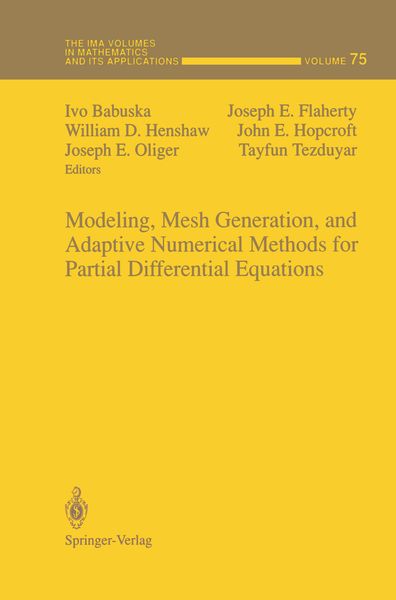
Modeling, Mesh Generation, and Adaptive Numerical Methods for Partial Differential Equations

13% sparen

231,99 € UVP 267,49 €

inkl. gesetzl. MwSt., Versandkostenfrei


Beschreibung

Produktdetails

Einband

Taschenbuch

Erscheinungsdatum

21.11.2011

Abbildungen

LII, 450 p.

Herausgeber

Ivo Babuska + weitere

Verlag

Springer Us

Seitenzahl

450

Maße (L/B/H)

23,5/15,5/2,8 cm

Gewicht

762 g

Auflage

Softcover reprint of the original 1st ed. 1995

Sprache

Englisch

ISBN

978-1-4612-8707-0

Beschreibung

Produktdetails

Einband

Taschenbuch

Erscheinungsdatum

21.11.2011

Abbildungen

LII, 450 p.

Herausgeber

Verlag

Springer Us

Seitenzahl

450

Maße (L/B/H)

23,5/15,5/2,8 cm

Gewicht

762 g

Auflage

Softcover reprint of the original 1st ed. 1995

Sprache

Englisch

ISBN

978-1-4612-8707-0

Herstelleradresse

Springer-Verlag KG
Sachsenplatz 4-6
1201 Wien
AT

Email: GPSR Kontakt

Noch keine Bewertungen vorhanden

Verfassen Sie die erste Bewertung zu diesem Artikel

Helfen Sie anderen Kundinnen und Kunden durch Ihre Meinung.

Kundinnen und Kunden meinen

Bewertungen (0)

  • Produktbild: Modeling, Mesh Generation, and Adaptive Numerical Methods for Partial Differential Equations
  • Produktbild: Modeling, Mesh Generation, and Adaptive Numerical Methods for Partial Differential Equations
  • Week 1.- NURBS and grid generation.- Coping with degeneracies in Delaunay triangulation.- Geometric approaches to mesh generation.- Refining quadrilateral and brick element meshes.- Automatic meshing of curved three—dimensional domains: Curving finite elements and curvature-based mesh control.- Week 2.- Optimization of tetrahedral meshes.- A class of error estimators based on interpolating the finite element solutions for reaction-diffusion equations.- Accuracy-based time step criteria for solving parabolic equations.- Week 3.- Adaptive domain decomposition methods for advection-diffusion problems.- LP-posteriori error analysis of mixed methods for linear and quasilinear elliptic problems.- A characteristic-Galerkin method for the Navier-Stokes equations in thin domains with free boundaries.- Parallel partitioning strategies for the adaptive solution of conservation laws.- Adaptive multi-grid method for a periodic heterogeneous medium in 1 ? D.- A knowledge-based approach to the adaptive finite element analysis.- An asymptotically exact, pointwise, a posteriori error estimator for the finite element method with super convergence properties.- A mesh-adaptive collocation technique for the simulation of advection-dominated single- and multiphase transport phenomena in porous media.- Three-step H-P adaptive strategy for the incompressible Navier-Stokes equations.- Applications of automatic mesh generation and adaptive methods in computational medicine.- Solution of elastic-plastic stress analysis problems by the p-version of the finite element method.- Adaptive finite volume methods for time-dependent P.D.E.S.- Superconvergence of the derivative patch recovery technique and a posteriori error estimation.