
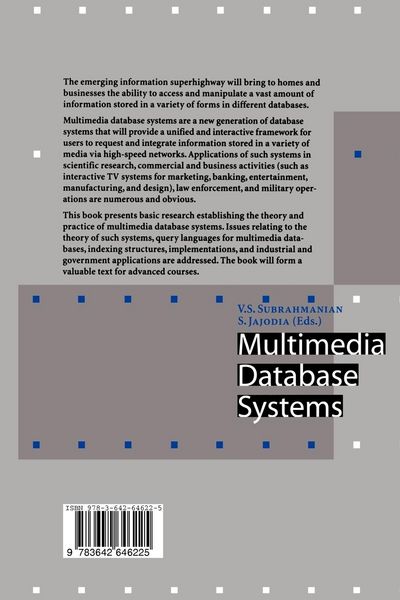
• Produktbild: Multimedia Database Systems
  • Produktbild: Multimedia Database Systems

Multimedia Database Systems Issues and Research Directions

Aus der Reihe Artificial Intelligence

97,99 €

inkl. gesetzl. MwSt., Versandkostenfrei


Beschreibung

Produktdetails

Einband

Taschenbuch

Erscheinungsdatum

27.09.2011

Herausgeber

V.S. Subrahmanian + weitere

Verlag

Springer Berlin

Seitenzahl

323

Maße (L/B/H)

23,5/15,5/1,9 cm

Gewicht

522 g

Auflage

Softcover reprint of the original 1st ed. 1996

Sprache

Englisch

ISBN

978-3-642-64622-5

Beschreibung

Portrait

The information superhighway will bring vast amounts of information to everyone. Multimedia database systems will provide a unified and interactive framework for users to access and manipulate such information. This book presents basic research on such systems and is a valuable text for advanced courses.

Produktdetails

Einband

Taschenbuch

Erscheinungsdatum

27.09.2011

Herausgeber

Verlag

Springer Berlin

Seitenzahl

323

Maße (L/B/H)

23,5/15,5/1,9 cm

Gewicht

522 g

Auflage

Softcover reprint of the original 1st ed. 1996

Sprache

Englisch

ISBN

978-3-642-64622-5

Herstelleradresse

Springer-Verlag KG
Sachsenplatz 4-6
1201 Wien
AT

Email: GPSR Kontakt

Noch keine Bewertungen vorhanden

Verfassen Sie die erste Bewertung zu diesem Artikel

Helfen Sie anderen Kundinnen und Kunden durch Ihre Meinung.

Kundinnen und Kunden meinen

Bewertungen (0)

  • Produktbild: Multimedia Database Systems
  • Produktbild: Multimedia Database Systems
  • Towards a Theory of Multimedia Database Systems.- 1. Introduction.- 2. Basic Ideas Underlying the Framework.- 3. Media Instances.- 3.1 The Clinton Example.- 3.2 Examples of Media-Instances.- 4. Indexing Structures and a Query Language for Multimedia Systems.- 4.1 Frame-Based Query Language.- 4.2 The Frame Data Structure.- 4.3 Query Processing Algorithms.- 4.4 Updates in Multimedia Databases.- 5. Multimedia Presentations.- 5.1 Generation of Media Events = Query Processing.- 5.2 Synchronization = Constraint Solving.- 5.3 Internal Synchronization.- 5.4 Media Buffers.- 6. Related Work.- 7. Conclusions.- A Unified Approach to Data Modelling and Retrieval for a Class of Image Database Applications.- 1. Introduction.- 2. Approaches to Image Data Modeling.- 2.1 Terminology.- 2.2 Conventional Data Models.- 2.3 Image Processing/Graphics Systems with Database Functionality.- 2.4 Extended Conventional Data Models.- 2.5 Extensible Data Models.- 2.6 Other Data Models.- 3. Requirements Analysis of Application Areas.- 3.1 A Taxonomy for Image Attributes.- 3.2 A Taxonomy for Retrieval Types.- 3.3 Art Galleries and Museums.- 3.4 Interior Design.- 3.5 Architectural Design.- 3.6 Real Estate Marketing.- 3.7 Face Information Retrieval.- 4. Logical Representations.- 5. Motivations for the Proposed Data Model.- 6. An Overview of AIR Framework.- 6.1 Data Model.- 6.2 The Proposed DBMS Architecture.- 7. Image Database Systems Based on AIR Model.- 8. Image Retrieval Applications Based on the Prototype Implementation of AIR Framework.- 8.1 Realtors Information System.- 8.2 Face Information Retrieval System.- 9. Research Issues in AIR Framework.- 9.1 Query Interface.- 9.2 Algorithms for RSC and RSS Queries.- 9.3 Relevance Feedback Modeling and Improving Retrieval Effectiveness.- 9.4 Elicitation of Semantic Attributes.- 10. Conclusions and Future Direction.- A. Image Logical Structures.- The QBISM Medical Image DBMS.- 1. Introduction.- 2. The Medical Application.- 2.1 Problem Definition.- 2.2 Data Characteristics.- 3. Logical Design.- 3.1 Data Types.- 3.2 Spatial Operations.- 3.3 Schema.- 3.4 Queries.- 4. Physical Database Design.- 4.1 Representation of a VOLUME.- 4.2 Representation of a REGION.- 4.3 Conclusions.- 5. System Issues.- 5.1 Starburst Extensions.- 5.2 System Architecture.- 6. Performance Experiments.- 6.1 Experimental Environment.- 6.2 Single-study Queries.- 6.3 Multi-study Queries.- 6.4 Results from the Performance Experiments.- 7. Conclusions and Future Work.- Retrieval of Pictures Using Approximate Matching.- 1. Introduction.- 2. Picture Representation.- 3. User Interface.- 4. Computation of Similarity Values.- 4.1 Similarity Functions.- 4.2 Object Similarities.- 4.3 Similarities of Non-spatial Relationships.- 4.4 Spatial Similarity Functions.- 5. Conclusion.- Ink as a First-Class Datatype in Multimedia Databases.- 1. Introduction.- 2. Ink as First-Class Data.- 2.1 Expressiveness of Ink.- 2.2 Approximate Ink Matching.- 3. Pictographic Naming.- 3.1 Motivation.- 3.2 A Pictographic Browser.- 3.3 The Window Algorithm.- 3.4 Hidden Markov Models.- 4. The ScriptSearch Algorithm.- 4.1 Definitions.- 4.2 Approaches to Searching Ink.- 4.3 Searching for Patterns in Noisy Text.- 4.4 The ScriptSearch Algorithm.- 4.5 Evaluation of ScriptSearch.- 4.6 Experimental Results.- 4.7 Discussion.- 5. Searching Large Databases.- 5.1 The HMM-Tree.- 5.2 The Handwritten Trie.- 5.3 Inter-character Strokes.- 5.4 Performance.- 6. Conclusions.- Indexing for Retrieval by Similarity.- 1. Introduction.- 2. Shape Matching.- 2.1 Rectangular Shape Covers.- 2.2 Storage Structure.- 2.3 Queries.- 2.4 Approximate Match.- 2.5 An Example.- 2.6 Experiment.- 3. Word Matching.- 4. Discussion.- Filtering Distance Queries in Image Retrieval.- 1. Introduction.- 2. Spatial Access Methods and Image Retrieval.- 2.1 Query Processor.- 2.2 Image Objects and Spatial Predicates.- 3. Snapshot.- 3.1 Regular Grid with Locational Keys.- 3.2 Clustering Technique.- 3.3 Extensible Hashing.- 3.4 Organization of Snapshot.- 4. Filtering Metric Queries with Snapshot.- 4.1 Search Algorithm.- 4.2 Min Algorithm.- 5. Optimization of Spatial Queries.- 6. Conclusions and Future Work.- Stream-based Versus Structured Video Objects: Issues, Solutions, and Challenges.- 1. Introduction.- 2. Stream-based Presentation.- 2.1 Continuous Display.- 2.2 Pipelining to Minimize Latency Time.- 2.3 High Bandwidth Objects and Scalable Servers.- 2.4 Challenges.- 3. Structured Presentation.- 3.1 Atomic Object Layer.- 3.2 Composed Object Layer.- 3.3 Challenges.- 4. Conclusion.- The Storage and Retrieval of Continuous Media Data.- 1. Introduction.- 2. Retrieving Continuous Media Data.- 3. Matrix-Based Allocation.- 3.1 Storage Allocation.- 3.2 Buffering.- 3.3 Repositioning.- 3.4 Implementation of VCR Operations.- 4. Variable Disk Transfer Rates.- 5. Horizontal Partitioning.- 5.1 Storage Allocation.- 5.2 Retrieval.- 6. Vertical Partitioning.- 6.1 Size of Buffers.- 6.2 Data Retrieval.- 7. Related Work.- 8. Research Issues.- 8.1 Load Balancing and Fault Tolerance Issues.- 8.2 Storage Issues.- 8.3 Data Retrieval Issues.- 9. Concluding Remarks.- Querying Multimedia Databases in SQL.- 1. Introduction.- 2. Automobile Multimedia Database Example.- 3. Logical Query Language.- 4. Querying Multimedia Databases in SQL.- 5. Expressing User Requests in SQL.- 6. Conclusions.- Multimedia Authoring Systems.- 1. Introduction.- 2. Underlying Technology.- 2.1 ODBC.- 2.2 OLE.- 2.3 DDE.- 2.4 DLL.- 2.5 MCI.- 3. Sample Application - “Find-Movie”.- 4. Multimedia Toolbook 3.0.- 5. IconAuthor 6.0.- 6. Director 4.0.- 7. MAS’s and Current Technology.- 7.1 How to improve MAS’s?.- 7.2 How to Benefit from MAS’s in Multimedia Research.- 8. Conclusion.- Metadata for Building the Multimedia Patch Quilt.- 1. Introduction.- 2. Characterization of the Ontology.- 2.1 Terminological Commitments: Constructing an Ontology.- 2.2 Controlled Vocabulary for Digital Media.- 2.3 Better understanding of the query.- 2.4 Ontology Guided Extraction of Metadata.- 3. Construction and Design of Metadata.- 3.1 Classification of Metadata.- 3.2 Meta-correlation: The Key to Media-Independent Semantic Correlation.- 3.3 Extractors for Metadata.- 3.4 Storage of Metadata.- 4. Association of Digital Media Data with Metadata.- 4.1 Association of Metadata with Image Data.- 4.2 Association of Symbolic Descriptions with Image Data.- 4.3 Metadata for Multimedia Objects.- 5. Conclusion.- Contributors.