• Produktbild: Cellular Neural Networks
  • Produktbild: Cellular Neural Networks
Band 1

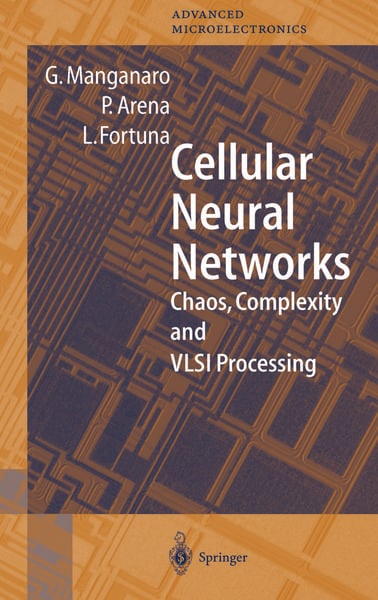
Cellular Neural Networks Chaos, Complexity and VLSI Processing

98,99 €

inkl. gesetzl. MwSt., Versandkostenfrei


Beschreibung

Produktdetails

Einband

Taschenbuch

Erscheinungsdatum

22.09.2011

Verlag

Springer Berlin

Seitenzahl

273

Maße (L/B/H)

23,5/15,5/1,6 cm

Gewicht

446 g

Auflage

Softcover reprint of the original 1st ed. 1999

Sprache

Englisch

ISBN

978-3-642-64232-6

Beschreibung

Rezension

From the reviews:


"The book is divided into eight chapters and each of them guides us through one area where the CNNs can be used … . I recommend the publication to everybody, who is interested in the CNN and its application and implementation, but also to those who face some of the technologies described there, such as nonlinear dynamics, synchronization, signal processing or motion control, because the CNN can show a quite novel and beneficial point of view." (Václav Dekanovský, Neural Network World, Vol. 15 (5), 2005)

Produktdetails

Einband

Taschenbuch

Erscheinungsdatum

22.09.2011

Verlag

Springer Berlin

Seitenzahl

273

Maße (L/B/H)

23,5/15,5/1,6 cm

Gewicht

446 g

Auflage

Softcover reprint of the original 1st ed. 1999

Sprache

Englisch

ISBN

978-3-642-64232-6

Herstelleradresse

Springer-Verlag KG
Sachsenplatz 4-6
1201 Wien
AT

Email: GPSR Kontakt

Noch keine Bewertungen vorhanden

Verfassen Sie die erste Bewertung zu diesem Artikel

Helfen Sie anderen Kundinnen und Kunden durch Ihre Meinung.

Kundinnen und Kunden meinen

Bewertungen (0)

  • Produktbild: Cellular Neural Networks
  • Produktbild: Cellular Neural Networks
  • I. Circuit Theory and Applications of CNNs.- 1. CNN Basics.- 1.1 The CNN of Chua and Yang.- 1.1.1 The Cell.- 1.1.2 The CNN Array.- 1.1.3 More About Templates.- 1.1.4 Multilayer CNNs.- 1.1.5 The CNN as an Analog Processor.- 1.1.6 Some Stability Results.- 1.2 Main Generalizations.- 1.2.1 Nonlinear CNNs and Delay CNNs.- 1.2.2 Nonuniform Processor CNNs and Multiple Neighborhood Size CNNs.- 1.2.3 Discrete-Time CNNs.- 1.2.4 The CNN Universal Machine.- 1.3 A Formal Definition.- 1.3.1 The Cells and Their Coupling.- 1.3.2 Boundary Conditions.- 1.4 Summary.- 2. Some Applications of CNNs.- 2.1 CNN-Based Image Pre-processing for the Automatic Classification of Fruits.- 2.1.1 The Pre-filtering.- 2.2 Processing of NMR Spectra.- 2.2.1 Two-Dimensional NMR Spectra.- 2.2.2 Processing of NMR Spectra with CNNs.- 2.2.3 Description of the Dual Algorithm.- 2.3 Air Quality Modeling.- 2.3.1 Models.- 2.3.2 CNNs for Air Quality Modeling.- 2.3.3 Examples.- 2.4 Conclusions.- 3. The CNN as a Generator of Nonlinear Dynamics.- 3.1 The State Controlled CNN Model.- 3.1.1 Discrete Components Realization of SC-CNN Cells.- 3.2 Chua Oscillator Dynamics Generated by the SC-CNN.- 3.2.1 Main Result.- 3.2.2 Experimental Results.- 3.3 Chaotic Dynamics of a Colpitts Oscillator.- 3.4 Hysteresis Hyperchaotic Oscillator.- 3.5 n-Double Scroll Attractors.- 3.5.1 A New Realization of the n-Double Scroll Family.- 3.5.2 n-Double Scrolls in SC-CNNs.- 3.6 Nonlinear Dynamics Potpourri.- 3.6.1 A Non-autonomous Second Order Chaotic Circuit.- 3.6.2 A Circuit with a Nonlinear Reactive Element.- 3.6.3 Canards and Chaos.- 3.6.4 Multimode Chaos in Coupled Oscillators.- 3.6.5 Coupled Circuits.- 3.7 General Case and Conclusions.- 3.7.1 Theoretical Implications.- 3.7.2 Practical Implications.- 4. Synchronization.- 4.1 Background.- 4.1.1 Pecora-Carroll Approach.- 4.1.2 Inverse System Approach.- 4.2 Experimental Signal Transmission Using Synchronized SC-CNN.- 4.2.1 Circuit Description.- 4.2.2 Synchronization: Results of Experiment and Simulation.- 4.2.3 Non-ideal Channel Effects.- 4.2.4 Effects of Additive Noise and Disturbances on the Channel.- 4.3 Chaotic System Identification.- 4.3.1 Description of the Algorithm.- 4.3.2 Identification of the Chua Oscillator.- 4.3.3 Examples.- 4.4 Summary and Conclusions.- 5. Spatio-temporal Phenomena.- 5.1 Analysis of the Cell.- 5.1.1 Fixed Points.- 5.1.2 Limit Cycle and Bifurcations.- 5.1.3 Slow-Fast Dynamics.- 5.1.4 Some Simulation Results.- 5.2 The Two-Layer CNN.- 5.3 Traveling Wavefronts.- 5.3.1 Autowaves.- 5.3.2 Labyrinths.- 5.4 Pattern Formation.- 5.4.1 Condition for the Existence of Turing Patterns in Arrays of Coupled Circuits.- 5.4.2 Turing Patterns in the Two-Layer CNN.- 5.4.3 Simulation Results.- 5.5 Sensitivity to Parametric Uncertainties and Noise.- 5.5.1 Spiral Wave: Parametric Uncertainty.- 5.5.2 Spiral Waves: Presence of Noise in the Initial Conditions.- 5.5.3 Patterns: Parametric Uncertainties.- 5.6 Summary and Conclusions.- 6. Experimental CNN Setup and Applications to Motion Control.- 6.1 The Experimental Setup.- 6.1.1 Realization of the Cell for Autowave Generation.- 6.1.2 Realization of the Cell for Pattern formation.- 6.1.3 Realization of the Laplacian Couplings and Boundary Conditions.- 6.1.4 Realization of the Main Board.- 6.1.5 Autowave Experiments.- 6.2 Pattern Formation and Propagation.- 6.3 CNNs for Generating and Controlling Artificial Locomotion.- 6.3.1 Links to Biological Locomotion.- 6.3.2 WORMBOT: A Ring-Worm-like Walking Robot.- 6.3.3 REXABOT: An Hexapode Reaction-Diffusion Walking Robot.- 6.3.4 READIBELT: Reaction Diffusion Conveyor Belt Autowave Driven.- 6.4 Conclusion.- II. Implementation and Design.- 7. A Four Quadrant S2I Switched-Current Multiplier.- 7.1 Detailed Analysis of the S2I Memory Cell.- 7.2 The Multiplier Architecture.- 7.3 Analysis and Design of the S2I Multiplier.- 7.3.1 Circuit Analysis of the Multiplier.- 7.3.2 Circuit Design.- 7.4 Experimental Performance Evaluation.- 7.5 Summary.- 8. A One-Dimensional Discrete-Time CNN Chip for Audio Signal Processing.- 8.1 System Architecture.- 8.2 The Tapped Delay Line.- 8.3 CNN Cells.- 8.3.1 Multiplier and Ancillary Circuitry.- 8.4 Cell Behavior and Hardware Multiplexing.- 8.5 Results and Example.- 8.6 Summary.- A. Mathematical Background.- A.1 Topology.- A.2 Operations and Functions.- A.3 Matrices.- A.4 Dimension.- A.5 Dynamical Systems: Basic Definitions.- A.6 Steady-State Behavior.- A.6.1 Classification of Asymptotic Behavior.- A.7 Stability.- A.7.1 Stability of equilibrium points.- A.7.2 Stability of Limit Cycles.- A.7.3 Lyapunov Exponents.- A.8 Topological Equivalence and Conjugacy, Structural Stability and Bifurcations.- A.9 Silnikov Method.- A.10 Particular Results for Two-Dimensional Flows.- B. Library of Templates.- References.