• Produktbild: Pattern Recognition in Chemistry
  • Produktbild: Pattern Recognition in Chemistry
Band 21

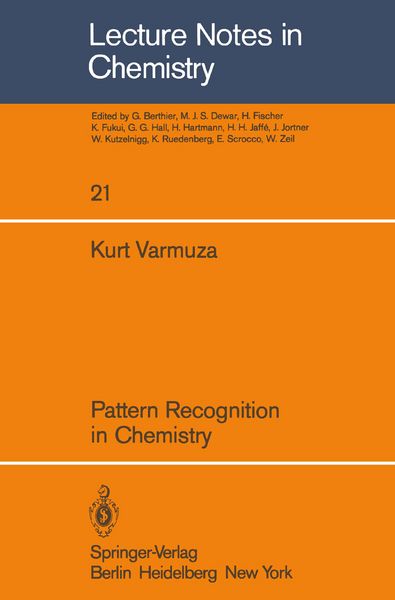
Pattern Recognition in Chemistry

49,99 €

inkl. gesetzl. MwSt., Versandkostenfrei


Beschreibung

Produktdetails

Einband

Taschenbuch

Erscheinungsdatum

01.11.1980

Verlag

Springer Berlin

Seitenzahl

222

Maße (L/B/H)

23,5/15,5/1,3 cm

Gewicht

365 g

Auflage

Softcover reprint of the original 1st ed. 1980

Sprache

Englisch

ISBN

978-3-540-10273-1

Beschreibung

Produktdetails

Einband

Taschenbuch

Erscheinungsdatum

01.11.1980

Verlag

Springer Berlin

Seitenzahl

222

Maße (L/B/H)

23,5/15,5/1,3 cm

Gewicht

365 g

Auflage

Softcover reprint of the original 1st ed. 1980

Sprache

Englisch

ISBN

978-3-540-10273-1

Herstelleradresse

Springer-Verlag KG
Sachsenplatz 4-6
1201 Wien
AT

Email: GPSR Kontakt

Noch keine Bewertungen vorhanden

Verfassen Sie die erste Bewertung zu diesem Artikel

Helfen Sie anderen Kundinnen und Kunden durch Ihre Meinung.

Kundinnen und Kunden meinen

Bewertungen (0)

  • Produktbild: Pattern Recognition in Chemistry
  • Produktbild: Pattern Recognition in Chemistry
  • A: Introduction to Some Pattern Recognition Methods.- 1. Basic Concepts.- 1.1. First Ideas of Pattern Recognition.- 1.2. Pattern Space.- 1.3. Binary Classifiers.- 1.4. Training and Evaluation of Classifiers.- 1.5. Additional Aspects.- 1.6. Warning.- 1.7. Applications of Pattern Recognition.- 1.8. Literature.- 1.8.1. General Pattern Recognition.- 1.8.2. Pattern Recognition from the Chemist’s Point of View.- 2. Computation of Binary Classifiers.- 2.1. Classification by Distance Measurements to Centres of Gravity.- 2.1.1. Principle.- 2.1.2. Centres of Gravity in a d-DimensionaI Space.- 2.1.3. Classification by Distance Measurements.- 2.1.4. Classification by the Symmetry Plane.- 2.1.5. Classification by Mean Vectors.- 2.1.6. Evaluation.- 2.1.7. Projection of Pattern Points on a Hypersphere.- 2.1.8. Distance Measurements in Pattern Space (Overview),.- 2.1.9. Distance Measurements with Weighted Features (Generalized Distances).- 2.1.10. Chemical Applications.- 2.2. Learning Machine.- 2.2.1. Principle.- 2.2.2. Initial Weight Vector.- 2.2.3. Correction of the Weight Vector.- 2.2.4. Methods of Training.- 2.2.5. Restrictions.- 2.2.6. Evaluation.- 2.2.7. Dead Zone Training.- 2.2.8. Chemical Applications.- 2.3. Linear Regression (Least-Squares Classification).- 2.3.1. Principle.- 2.3.2. Mathematical Treatment.- 2.3.3. Characteristics and Variations of the Method.- 2.3.4. Chemical Applications.- 2.4. Simplex Optimization of Classifiers.- 2.4.1. Principle.- 2.4.2. Starting the Simplex.- 2.4.3. Response Function.- 2.4.4. Moving the Simplex.- 2.4.5. Halting the Simplex.- 2.4.6. Chemical Applications.- 2.5. Piecewise-Linear Classifiers.- 2.6. Implementation of Binary Classifiers.- 2.6.1. Discrete or Continuous Response.- 2.6.2. Classification by a Committee of Classifiers.- 2.6.3. MuIticategory Classification.- 3. K — Nearest Neighbour Classification (KNN-Method).- 3.1. Principle.- 3.2. Maximum Risk of KNN-Classifications.- 3.3. Characteristics and Variations of the KNN-Method.- 3.4. Classification with Potential Functions.- 3.5. KNN-Classification with a Condensed Data Set.- 3.6. Chemical Applications.- 4. Classification by Adaptive Networks.- 4.1. Perceptron.- 4.2. Adaptive Digital Learning Network.- 4.3. Chemical Applications.- 5. Parametric Classification Methods.- 5.1. Principle.- 5.2. Bayes- and Maximum Likelihood Classifiers.- 5.3. Estimation of Probability Densities.- 5.4. Bayes- and Maximum Likelihood Classifiers for Binary Encoded Patterns.- 5.5. A Simple Sequential Classification Method Based on Probability Densities.- 5.6. Chemical Applications.- 6. Modelling of Clusters.- 6.1. Principle.- 6.2. Modelling by a Hypersphere.- 6.3. SIMCA-Method.- 7. Clustering Methods.- 7.1. Principle.- 7.2. Hierarchical Clustering.- 7.3. Minimal Spanning Tree Clustering.- 7.4. Chemical Applications.- 8. Display Methods.- 8.1. Principle.- 8.2. Linear Methods.- 8.3. Nonlinear Methods.- 8.4. Chemical Applications.- 9. Preprocessing.- 9.1. Principle.- 9.2. Scaling.- 9.3. Weighting.- 9.4. Transformation.- 9.5. Combination of Features.- 10. Feature Selection.- 10.1. Principle.- 10.2. Feature Selection by Using Data Statistics.- 10.2.1. Variance Weighting.- 10.2.2. Fisher Weighting.- 10.2.3. Use of Probability Density Curves.- 10.2.4. Methods for Binary Encoded Patterns.- 10.2.5. Elimination of Correlations.- 10.3. Feature Selection by Using Classification Results.- 10.3.1. Evaluation of the Components of a Single Weight Vector.- 10.3.2. Feature Selection with the Learning Machine.- 10.3.3. Other Methods.- 10.4. Number of Intrinsic Dimensions and Number of Patterns (n/d — Problem).- 11. Evaluation of Classifiers.- 11.1. Principle.- 11.2. Predictive Abilities.- 11.3. Loss.- 11.4. A posteriori Probabilities.- 11.5. Terminology Problems.- 11.6. Application of Information Theory.- 11.6.1. Introduction to Information Theory.- 11.6.2. Transinformation.- 11.6.3. Figure of Merit.- 11.7. Evaluation of Classifiers with Continuous Response.- 11.8. Confidence of Predictive Abilities.- 11.9. Comparison with the Capability of Chemists.- B: Application of Pattern Recognition Methods in Chemistry.- 12. General Aspects of Pattern Recognition in Chemistry.- 13. Spectral Analysis.- 13.1. Mass Spectrometry.- 13.1.1. Survey.- 13.1.2. Representation of Mass Spectra as Pattern Vectors.- 13.1.3. Determination of Molecular Formulas and Molecular Weights.- 13.1.4. Recognition of Molecular Structures.- 13.1.5. Chemical Interpretation of Mass Spectral Classifiers.- 13.1.6. Simulation of Mass Spectra.- 13.1.7. Miscellaneous.- 13.2. Infrared Spectroscopy.- 13.3. Raman Spectroscopy.- 13.4. Nuclear Magnetic Resonance Spectroscopy.- 13.5. Gamma-Ray Spectroscopy.- 13.6. Combined Spectral Data.- 14. Chromatography.- 14.1. Gas Chromatography.- 14.2. Thin Layer Chromatography.- 15. Electrochemistry.- 16. Classification of Materials and Chemical Compounds.- 16.1. Technology.- 16.2. Archaeology.- 16.3. Food.- 16.4. Biology.- 16.5. Chemistry.- 17. Relationships between Chemical Structure and Biological Activity.- 17.1. Pharmacological Activity.- 17.1.1. General Remarks.- 17.1.2. Sedatives and Tranquilizers.- 17.1.3. Cancer and Tumors.- 17.1.4. Miscellaneous.- 17.2. Odour Classification.- 17.3. Spectra — Activity Relationships.- 18. Clinical Chemistry.- 19. Environmental Chemistry.- 19.1. Petroleum Pollutants.- 19.2. Atmospheric Particulates.- 19.3. Miscellaneous.- 20. Classification of Analytical Methods.- C: Append.- 21. Literature.- 21.1. Pattern Recognition in Chemistry.- 21.2. General Pattern Recognition.- 21.3. Other Literature.- 21.4. List of Authors.- 22. Subject Index.