• Produktbild: Cerebral Ischemia and Dementia
  • Produktbild: Cerebral Ischemia and Dementia
- 10%

Cerebral Ischemia and Dementia

10% sparen

143,99 € UVP 160,49 €

inkl. gesetzl. MwSt., Versandkostenfrei


Beschreibung

Produktdetails

Einband

Taschenbuch

Erscheinungsdatum

06.03.2012

Herausgeber

Alexander Hartmann + weitere

Verlag

Springer Berlin

Seitenzahl

472

Maße (L/B/H)

24,2/17/2,7 cm

Gewicht

834 g

Auflage

Softcover reprint of the original 1st ed. 1991

Sprache

Englisch

ISBN

978-3-642-76210-9

Beschreibung

Portrait

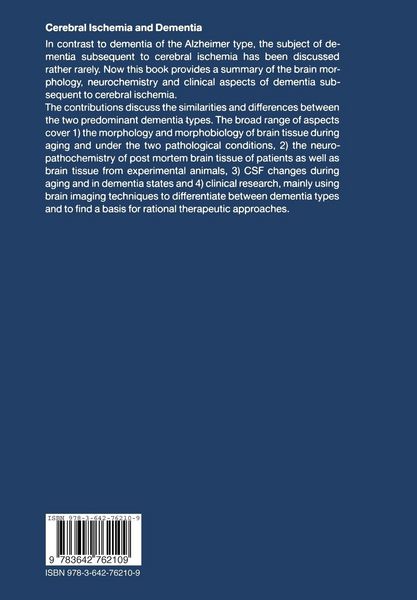
All aspects of dementia after cerebral ischemia are discussed in this book in detail, in contrast to other sources which usually only discuss general aspects.

Produktdetails

Einband

Taschenbuch

Erscheinungsdatum

06.03.2012

Herausgeber

Verlag

Springer Berlin

Seitenzahl

472

Maße (L/B/H)

24,2/17/2,7 cm

Gewicht

834 g

Auflage

Softcover reprint of the original 1st ed. 1991

Sprache

Englisch

ISBN

978-3-642-76210-9

Herstelleradresse

Springer-Verlag KG
Sachsenplatz 4-6
1201 Wien
AT

Email: GPSR Kontakt

Noch keine Bewertungen vorhanden

Verfassen Sie die erste Bewertung zu diesem Artikel

Helfen Sie anderen Kundinnen und Kunden durch Ihre Meinung.

Kundinnen und Kunden meinen

Bewertungen (0)

  • Produktbild: Cerebral Ischemia and Dementia
  • Produktbild: Cerebral Ischemia and Dementia
  • How Does Cerebrovascular Disease Cause Dementia?.- Epidemiology.- The Epidemiology of Vascular Dementia.- Epidemiology of Vascular Dementia and Stroke in Akita, Japan.- Dementia in Stroke Survivors.- Pathology.- The Anatomical Substrate of Ischemic Vascular Dementia.- Vascular Dementia: The Search for a Correlate.- Incomplete Infarction Is an Important Component in Cerebrovascular Dementia.- Risk Factors.- Molecular Biology of Atherothrombotic Brain Infarction and Its Role in Vascular Dementia.- Cellular Aspects of Atherosclerosis and Approaches to Intervention: A Mechanism to Reduce Stroke and Vascular Dementia Risk.- Inhibition of Atherogenesis In Vivo and In Vitro.- Biochemistry and Pharmacology.- Alzheimer’s Disease: Role of Energy Metabolism and Treatment of Symptoms.- Neurochemical Changes in Brains from Patients with Vascular Dementia.- Subcortical Changes Following Ischaemic and Other Lesions of Cerebral Cortical Structures: Trophic Mechanisms and Neuronal Degeneration.- Experimental.- Selective Vulnerability of the CA1 Sector in the Gerbil After 5 Minutes of Global Ischemia: Relationship to Disturbances in Protein Synthesis and to Motor Hyperactivity.- Energy Metabolism in Cortex and Hippocampus During Aging, Ischemia, and Dementia.- Mechanisms of Glial Swelling from Lactacidosis and High K+-Levels in the Extracellular Compartment.- Potential Mechanisms Underlying Protection Against Cerebral Ischemia by Spontaneous Locomotion in Mongolian Gerbils.- Glutamate: A Role in Both Cerebral Ischaemia and Dementia of the Alzheimer Type.- Sabeluzole Enhances Spontaneous EEG Activity and SSEP, and Accelerates Their Posthypoxic Recovery in Rat.- Experimental.- Linkage Analysis in Italian Pedigrees with Autosomal Dominant Familial Alzheimer’s Disease.- RBC Aggregation Is Not a Primary Factor for Microvascular Stasis on Temporary Complete Ischemia of the Feline Brain.- White Blood Cell Behavior in the Cerebral Microcirculation.- Improved Learning with N-Methyl-D-aspartate Receptor Antagonist After Global Cerebral Ischemia.- Electrophysiological Markers of the Early Stages of Alzheimer’s Disease.- Diagnostics.- Neuropsychology.- Neuropsychological Assessment of Demented Patients.- Multiinfarct and Microinfarct Dementia.- Acute Aphasia.- Computerized Tomography, Magnetic Resonance Tomography.- Cerebral Hemodynamics in Patients with Periventricular White-Matter Lesions on Brain Imaging.- The Relation of Stroke to Leukoaraiosis.- Computed Tomographic Evaluation of the Cervical Carotid Artery.- Magnetic Resonance Imaging and Spectroscopy: A Unique Approach to Ischemic Cerebrovascular Disease.- Imaging Techniques and Neuropsychological Testing in Dementia with Severe White Matter Changes.- Stable Xenon Computerized Tomography.- Cerebral Ischemia Correlates Better with Cognitive Impairments in Mild to Moderate Multi-Infarct Dementia than Infarcted Brain Volume.- Regional Cerebral Blood Flow in Binswanger’s Disease.- Xenon 133-Cerebrography and SPECT.- Cognitive Utilization of Cerebral Vasomotor Reserve in Cerebrovascular Disease.- Tomographic Measurements of Regional Cerebral Blood Flow by SPECT in Vascular Dementia.- Contribution of HM-PAO-SPECT and 133Xe-rCBF to the Differential Diagnosis of Dementia as Experienced in Clinical Practice.- Intracerebral Reserve Assessment with SPECT: Reactivity to Acetazolamide and Cerebral Blood Volume Measurement.- SPÉCT Brain Imaging in Chronic Stroke and Dementia: A Comparison of 99mTc-ECD and 99mTc-HMPAO.- CSF ?1-Antichymotrypsin and Antitrypsin in Multi-Infarct Dementia and Alzheimer’s Disease.- Positron Emission Tomography.- Functional Recovery After Cerebral Ischemia: Studies in the Motor System.- Detection of Structural and Metabolic Changes of the Brain in Normal Aging and Dementia with Modern Imaging Techniques.- Subcortical Lesions and Dementia: The Role of Positron Emission Tomography.- PET Metabolic and Neuropsychological Correlates of Periventricular Lucencies.- Clinical Presentation.- Accuracy of the Antemortem Diagnosis and Neuropathological Features of Multi-Infarct Dementia.- Development and Evaluation of the Maudsley Mentation Scale for Bedside Measurement of Fluctuations in Cognitive Function in Patients with Acute Vascular Lesions: Comparison with the Glasgow Coma Scale.- Acute Confusional States After Stroke: Occurrence, Determinants, and Neuroendocrine Correlates.- The Prognosis of Stroke in the Elderly.- Thalamic Dementia and Pseudodementia.- Therapy.- Positron Emission Tomography in Cerebrovascular Disease: Implications for Therapy?.- A Clinical Trial of Pentoxifylline in Vascular Dementia.- Rheological Therapy of Vascular Dementia: A Rational Basis?.- Monosialoganglioside in Subarachnoid Hemorrhage.- GM1 Ganglioside Therapy in Acute Ischemic Stroke.- Communicating Hydrocephalus — Diagnosis and Management.- Assessment of CSF Volume in Normal Subjects and Patients with Dementia Due to Normal Pressure Hydrocephalus.