• Produktbild: In-Patient Treatment for Alcoholism
  • Produktbild: In-Patient Treatment for Alcoholism

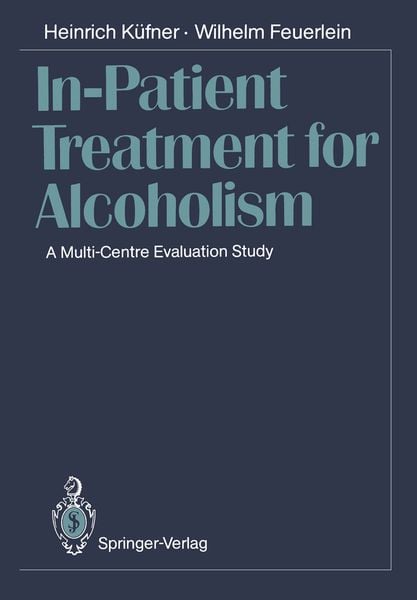
In-Patient Treatment for Alcoholism A Multi-Centre Evaluation Study

97,99 €

inkl. gesetzl. MwSt., Versandkostenfrei


Beschreibung

Produktdetails

Einband

Taschenbuch

Erscheinungsdatum

16.12.2011

Verlag

Springer Berlin

Seitenzahl

381

Maße (L/B/H)

24,2/17/2,2 cm

Gewicht

681 g

Auflage

Softcover reprint of the original 1st ed. 1989

Übersetzt von

F.K.H. Wagstaff

Sprache

Englisch

ISBN

978-3-642-74390-0

Beschreibung

Produktdetails

Einband

Taschenbuch

Erscheinungsdatum

16.12.2011

Verlag

Springer Berlin

Seitenzahl

381

Maße (L/B/H)

24,2/17/2,2 cm

Gewicht

681 g

Auflage

Softcover reprint of the original 1st ed. 1989

Übersetzt von

F.K.H. Wagstaff

Sprache

Englisch

ISBN

978-3-642-74390-0

Herstelleradresse

Springer-Verlag KG
Sachsenplatz 4-6
1201 Wien
AT

Email: ProductSafety@springernature.com

Kundinnen und Kunden meinen

0 Bewertungen

Informationen zu Bewertungen

Zur Abgabe einer Bewertung ist eine Anmeldung im Konto notwendig. Die Authentizität der Bewertungen wird von uns nicht überprüft. Wir behalten uns vor, Bewertungstexte, die unseren Richtlinien widersprechen, entsprechend zu kürzen oder zu löschen.

Die Bewertungen sind nach Format, Anzahl Sterne und Datum sortiert.

Verfassen Sie die erste Bewertung zu diesem Artikel

Helfen Sie anderen Kund*innen durch Ihre Meinung

Kundinnen und Kunden meinen

0 Bewertungen filtern

  • Produktbild: In-Patient Treatment for Alcoholism
  • Produktbild: In-Patient Treatment for Alcoholism
  • 1 Introduction.- 1.1 Aim of the Study.- 1.2 Review of the Literature.- 2 Method.- 2.1 Basic Model.- 2.2 Structure of the Study.- 2.2.1 Design.- 2.2.2 Selection of Treatment Centres.- 2.2.3 Description of Treatment Centres.- 2.3 Selection of Patients.- 2.4 Patient Variables.- 2.4.1 Sociodemographic Data.- 2.4.2 Social Behaviour.- 2.4.3 Life Events and Stress.- 2.4.4 Drinking Behaviour and Patients’ Attitudes to It.- 2.4.5 Complaints and Alcohol-Related Illnesses.- 2.4.6 Personality Traits.- 2.4.7 Attitudes to Treatment.- 2.4.8 Experiences of Therapy.- 2.5 Assessing the Outcome of Treatment.- 2.5.1 Drinking Behaviour and Use of Other Addictive Substances.- 2.5.2 Physical Health.- 2.5.3 Social Integration.- 2.5.4 Personality.- 2.6 Study Procedure.- 2.6.1 Data Recorded at Admission and Discharge.- 2.6.2 Data Recorded at 6- and 18-Month Follow-Up.- 2.7 Data Protection.- 2.8 Data Evaluation.- 3 Treatment Centres.- 3.1 Description.- 3.1.1 Size.- 3.1.2 Staffing.- 3.1.3 Admission Criteria.- 3.1.4 Goals of Treatment.- 3.1.5 General Description of Treatment.- 3.1.6 Particular Aspects of Therapy.- 3.2 Factors in the Therapeutic Atmosphere.- 3.2.1 Introduction.- 3.2.2 Method.- 3.2.3 Reliability of K-SEKT.- 3.2.4 Importance of Factors in the Therapeutic Atmosphere (K-SEKT-A).- 3.2.5 Implementation of Factors in the Therapeutic Atmosphere (K-SEKT-B).- 3.2.6 Comparison of K-SEKT-A and K-SEKT-B.- 3.3 Summary.- 4 Admission Data.- 4.1 Data Collection.- 4.2 Sociodemographic Data.- 4.3 Use of Addictive Substances.- 4.3.1 Drinking Behaviour.- 4.3.2 Medicaments and Drugs.- 4.4 Personality and Social Behaviour.- 4.4.1 Personality: Freiburg Personality Inventory.- 4.4.2 Social Behaviour: Self-Assertiveness Questionnaire.- 4.4.3 Psychosocial Problems.- 4.5 Physical Condition.- 4.6 Previous Treatment for Alcoholism.- 4.7 Attitudes to Treatment (EZB).- 4.8 Life Events (LEL).- 4.9 Summary.- 5 Discharge Data.- 5.1 Data Collection.- 5.2 Sociodemographic Data.- 5.3 Behaviour and Symptoms During Treatment.- 5.3.1 Drop-Outs.- 5.3.2 Relapses.- 5.3.3 Changes in Patients’ Attitudes to Their Drinking Behaviour.- 5.3.4 Secondary Psychiatric Diagnoses and Other Symptoms.- 5.3.5 Participation of Patients and Significant Persons in Treatment.- 5.3.6 Clinical Prognosis.- 5.4 Personality Changes.- 5.4.1 Freiburg Personality Inventory.- 5.4.2 Self-Assertiveness Questionnaire.- 5.4.3 Interpretation.- 5.5 Summary.- 6 Six-Month Follow-Up.- 6.1 Data Collection.- 6.2 Sociodemographic Data.- 6.3 Use of Addictive Substances.- 6.3.1 Alcohol.- 6.3.2 Medicaments.- 6.3.3 Smoking.- 6.3.4 Interpretation and Conclusions.- 6.4 Personality Changes.- 6.4.1 Freiburg Personality Inventory.- 6.4.2 Self-Assertiveness Questionnaire.- 6.5 Physical Condition.- 6.6 Life Events.- 6.7 Treatment During the First 6 Months After Discharge.- 6.7.1 Psychotherapy.- 6.7.2 In-Patient Treatment.- 6.7.3 Interpretation and Conclusions.- 6.8 Comparison of Some Outcome Criteria.- 6.9 Summary.- 7 Eighteen-Month Follow-Up.- 7.1 Data Collection.- 7.2 Sociodemographic Data.- 7.3 Use of Addictive Substances.- 7.3.1 Alcohol.- 7.3.2 Other Addictive Substances.- 7.3.3 Diagnoses of Secondary Abuse of or Dependence on Medicaments or Drugs.- 7.4 Personality and Social Behaviour.- 7.4.1 Freiburg Personality Inventory.- 7.4.2 Selected Complaints.- 7.4.3 Self-Assertiveness Questionnaire.- 7.5 Physical Condition and Complaints.- 7.6 Life Events.- 7.7 Treatment During the Follow-Up Period.- 7.7.1 Self-Help Groups and Out-Patient Treatment.- 7.7.2 In-Patient Treatment.- 7.8 Comparison of Different Outcome Criteria.- 7.9 Summary.- 8 Data from Health and Pension Insurance Institutions.- 8.1 Health Insurance Companies.- 8.1.1 Data Collection.- 8.1.2 Method.- 8.1.3 Results.- 8.2 Pension Insurance Institutions.- 8.2.1 Data Collection.- 8.2.2 Results.- 8.3 Summary.- 8.3.1 Health Insurance Companies.- 8.3.2 Pension Insurance Institutions.- 9 Reliability and Validity of Data.- 9.1 Heterogeneity of Data.- 9.2 Results.- 9.2.1 Comparison of Interviews with Written Follow-Up.- 9.2.2 Comparison of Data at 6-Month and 18-Month Follow-Up.- 9.2.3 Comparison with Data given by Significant Others.- 9.2.4 Comparison with Data from the Health Insurance Companies.- 9.2.5 Comparison of a Patient Sample with a High Refusal Rate and the Anonymous, Unselected Sample.- 9.2.6 Factors in the Patient Group Without 18-Month Follow-Up Data.- 9.3 Summary.- 10 Changes Over the Course of the Study.- 10.1 Alcohol Abstinence.- 10.2 Marital Status, Living Arrangements and Work.- 10.2.1 Marital Status and Living Arrangements.- 10.2.2 Work and Retirement.- 10.3 Changes In and Interactions Between Outcome Criteria.- 10.3.1 Introduction.- 10.3.2 Unemployment and Abstinence.- 10.3.3 Other Outcome Criteria and Abstinence.- 10.4 Changes in Personality and Social Behaviour.- 10.4.1 Freiburg Personality Inventory.- 10.4.2 Self-Assertiveness Questionnaire.- 10.5 Drop-Outs from Treatment, Length of Treatment and Outcome.- 10.6 Summary.- 11 Patients’ Attitudes to and Experiences of Treatment.- 11.1 Attitudes to Treatment (EZB).- 11.1.1 Theoretical Background.- 11.1.2 Results.- 11.2 Patients’ Experiences of Therapy (TEL).- 11.2.1 Theoretical Background.- 11.2.2 Comparison of Treatment Experiences at Discharge and 6-Month Follow-Up.- 11.2.3 Univariate Item Selection.- 11.2.4 Multivariate Item Selection.- 11.2.5 TEL Scales and Outcome Criteria.- 11.3 Correlation Between EZB and TEL.- 11.4 Summary.- 12 Patient Variables as Prognostic Factors.- 12.1 Introduction.- 12.1.1 Selection of Criteria for Prognosis.- 12.1.2 Time and Range of Prognosis.- 12.1.3 Selection of Variables on Which to Base a Prognosis.- 12.1.4 General and Special (Treatment-Related) Prognostic Factors.- 12.1.5 Reliability and Validity of Prognostic Factors.- 12.1.6 Single Variables vs. Combinations as Prognostic Factors.- 12.2 Method.- 12.2.1 Procedure.- 12.2.2 Selection Criterion.- 12.3 Prognostic Factors for Drinking Behaviour.- 12.3.1 Admission Data.- 12.3.2 Discharge Data.- 12.4 Prognostic Factors for Other Outcome Criteria.- 12.4.1 Prognosis Index and Other Outcome Criteria.- 12.4.2 Clinical Prognosis vs. Statistical Prognosis.- 12.4.3 Time When the Prognosis Is Made.- 12.5 Analysis of Variables and Constructs of Special Clinical Relevance.- 12.5.1 Age.- 12.5.2 Severity of Alcoholism.- 12.5.3 Previous Treatment in an Addiction Unit.- 12.6 Prognostic Significance of Dropping Out.- 12.6.1 Reasons for Dropping Out Related to Abstinence.- 12.6.2 Time in Treatment Before Dropping Out.- 12.6.3 Factors Predictive of Dropping Out.- 12.7 Summary.- 13 Treatment Variables.- 13.1 Introduction.- 13.2 Grouping of Treatment Variables and Treatment Centres.- 13.2.1 Factor Analysis.- 13.2.2 Cluster Analysis.- 13.3 Treatment Variables and Outcome.- 13.3.1 Method.- 13.3.2 Treatment Effects of Index Treatment.- 13.4 Effect of the Length of Treatment.- 13.4.1 Starting Point and Procedure.- 13.4.2 Approach 1: Matching.- 13.4.3 Approach 2: Logit Analysis.- 13.4.4 Approach 3: Analysis of the Centres.- 13.4.5 Other Outcome Criteria.- 13.4.6 Intercorrelation Between Length and Other Features of Treatment.- 13.4.7 Interpretation and Conclusions.- 13.5 Effects of After-Care in the Follow-Up Period.- 13.5.1 Influence of Self-Help Groups.- 13.5.2 Attendance at Self-Help Groups and Index Treatment Variables.- 13.6 Summary.- 14 Indication.- 14.1 Introduction.- 14.2 Indication for Length of Treatment.- 14.3 Method.- 14.3.1 Preliminary Assessments.- 14.3.2 Final Procedure.- 14.4 Results for Men.- 14.4.1 Poor Prognosis Group.- 14.4.2 Moderate Prognosis Group.- 14.4.3 Good Prognosis Group.- 14.5 Indication Model for Men.- 14.5.1 Poor Prognosis Group.- 14.5.2 Moderate Prognosis Group.- 14.5.3 Good Prognosis Group.- 14.5.4 Summary of Optimization of Abstinence in Men.- 14.6 Results for Women.- 14.6.1 Negative Prognosis Group.- 14.6.2 Positive Prognosis Group.- 14.7 Indication Model for Women.- 14.7.1 Negative Prognosis Group.- 14.7.2 Positive Prognosis Group.- 14.7.3 Summary of Optimization of Abstinence in Women.- 14.8 Prognosis and Indication.- 14.9 Summary.- 14.9.1 Results for Men.- 14.9.2 Results for Women.- 15 Other Factors Influencing Outcome.- 15.1 Influence Factors in After-Care and After-Treatment.- 15.1.1 Self-Help Groups and Treatment Outcome.- 15.1.2 Out-Patient Psychotherapy and Treatment Outcome.- 15.2 Influence Factors in the Social Environment.- 15.3 Network of Influence Factors and Treatment Outcome.- 15.4 Summary.- 16 Discussion.- 16.1 Methodology.- 16.1.1 Type of Study.- 16.1.2 Reliability and Validity of Data.- 16.1.3 Evaluation Procedure.- 16.2 Results of the Individual Data Collections.- 16.2.1 Description of Treatment.- 16.2.2 Description of the Patient Sample.- 16.2.3 Discharge.- 16.2.4 Follow-Up at 6 and 18 Months.- 16.3 Patients’ Attitudes to and Experiences of Treatment.- 16.3.1 Attitudes to Treatment (EZB).- 16.3.2 Experiences of Treatment (TEL).- 16.4 Prognosis.- 16.4.1 Methodological Problems.- 16.4.2 Individual Prognostic Factors.- 16.4.3 Prognosis of Particular Subgroups.- 16.5 Treatment Variables.- 16.5.1 Reduction of the Number of Treatment Variables.- 16.5.2 Discussion of Methods and General Comments.- 16.5.3 Individual Treatment Variables.- 16.5.4 Length of Treatment.- 16.6 Indication.- 16.7 Influence Factors After Index Treatment.- References.- Appendices.