
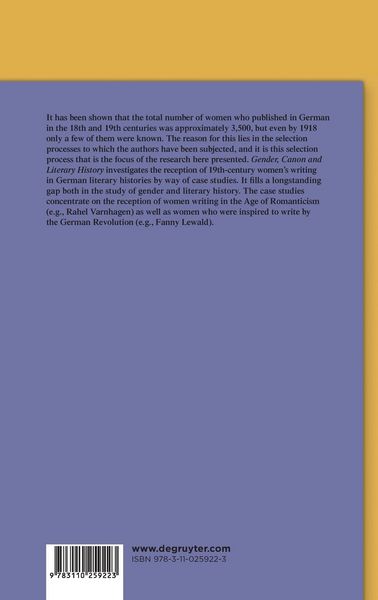
Gender, Canon and Literary History The Changing Place of Nineteenth-Century German Women Writers (1835-1918)
136,99 €
inkl. gesetzl. MwSt.,
Beschreibung
Produktdetails
Einband
Gebundene Ausgabe
Erscheinungsdatum
19.08.2013
Verlag
De GruyterSeitenzahl
204
Maße (L/B/H)
23,6/16/1,7 cm
Gewicht
431 g
Auflage
1
Sprache
Englisch
ISBN
978-3-11-025922-3
It has been shown that the total number of women who published in German in the 18th and 19th centuries was approximately 3,500, but even by 1918 only a few of them were known. The reason for this lies in the selection processes to which the authors have been subjected, and it is this selection process that is the focus of the research here presented.
The selection criteria have not simply been gender-based but have had much to do with the urgent quest for establishing a German Nation State in 1848 and beyond. Prutz, Gottschall, Kreyßig and others found it necessary to use literary historiography, which had been established by 1835, in order to construct an ideal of ‘Germanness’ at a time when a political unity remained absent, and they wove women writers into this plot. After unification in 1872, this kind of weaving seemed to have become less pressing, and other discourses came to the fore, especially those revolving round femininity vs. masculinity, and races.
The study of the processes at work here will enhance current debates about the literary canon by tracing its evolution and identifying the factors which came to determine the visibility or obscurity of particular authors and texts. The focus will be on a number of case studies, but, instead of isolating questions of gender, Gender, Canon and Literary History will discuss the broader cultural context.
Kundinnen und Kunden meinen
Verfassen Sie die erste Bewertung zu diesem Artikel
Helfen Sie anderen Kund*innen durch Ihre Meinung
Kurze Frage zu unserer Seite
Vielen Dank für Ihr Feedback
Wir nutzen Ihr Feedback, um unsere Produktseiten zu verbessern. Bitte haben Sie Verständnis, dass wir Ihnen keine Rückmeldung geben können. Falls Sie Kontakt mit uns aufnehmen möchten, können Sie sich aber gerne an unseren Kund*innenservice wenden.
zum Kundenservice