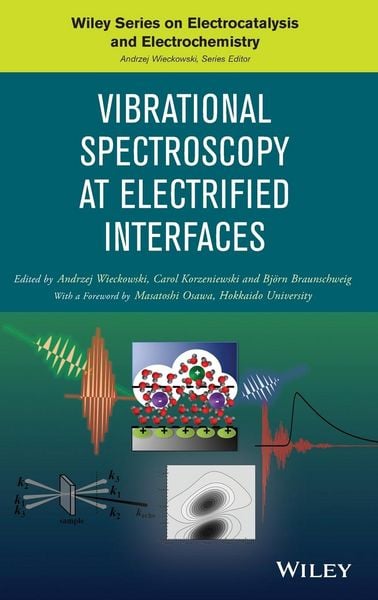
Vibrational Spectroscopy at Electrified Interfaces
199,99 €
inkl. gesetzl. MwSt.,
Beschreibung
Produktdetails
Einband
Gebundene Ausgabe
Erscheinungsdatum
30.08.2013
Verlag
John Wiley & SonsSeitenzahl
440
Maße (L/B/H)
24/16,1/2,8 cm
Gewicht
824 g
Sprache
Englisch
ISBN
978-1-118-15717-6
Reviews the latest theory, techniques, and applications
Surface vibrational spectroscopy techniques probe the structure and composition of interfaces at the molecular level. Their versatility, coupled with their non-destructive nature, enables in-situ measurements of operating devices and the monitoring of interface-controlled processes under reactive conditions.
Vibrational Spectroscopy at Electrified Interfaces explores new and emerging applications of Raman, infrared, and non-linear optical spectroscopy for the study of charged interfaces. The book draws from hundreds of findings reported in the literature over the past decade. It features an internationally respected team of authors and editors, all experts in the field of vibrational spectroscopy at surfaces and interfaces. Content is divided into three parts:
- Part One, Nonlinear Vibrational Spectroscopy, explores properties of interfacial water, ions, and biomolecules at charged dielectric, metal oxide, and electronically conductive metal catalyst surfaces. In addition to offering plenty of practical examples, the chapters present the latest measurement and instrumental techniques.
- Part Two, Raman Spectroscopy, sets forth highly sensitive approaches for the detection of biomolecules at solid-liquid interfaces as well as the use of photon depolarization strategies to elucidate molecular orientation at surfaces.
- Part Three, IRRAS Spectroscopy (including PM-IRRAS), reports on wide-ranging systems?from small fuel molecules at well-defined surfaces to macromolecular complexes?that serve as the building blocks for functional interfaces in devices designed for chemical sensing and electric power generation.
The Wiley Series on Electrocatalysis and Electrochemistry is dedicated to reviewing important advances in the field, exploring how these advances affect industry. The series defines what we currently know and can do with our knowledge of electrocatalysis and electrochemistry as well as forecasts where we can expect the field to be in the future.
Noch keine Bewertungen vorhanden
Verfassen Sie die erste Bewertung zu diesem Artikel
Helfen Sie anderen Kundinnen und Kunden durch Ihre Meinung.
Kurze Frage zu unserer Seite
Vielen Dank für Ihr Feedback
Wir nutzen Ihr Feedback, um unsere Produktseiten zu verbessern. Bitte haben Sie Verständnis, dass wir Ihnen keine Rückmeldung geben können. Falls Sie Kontakt mit uns aufnehmen möchten, können Sie sich aber gerne an unseren Kund*innenservice wenden.
zum Kundenservice