• Produktbild: The Competitive Advantage of Emerging Market Multinationals
  • Produktbild: The Competitive Advantage of Emerging Market Multinationals

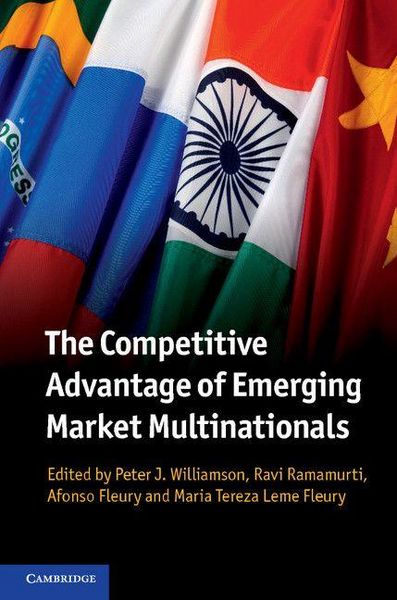
The Competitive Advantage of Emerging Market Multinationals

66,99 €

inkl. gesetzl. MwSt., Versandkostenfrei


Beschreibung

Produktdetails

Einband

Taschenbuch

Erscheinungsdatum

04.04.2013

Herausgeber

Williamson Peter J. + weitere

Verlag

Cambridge Academic

Seitenzahl

376

Maße (L/B/H)

22,9/15,2/2 cm

Gewicht

600 g

Sprache

Englisch

ISBN

978-1-107-65941-4

Beschreibung

Zitat

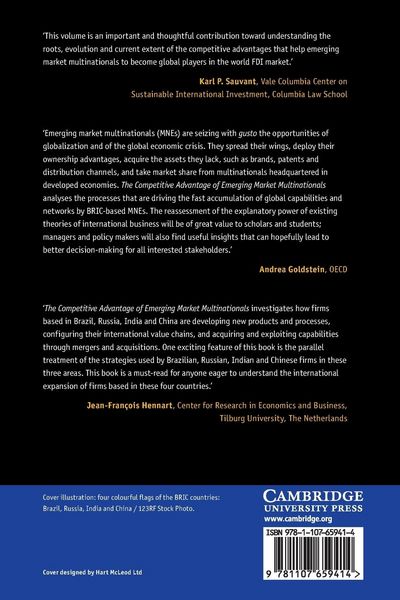
Advance praise: 'This volume is an important and thoughtful contribution toward understanding the roots, evolution and current extent of the competitive advantages that help emerging market multinationals to become global players in the world FDI market.' Karl P. Sauvant, Vale Columbia Center on Sustainable International Investment, Columbia Law School Advance praise: 'Emerging market multinationals (MNEs) are seizing with gusto the opportunities of globalization and of the global economic crisis. They spread their wings, deploy their ownership advantages, acquire the assets they lack, such as brands, patents and distribution channels, and take market share from multinationals headquartered in developed economies. The Competitive Advantage of Emerging Market Multinationals analyses the processes that are driving the fast accumulation of global capabilities and networks by BRIC-based MNEs. The reassessment of the explanatory power of existing theories of international business will be of great value to scholars and students; managers and policy makers will also find useful insights that can hopefully lead to better decision-making for all interested stakeholders.' Andrea Goldstein, OECD Advance praise: 'The Competitive Advantage of Emerging Market Multinationals investigates how firms based in Brazil, Russia, India and China are developing new products and processes, configuring their international value chains, and acquiring and exploiting capabilities through mergers and acquisitions. One exciting feature of this book is the parallel treatment of the strategies used by Brazilian, Russian, Indian and Chinese firms in these three areas. This book is a must-read for anyone eager to understand the international expansion of firms based in these four countries.' Jean-Francois Hennart, Center for Research in Economics and Business, Tilburg University, The Netherlands

Produktdetails

Einband

Taschenbuch

Erscheinungsdatum

04.04.2013

Herausgeber

Verlag

Cambridge Academic

Seitenzahl

376

Maße (L/B/H)

22,9/15,2/2 cm

Gewicht

600 g

Sprache

Englisch

ISBN

978-1-107-65941-4

Herstelleradresse

Libri GmbH
Europaallee 1
36244 Bad Hersfeld
DE

Email: gpsr@libri.de

Kundinnen und Kunden meinen

0 Bewertungen

Informationen zu Bewertungen

Zur Abgabe einer Bewertung ist eine Anmeldung im Konto notwendig. Die Authentizität der Bewertungen wird von uns nicht überprüft. Wir behalten uns vor, Bewertungstexte, die unseren Richtlinien widersprechen, entsprechend zu kürzen oder zu löschen.

Die Bewertungen sind nach Format, Anzahl Sterne und Datum sortiert.

Verfassen Sie die erste Bewertung zu diesem Artikel

Helfen Sie anderen Kund*innen durch Ihre Meinung

Kundinnen und Kunden meinen

0 Bewertungen filtern

Die Leseprobe wird geladen.
  • Produktbild: The Competitive Advantage of Emerging Market Multinationals
  • Produktbild: The Competitive Advantage of Emerging Market Multinationals
  • Introduction Peter J. Williamson, Ravi Ramamurti, Afonso Fleury and Maria Tereza Leme Fleury; Part I. Innovation and Competitive Advantage: 1. Innovation by Brazilian EMNEs Moacir de Miranda Oliveira Junior, Felipe Mendes Borini and Afonso Fleury; 2. Innovation by Russian EMNEs Sergey Filippov and Alexander Settles; 3. Innovation by Indian EMNEs Nikhil Celly, Jaideep Prabhu and Venkat Subramanian; 4. Innovation by Chinese EMNEs Peter J. Williamson and Eden Yin; Commentaries on Part I: i. The contribution of innovation to EMNEs' competitive advantage Bridgette Sullivan-Taylor; ii. Innovation in emerging markets and the rise of emerging market MNEs Ram Mudambi; Part II. Value-Chain Configuration and Competitive Advantage: 5. Value-chain configuration of Brazilian EMNEs Afonso Fleury, Maria Tereza Leme Fleury and Felipe Mendes Borini; 6. Value-chain configurations of Russian EMNEs Valery S. Katkalo and Andrey G. Medvedev; 7. Value-chain configurations of Indian EMNEs Suma Athreye; 8. Value-chain configurations of Chinese EMNEs Kaimei Wang and Yongjiang Shi; Commentaries on Part II: i. How emerging market multinational companies upgrade capabilities using value-chain configuration in advanced economies Alvaro Cuervo-Cazurra; ii. Value-chain configurations of emerging country multinationals Jagjit Singh Srai; Part III. Mergers and Acquisitions and Competitive Advantage: 9. Cross-border M&A and competitive advantage of Brazilian EMNEs Alvaro B. Cyrino and Erika P. Barcellos; 10. Cross-border M&A and competitive advantage of Russian EMNEs Kalman Kalotay and Andrei Panibratov; 11. Cross-border M&A and competitive advantage of Indian EMNEs Ravi Ramamurti; 12. Cross-border M&A and competitive advantage of Chinese EMNEs Peter J. Williamson and Anand P. Raman; Commentaries on Part III: i. Cross-border M&A by the new multinationals: different reasons to 'go global' Simon Collinson; ii. Cross-border acquisitions by EMNEs Ravi Sarathy; Conclusion: rethinking the implications of EMNEs' rise Peter J. Williamson, Ravi Ramamurti, Afonso Fleury and Maria Tereza Leme Fleury; References; Index.