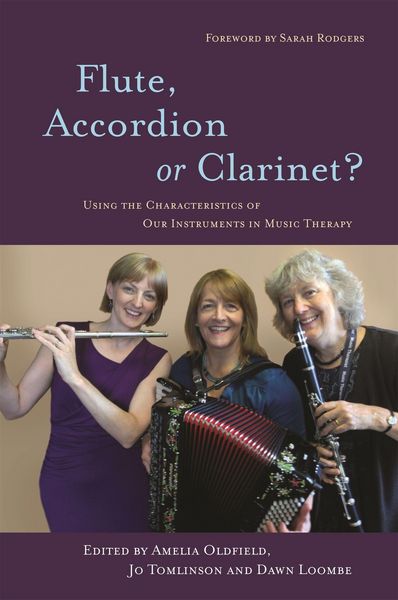
Produktbild: Flute, Accordion or Clarinet?

Flute, Accordion or Clarinet? Using the Characteristics of Our Instruments in Music Therapy

41,99 €

inkl. gesetzl. MwSt., Versandkostenfrei


Beschreibung

Produktdetails

Einband

Taschenbuch

Erscheinungsdatum

21.04.2015

Verlag

Jessica Kingsley Publishers Ltd

Seitenzahl

344

Maße (L/B/H)

22,6/15,2/2,3 cm

Gewicht

502 g

Sprache

Englisch

ISBN

978-1-84905-398-3

Beschreibung

Produktdetails

Einband

Taschenbuch

Erscheinungsdatum

21.04.2015

Verlag

Jessica Kingsley Publishers Ltd

Seitenzahl

344

Maße (L/B/H)

22,6/15,2/2,3 cm

Gewicht

502 g

Sprache

Englisch

ISBN

978-1-84905-398-3

Herstelleradresse

Libri GmbH
Europaallee 1
36244 Bad Hersfeld
DE

Email: gpsr@libri.de

Kundinnen und Kunden meinen

0 Bewertungen

Informationen zu Bewertungen

Zur Abgabe einer Bewertung ist eine Anmeldung im Konto notwendig. Die Authentizität der Bewertungen wird von uns nicht überprüft. Wir behalten uns vor, Bewertungstexte, die unseren Richtlinien widersprechen, entsprechend zu kürzen oder zu löschen.

Die Bewertungen sind nach Format, Anzahl Sterne und Datum sortiert.

Verfassen Sie die erste Bewertung zu diesem Artikel

Helfen Sie anderen Kund*innen durch Ihre Meinung

Kundinnen und Kunden meinen

0 Bewertungen filtern

Die Leseprobe wird geladen.
  • Produktbild: Flute, Accordion or Clarinet?
  • Foreword. Acknowledgements. Introduction. Amelia Oldfield, Child and Family Psychiatry, Cambridge and Anglia Ruskin University. 1. The Clarinet. Henry Dunn, Arts Therapies Service, Devon Partnership Trust, Amelia Oldfield, Child and Family Psychiatry, Cambridge and Anglia Ruskin University, Catrin Piears-Banton, Adult Mental Health, Surrey and Borders NHS Trust and Adults with Learning Disabilities, Norwood and Colette Salkeld, The Portland Hospital for Women and Children and Chroma Therapies. 2. The Piano Accordion. Susan Greenhalgh, Psychiatric, Residential and Educational Settings and GCSE Music Teacher and Dawn Loombe, Child Development Centre, Addenbrooke's Hospital, Cambridge and Private Practice, Adults with Profound and Multiple Learning Disabilities. 3. The Flute. Caroline Anderson, PhD Student, Intercultural Music Therapy, Veronica Austin, Key Changes Music Therapy Charity, Hampshire and Chelsea and Westminster Hospital, London, Emily Corke, Anglia Ruskin University's Music Therapy Centre, St. Edmund's Trust and Arthur Rank Hospice and Schools in the Cambridgeshire Area, Mary-Clare Fearn, Children and Adults with a Range of Learning Disabilities, NHS and Education Settings, Esther Mitchell, Two Special Schools and Thomas's Fund and Jo Tomlinson, Cambridgeshire Music, PhD student, Anglia Ruskin University. 4. The Cello. Philip Hughes, Low-secure Unit, Hertfordshire, Annie Tyhurst, MusicSpace, Bristol, Catherine Warner, University of the West of England and Tessa Watson, University of Roehampton and NHS and Social Services Community Team. 5. The Trumpet and the Flugelhorn. Philippa Derrington, Queen Margaret University, Edinburgh, Mike Gilroy, SEN Schools, Shlomi Hason, Inner Echo Music Therapy, Hackney, East London and Concetta Tomaino, Institute for Music and Neurologic Function and CenterLight Health System, New York City. 6. The Bassoon. Penelope Birnstingl, Music as Therapy International, Lisa Margetts, Norwood and University of Roehampton and Grace Watts, Cheyne Child Development Service, Chelsea and Westminster Hospital. 7. The Violin. Katy Bell, Special School Setting, Residential Centre for Young Adults with Life Limiting Conditions and Complex Learning Difficulties and Private Practice, Nicky Haire, Freelance and Music as Therapy International's Project Rwanda Team, Trisha Montague, North London Forensic Service and Sharon Warnes, Headway Thames Valley and Guideposts Music Therapy. 8. The Viola. Angela Harrison, North Yorkshire Music Therapy Centre and Oonagh Jones, Nordoff Robbins London Centre and Oxleas NHS Foundation Trust. 9. The Harp. Rivka Gottlieb, Specialist Provision for Children on the Autistic Spectrum, Secondary School, Anna Lockett, Fitzwarren School, Wantage, Oxfordshire and Holly Mentzer, PhD Student, New York University and Memorial Sloan Cancer Center. 10. The Guitar. Steve Lyons, Resources for Autism, Jonathan Poole, The Children's Trust in Tadworth and Caroline Long, Recently Qualified, Alex Street, PhD Student and Prodromos Stylianou, Private Practice, Ministry of Health, Cyprus. 11. Lower Brass (The Trombone and the Euphonium). Trygve Aasgaard, Oslo and Akershus University College of Applied Sciences and the Norwegian Academy of Music, George Murray, Wakefield Hospice and a School for Special Educational Needs and Disabilities and Helen Mottram, Two Special Schools and Coram, Adoption Charity, London. 12. The Oboe. Nathan Bettany, Nottinghamshire Healthcare NHS Trust, Stella Compton-Dickinson, Rampton High Security Hospital, Nottinghamshire Healthcare NHS Trust Forensic Services and Spela Loti Knoll, Knoll Institute for Music Therapy and Supervision, Kranj, Slovenia. 13. The Saxophone. Luke Annesley, Oxleas Music Therapy Service (NHS), Susanna Crociani, Elderly People and a Psychiatric Centre, Billy Davidson, Freelance and Anita Vaz, Schools and a Children's Hospice. 14. The Bass (The Double Bass and the Bass Guitar). Paolo Pizziolo, Private Practice and National Health Institutions, Florence, Italy, Joseph Piccinnini, Richmond Music Center, Staten Island, New York and John Preston, Adult Psychiatry, Fulbourn Hospital, Cambridgeshire. Reflections. Amelia Oldfield. Child and Family Psychiatry, Cambridge and Anglia Ruskin University. Biographies. Index.