• Produktbild: Justice and Self-Interest
  • Produktbild: Justice and Self-Interest

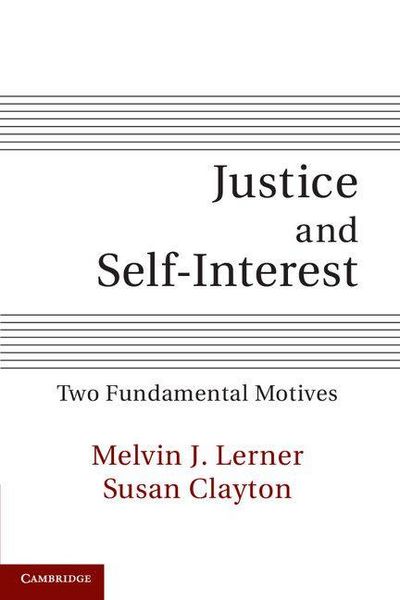
Justice and Self-Interest Two Fundamental Motives

63,99 €

inkl. gesetzl. MwSt., Versandkostenfrei


Beschreibung

Produktdetails

Einband

Taschenbuch

Erscheinungsdatum

01.03.2011

Verlag

Cambridge Academic

Seitenzahl

280

Maße (L/B/H)

22,9/15,2/1,5 cm

Gewicht

420 g

Sprache

Englisch

ISBN

978-1-107-64028-3

Beschreibung

Zitat

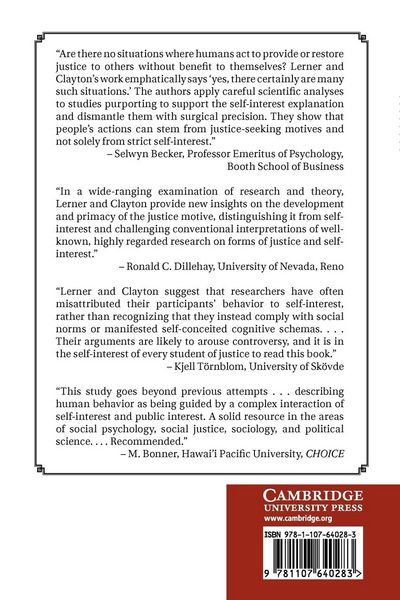
"Given the broad acceptance of capitalist philosophy in most of the developed and developing world, one could expect that self-interest motives would be used to explain all sorts of human interactions with others. Further, it could be expected that such explanations would be readily accepted. Are there no situations where humans act to provide or restore justice to others without benefit to themselves? Lerner and Clayton's work emphatically says 'yes, there certainly are many such situations.' The authors apply careful scientific analyses to studies purporting to support the self-interest explanation and dismantle them with surgical precision. They show that people's actions can stem from justice-seeking motives and not solely from strict self-interest." - Selwyn Becker, Professor Emeritus of Psychology, Booth School of Business "In a wide-ranging examination of research and theory, Lerner and Clayton provide new insights on the development and primacy of the justice motive, distinguishing it from self-interest and challenging conventional interpretations of well-known, highly regarded research on forms of justice and self-interest." - Ronald C. Dillehay, University of Nevada, Reno "Most people would like to believe that the world is just, that you get what you deserve and deserve what you get. And despite almost daily indications to the contrary, people are generally committed to various norms of justice to guide their own behavior. A frequently conflicting but pervasive belief is that people are essentially self-interested in their interactions with others. Lerner and Clayton suggest that researchers have often misattributed their participants' behavior to self-interest, rather than recognizing that they instead comply with social norms or manifested self-conceited cognitive schemas. They critically analyze existing research and offer an alternative preliminary model that integrates the two motivational forces of justice and self-interest into 'a more comprehensive theory of behavior.' Their arguments are likely to arouse controversy, and it is in the self-interest of every student of justice to read this book." - Kjell Tornblom, University of Skovde "...This study goes beyond previous attempts (such as Beyond Self-Interest, ed. by Jane Mansbridge, CH, Dec'90, 28-2396) describing human behavior as being guided by a complex interaction of self-interest and public interest. A solid resource in the areas.of social psychology, social justice, sociology, and political science... Recommended..." --M. Bonner, Hawai'i Pacific University, CHOICE

Produktdetails

Einband

Taschenbuch

Erscheinungsdatum

01.03.2011

Verlag

Cambridge Academic

Seitenzahl

280

Maße (L/B/H)

22,9/15,2/1,5 cm

Gewicht

420 g

Sprache

Englisch

ISBN

978-1-107-64028-3

Herstelleradresse

Libri GmbH
Europaallee 1
36244 Bad Hersfeld
DE

Email: gpsr@libri.de

Noch keine Bewertungen vorhanden

Verfassen Sie die erste Bewertung zu diesem Artikel

Helfen Sie anderen Kundinnen und Kunden durch Ihre Meinung.

Kundinnen und Kunden meinen

Bewertungen (0)

Die Leseprobe wird geladen.
  • Produktbild: Justice and Self-Interest
  • Produktbild: Justice and Self-Interest
  • 1. Contesting the primacy of self-interest; 2. Why does justice matter? The development of a personal contract; 3. Commitment to justice: the initial primary automatic reaction; 4. Explaining the myth of self-interest; 5. Defining the justice motive: re-integrating procedural and distributive justice; 6. How people assess deserving and justice: the role of social norms; 7. Integrating justice and self-interest: a tentative model; 8. Maintaining the commitment to justice in a complex world; 9. Bringing it closer to home: justice in another 'American tragedy'; 10. Emotional aftereffects: some negative consequences and thoughts on how to avoid them.