• Produktbild: Rise of the U.S. Environmental Health Movement
  • Produktbild: Rise of the U.S. Environmental Health Movement

Rise of the U.S. Environmental Health Movement

79,99 €

inkl. gesetzl. MwSt., Versandkostenfrei


Beschreibung

Produktdetails

Einband

Gebundene Ausgabe

Erscheinungsdatum

28.03.2013

Verlag

Rowman & Littlefield

Seitenzahl

288

Maße (L/B/H)

23,5/15,7/2,2 cm

Gewicht

562 g

Sprache

Englisch

ISBN

978-1-4422-2137-6

Beschreibung

Zitat

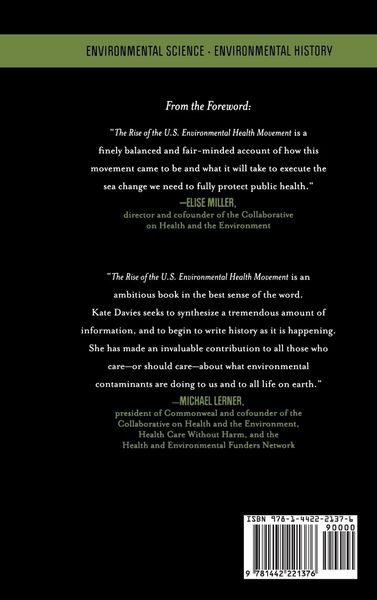
The world is not a safe place. Toxic waste, air pollution, and pesticide use can be hazardous to your health. According to the World Health Organization, more than 40-percent of all asthma, nearly 20-percent of all cancers, and 5-percent of all birth defects are attributable to poor environmental quality. It's impossible to avoid exposure to at least some of the 80,000 different chemicals utilized in the U.S. The environmental health movement consists of many individuals and organizations cognizant of the relationship between people and the environment and environmental factors that potentially affect health. Davies extensively covers the historical roots and rise of this movement in the U.S. and tracks its current status and strategies, from forging national coalitions to lobbying for legislation and promoting grassroots activism. America's environmental health movement focuses on environmental safety through precaution and prevention, opposes the use of toxic chemicals, and advocates sustainability and environmental justice. As ecotheologian Thomas Berry once declared, "You cannot have well humans on a sick planet." Booklist The Rise of the U.S. Environmental Health Movement is a well-done history of America's environmental health movement and offers readers valuable information on how grassroots organizing prevents harm from toxic exposures and leads to safe and healthy communities. -- Lois Marie Gibbs, Executive Director, Center for Health, Environment & Justice The Rise of the US Environmental Health Movement is an ambitious book in the best sense of the word. Davies seeks to synthesize a tremendous amount of information, and to begin to write history as it is happening. She has made an invaluable contribution to all those who care - or should care - about what environmental contaminants are doing to us and to all life on earth. -- Michael Lerner, president of Commonweal and co-founder of the Collaborative on Health and the Environment, Health Care Without Harm and the Health and Environmental Funders Network The Rise of the U.S. Environmental Health Movement is a finely-balanced and fair-minded account of how this movement came to be and what it will take to execute the sea change we need to fully protect public health. -- Elise Miller, Director and co-founder of the Collaborative on Health and the Environment, founded and directed the Institute for Children's Environmental Health, Founding Executive Director of the Jenifer Altman Foundation Kate Davies' authoritative history describes the origins and dimensions of one wing of the environmental movement. It is both generous and accurate in its portrayal of the ideas, the people, and organizations that forged the link between the environment and human health. This is the definitive guide to the story of one of the most important movements of our century. -- Carolyn Raffensperger, Science and Environmental Health Network A compelling history and an accessible guide that unravels the complexity of environmental health issues and the evolving environmental health movement and offers references and examples for how our collective and individual actions can make a healthy difference in the places where we live, work, play, and go to school. -- Peggy M. Shepard, Executive Director and co-founder of WE ACT for Environmental Justice The Greek mathematician Archimedes, referring to levers, is reputed to have said, "Give me a place to stand and I will move the earth." It is in that spirit that author Kate Davies calls for identifying "leverage points" for improving environmental health: "Leverage points are places in complex systems where a small shift in one thing can produce big changes across an entire system." For example, Davies points to the cost of health care, noting that health care in the US is "one of the least effective health-care systems among industrialized countries." She argues that combining environmental health with the economics of health care will help create change. Davies is well equipped to generate social change. She founded and directed the first local government office on the environment in Canada and is on the faculty in the Environment and Community program at Antioch University's Center for Creative Change in Seattle. In the most revealing portion of the book, Davies closes with a discussion of what she calls "Strategies for Social Change." She details how, historically, the movement organized for collective action on local issues, such as the response to the Love Canal contamination in Niagara Falls, New York, during the 1970s. Later, groups began lobbying for new legislation controlling toxic chemicals. Davies acknowledges that these latter efforts created tensions among environmental advocates. She argues that local groups felt state lobbying organizations, who were pursuing legislation, ignored local problems. Furthermore, she says, these local groups consisted mostly of passionate, penniless volunteers who believed the state and national groups dominated fund raising. Davies downplays the legislative accomplishments made in the 1970s by national environmental lobbying groups, such as adoption of the Clean Air Act and the Clean Water Act. However, she clearly acknowledges the failure of the Toxic Substances Control Act passed in 1976. "By 'grandfathering' nearly all the chemicals that were used in 1976 (about sixty-two thousand) and excluding them from any review or testing requirements, the Act created a monumental loophole for the chemical industry." Davies urges the environmental health movement to follow the example of others, such as the civil rights movement, by considering "collective, peaceful civil disobedience more often." To defend such a proposal, Davies must conclude that other paths to social change using conventional, lawful means have been exhaustively tried and found ineffective-but she has not made this case. Needlessly engaging in militant actions could cause a negative reaction in some supporters. And, as Thomas Jefferson said: "The good opinion of mankind, like the lever of Archimedes ... moves the world." The Rise of the U.S. Environmental Health Movement contains a great deal of complex information that will interest primarily those already in the movement. ForeWord Reviews

Produktdetails

Einband

Gebundene Ausgabe

Erscheinungsdatum

28.03.2013

Verlag

Rowman & Littlefield

Seitenzahl

288

Maße (L/B/H)

23,5/15,7/2,2 cm

Gewicht

562 g

Sprache

Englisch

ISBN

978-1-4422-2137-6

Herstelleradresse

Libri GmbH
Europaallee 1
36244 Bad Hersfeld
DE

Email: gpsr@libri.de

Kundinnen und Kunden meinen

0 Bewertungen

Informationen zu Bewertungen

Zur Abgabe einer Bewertung ist eine Anmeldung im Konto notwendig. Die Authentizität der Bewertungen wird von uns nicht überprüft. Wir behalten uns vor, Bewertungstexte, die unseren Richtlinien widersprechen, entsprechend zu kürzen oder zu löschen.

Die Bewertungen sind nach Format, Anzahl Sterne und Datum sortiert.

Verfassen Sie die erste Bewertung zu diesem Artikel

Helfen Sie anderen Kund*innen durch Ihre Meinung

Kundinnen und Kunden meinen

0 Bewertungen filtern

Die Leseprobe wird geladen.
  • Produktbild: Rise of the U.S. Environmental Health Movement
  • Produktbild: Rise of the U.S. Environmental Health Movement
  • Acknowledgments

    Introduction
    Environmental Health
    The US Environmental Health Movement
    Background
    This Book

    Part 1: Historical and Cultural Roots
    Chapter 1: The European Ancestry of Environmental Health
    The Philosophy of Ancient Greece
    The Engineering Achievements of Rome
    The Spread of Judeo-Christian Religions
    The Scientific Revolution and the Nature of Science
    Social Justice and the Enlightenment
    The Environmental Health Consequences of the Industrial Revolution
    New Policies and Legislation
    Recognizing and Preventing Environmentally-Related Diseases

    Chapter 2: Early Environmental Public Health
    The Environmental Health Consequences of the American Industrial Revolution
    Environmental Public Health Concerns
    Occupational Health: Working with the Urban Poor
    The Home as an Environment for Protecting Health
    The Progressive Era and Environmental Conservation
    The Origins of Urban Planning
    Preventing Environmentally-Transmitted Diseases

    Chapter 3: Environmentalism and Economic Growth
    Post World War II Economic Growth and the Creation of a Consumer Society
    The Environmental Health Effects of Air Pollution
    The Environmental Health Effects of Water Pollution
    The Environmental Health Effects of Food Quality
    The Antinuclear Movement and the Precedents It Set
    New Ideas: Toxic Chemicals
    New Ideas: Deep Ecology and Social Ecology
    New Ideas: Population Growth and Resource Depletion
    The Rise of Environmentalism
    EPA and the Final Separation of Environmental and Public Health
    The Relationship Between the Environmental Movement and the Labor Movement
    The Toxic Substances Control Act and Other Environmental Legislation of the 1970s

    Chapter 4: The Birth of the US Environmental Health Movement
    Love Canal and Its Aftermath
    The Beginnings of the Environmental Justice Movement
    The Role of Disasters in Building the Environmental Health Movement
    Struggles for Regional Environmental Health in the Great Lakes
    Winning the Battle Against Waste Incineration
    Opposition to Pesticides: An Ongoing Struggle
    Securing the Right to Know
    Toxics Use Reduction and Pollution Prevention: Limited Success
    The Lead Saga
    Newer Challenges: Endocrine Disruptors and Epigenetics

    Part II: The Contemporary Movement
    Chapter 5: Organizations and Issues
    The Movement's Strongest Asset: State and Local Groups
    The Roles of National Groups
    The Influence of European Toxics Policy
    The Louisville Charter
    The Emergence of National Coalitions
    Communications and Getting the Word Out
    The Importance of Women's Organizations
    Alliances with Labor Organizations
    New Ways of Framing Environmental Health: Judeo-Christian Religions
    Beyond Toxics: Nanotechnology
    Beyond Toxics: Electromagnetic Fields
    Beyond Toxics: Fossil Fuels
    Beyond Toxics: Urban Planning and Green Building
    The Significance of Foundation Funding

    Chapter 6: Making Environmental Issues Personal
    Gaining Support from People Affected by Environmentally-Related Disease
    Working with Caregivers - Nurses
    Working with Caregivers - Physicians
    Engaging the Health Care Sector
    Protecting Children's Environmental Health
    Food, Glorious Food
    Opposing Toxics in Consumer Products
    And in Personal Care Products
    Pollution in People

    Chapter 7: Precaution and the Limitations of Science
    The Impossibility of Proving Environmental Causation
    The Failure to Consider Ethics
    The Distortion and Cover-up of Scientific Information
    Problems with Risk Assessment
    Overview of Precaution
    The Ingredients of Precaution
    Progress on Precaution

    Chapter 8: Environmental Justice and the Right to a Healthy Environment
    Perspectives on Environmental Justice
    Constitutional and Legal Rights to a Healthy Environment
    Scientific Information on Environmental Health Injustice in the US
    Environmental Justice Issues
    Community-Based Research
    Environmental Justice Strategies
    The US Environmental Justice and Environmental Health Movements

    Chapter 9: Changing Economics, the Markets and Business
    The Cost of Environmental Illness
    Market Campaigns: Overview
    Market Campaigns: PVC Products and Packaging
    Market Campaigns: Electronics
    Market Campaigns: The Health Sector
    Green Chemistry and Safer Materials
    Socially Responsible Investing
    Partnerships with Business

    Conclusion and Next Steps: Strategies for Social Change
    Strategies for Social Change
    Creating Inspiring Visions
    Minding the Gap between our Collective Aspirations and Reality
    Seeing the Forest and the Trees
    Identifying Leverage Points for Environmental Health
    Organizing More, Collective Action
    Telling Environmental Health Stories
    Self-Care
    Final Reflections

    A Chronology of Key Events in US Environmental Health

    Selected Resources on Environmental Health