• Produktbild: Incomplete Categorical Data Design
  • Produktbild: Incomplete Categorical Data Design

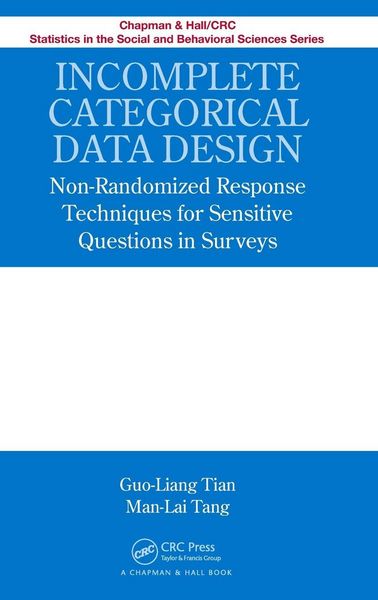
Incomplete Categorical Data Design Non-Randomized Response Techniques for Sensitive Questions in Surveys

149,99 €

inkl. gesetzl. MwSt., Versandkostenfrei


Beschreibung

Produktdetails

Einband

Gebundene Ausgabe

Erscheinungsdatum

17.08.2013

Verlag

Taylor and Francis

Seitenzahl

322

Maße (L/B/H)

24/16,1/2,2 cm

Gewicht

589 g

Sprache

Englisch

ISBN

978-1-4398-5533-1

Beschreibung

Produktdetails

Einband

Gebundene Ausgabe

Erscheinungsdatum

17.08.2013

Verlag

Taylor and Francis

Seitenzahl

322

Maße (L/B/H)

24/16,1/2,2 cm

Gewicht

589 g

Sprache

Englisch

ISBN

978-1-4398-5533-1

Herstelleradresse

Libri GmbH
Europaallee 1
36244 Bad Hersfeld
DE

Email: gpsr@libri.de

Noch keine Bewertungen vorhanden

Verfassen Sie die erste Bewertung zu diesem Artikel

Helfen Sie anderen Kundinnen und Kunden durch Ihre Meinung.

Kundinnen und Kunden meinen

Bewertungen (0)

Die Leseprobe wird geladen.
  • Produktbild: Incomplete Categorical Data Design
  • Produktbild: Incomplete Categorical Data Design
  • Introduction Randomized Response ModelsItem Count TechniquesNon-Randomized Response Models Scope of the Rest of the Book The Crosswise Model The Warner ModelA Non-Randomized Warner Model: The Crosswise ModelBayesian Methods for the Crosswise ModelAnalyzing the Induced Abortion Data An Experimental Survey Measuring Plagiarism The Triangular Model The Triangular DesignComparison with the Warner Model Asymptotic Properties of the MLE Bayesian Methods for the Triangular Model Analyzing the Sexual Behavior Data Case Studies on Premarital Sexual Behavior Sample Sizes for the Crosswise and Triangular ModelsPrecision and Power Analysis MethodsThe Triangular Model for One-Sample ProblemThe Crosswise Model for One-Sample Problem Comparison for the Crosswise and Triangular Models The Triangular Model for Two-Sample Problem An Example The Multi-Category Triangular Model A Brief Literature Review The Survey Design Likelihood-Based Inferences Bayesian Inferences Questionnaire on Sexual Activities in Korean Adolescents The Hidden Sensitivity Model Background The Survey Design Likelihood-Based Inferences Information Loss and Design ConsiderationSimulation Studies Bayesian Inferences under Dirichlet Prior Bayesian Inferences under Other Priors Analyzing HIV Data in an AIDS Study The Parallel Model The Unrelated Question Model A Non-Randomized Unrelated Question Model: The Parallel ModelComparison with the Crosswise Model Comparison with the Triangular Model Bayesian Inferences An Example: Induced Abortion in MexicoA Case Study on College Students’ Premarital Sexual Behavior at Wuhan A Case Study on Plagiarism at The University of Hong Kong Discussion Sample Size Calculation for the Parallel Model Sample Sizes for One-Sample ProblemComparison with the Crosswise ModelComparison with the Triangular Model Sample Size for Two-Sample Problem An Example The Multi-Category Parallel Model The Survey Design Likelihood-Based InferencesBayesian InferencesA Special Case of the Multi-Category Parallel ModelComparison with the Multi-Category Triangular ModelAn Example Discussion A Variant of the Parallel ModelThe Survey Design and Basic PropertiesStatistical Inferences on πStatistical Inferences on θBootstrap Confidence Intervals Bayesian InferencesComparison with the Crosswise ModelComparison with the Triangular ModelThe Noncompliance Behavior An Illustrative Example of Sexual Practices Case Studies on Cheating Behavior in ExaminationsDiscussion The Combination Questionnaire Model The Survey Design Likelihood-Based Inferences Bayesian Inferences Analyzing Cervical Cancer Data in Atlanta Group Dirichlet Distribution Appendix A The EM and DA Algorithms Appendix B The Exact IBF Sampling Appendix C Some Statistical Distributions References Author Index Subject Index