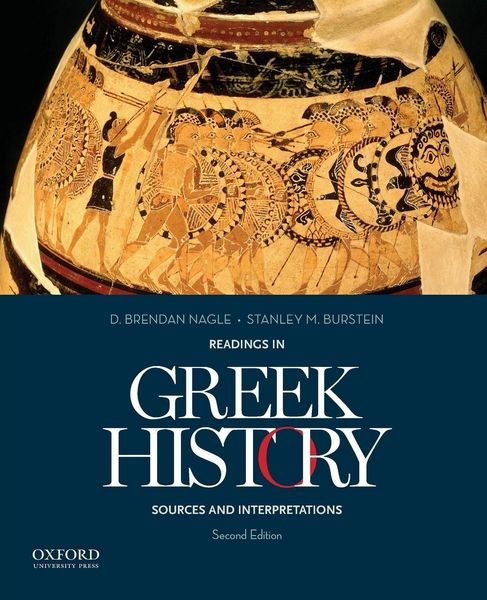
Produktbild: Readings in Greek History

Readings in Greek History Sources and Interpretations

152,99 €

inkl. gesetzl. MwSt., Versandkostenfrei


Beschreibung

Produktdetails

Einband

Taschenbuch

Erscheinungsdatum

01.04.2013

Verlag

Oxford University Press

Seitenzahl

370

Maße (L/B/H)

23,5/19,1/2 cm

Gewicht

635 g

Sprache

Englisch

ISBN

978-0-19-997845-8

Beschreibung

Zitat


"Readings in Greek History offers a diverse selection of translated ancient material with clear introductory sections that help students properly contextualize and fully understand the selected ancient texts."--Nikolaos Lazaridis, California State University, Sacramento
"This sourcebook has a demonstrated track record of success in providing digestible portions of ancient Greek source material to undergraduates."--Giovanni Ruffini, Fairfield University
"Especially in regard to length and price, this reader is without a rival."--Vasiliki Kostopoulou, University of Iowa
"A very complete and detailed collection of key primary sources, prefaced in a clear and illuminating manner, drawing attention to the wide variety of ways in which we can know the Ancient Greeks."--Lorraine Attreed, College of the Holy Cross

Produktdetails

Einband

Taschenbuch

Erscheinungsdatum

01.04.2013

Verlag

Oxford University Press

Seitenzahl

370

Maße (L/B/H)

23,5/19,1/2 cm

Gewicht

635 g

Sprache

Englisch

ISBN

978-0-19-997845-8

Herstelleradresse

Libri GmbH
Europaallee 1
36244 Bad Hersfeld
DE

Email: gpsr@libri.de

Noch keine Bewertungen vorhanden

Verfassen Sie die erste Bewertung zu diesem Artikel

Helfen Sie anderen Kundinnen und Kunden durch Ihre Meinung.

Kundinnen und Kunden meinen

Bewertungen (0)

  • Produktbild: Readings in Greek History
    • *=New to this Edition

    • List of Maps and Figures

    • * Time Line

    • Preface

    • 1. EARLY GREECE: FROM THE BRONZE AGE TO THE ORIGIN AND SPREAD OF THE POLIS SYSTEM

    • A. Greece in the Second Millennium B.C.

    • 1. The Mycenaean Kingdoms (ca. 1650-1150 BC)

    • 2. Mycenaean Relations with the Hittites: the Tawagalawas Letter (Selections)

    • * 3. The Sea Peoples and the End of the Bronze Age

    • B. Greek Definitions of the Polis

    • 1. The Natural Origins of the Polis: "Man Is by Nature a Political Animal"

    • 2. The Nature of Citizenship: "He Who Has the Right to Take Part in Deliberative or Judicial Administration Is a Citizen"

    • C. Greek Life in the Eighth Century B.C.

    • 1. Homer: The Shield of Achilles

    • 2. Hesiod's Works and Days

    • D. Colonization and the Expansion of the Polis System: The Case of Cyrene

    • 1. Herodotus' Account

    • 2. The Oath of the Colonists

    • E. Greeks and Non-Greeks in the Greek Colonies: The Foundation of Lampsacus

    • F. Greeks and Scythians in the Black Sea: Coexistence and Interaction

    • G. The Aristocratic Warrior

    • 1. The Warrior Ideal

    • 2. The Warrior and Society: The Drinking Song of Hybrias

    • H. The Hoplite Revolution and the Citizen Soldier

    • 1. The Reality of Battle

    • 2. A Good Citizen: Tellus of Athens

    • 3. Only Farmers Can Be Good Citizens

    • I. The Hoplite Polis: Sparta

    • J. The Role of Athletics

    • 1. An Athletic Dynasty: The Diagorids of Rhodes

    • 2. Athletics and the Polis: A Philosophical Critique

    • 2. THE RISE AND FALL OF THE GREEK ARISTOCRACY IN THE ARCHAIC PERIOD

    • * A. Religion in Aristocratic Greece

    • * 1. Relations between Man and Gods

    • * 2. Animal Sacrifice

    • B. Aristocratic Privilege

    • 1. The Gortyn Code

    • 2. How a Boy Becomes a Man in Crete

    • C. Aspects of Aristocratic Life at Its Peak

    • 1. A Fine Symposium: Xenophanes

    • 2. The Life of an Aristocrat: Alcaeus

    • 3. When You Are "Repulsive to Boys and a Laughing Stock to Women": Mimnermus on Old Age

    • 4. A Woman's View of Aristocratic Life: Sappho's "To Anactoria"

    • D. Heroic Athletics: The Chariot Race at Patroclus' Funeral Games

    • E. The Aristocracy and Its International Connections

    • 1. A Greek Officer in Egyptian Service

    • 2. Greek Mercenaries in the Egyptian Army

    • 3. The Life of a Soldier: An Order for Rations at Arad in the Kingdom of Judah

    • 4. Aristocratic Exiles

    • 5. Sappho on Intermarriage Between Aristocrats

    • F. The Crisis of the Aristocracy

    • 1. The Lament of Theognis

    • 2. Vulgar Upstarts: Artemon and Rhodopis

    • 3. The Crisis of the Aristocracy at Corinth: Cypselus and Periander

    • 4. The Crisis of the Aristocracy at Athens: Solon

    • * 5. The Crisis of the Aristocracy at Athens: Cleisthenes

    • 3. THE PERSIAN WARS

    • A. The Persian Empire

    • 1. The King and His Subjects: The Cyrus Cylinder

    • 2. "By the Grace of Ahurimazda I Am King": Persian Imperial Ideology

    • B. The Persian Wars

    • 1. How the Wars Began: The Problems of Aristagoras

    • 2. Aristagoras Seeks Help from Sparta

    • 3. Aristagoras at Athens

    • 4. The Battle of Marathon

    • C. The Second Persian Invasion of 480 B.C.

    • 1. The Muddled Greek Response: "It Was Plain That the Greater Number of the States Would Take No Part in the War but Warmly Favored the Persians"

    • 2. Themistocles and the "Alliance of the Willing"

    • 3. The Themistocles Decree

    • 4. Why Gelo of Syracuse Refused Help

    • 5. The Battle of Thermopylae

    • 6. Athens Evacuated

    • 7. The Great Debate: Fight at Salamis or Defend the Isthmus of Corinth?

    • 8. The Battle of Plataea

    • 9. Revenge for Thermopylae: The Humanity of Pausanias

    • 4. LIFE IN THE POLIS

    • A. The Household: Family Relations

    • 1. "What Is Sweeter Than Family?"

    • 2. Do Parents Love Their Children More Than Children Love Their Parents?

    • 3. The Nature of Youth

    • 4. Husbands and Wives

    • 5. Mothers and Sons: "My Mother Is a Trial"

    • 6. "Except for My Mother I Hate the Whole Female Sex"

    • 7. Procne's Lament: The Sorrows of Young Women

    • B. Household Management

    • 1. Women's Work

    • 2. "Where There Is No Wife Households Are Neither Orderly nor Prosperous"

    • 3. Woman and Legal Affairs

    • 4. The Education of a Wife

    • 5. Managing Obstreperous Children

    • 6. The Short Sad Life of a Good Woman: The Epitaph of Sokratea of Paros

    • C. Slaves and Slavery

    • 1. "The Best and Most Necessary Possessions"

    • 2. "We Have Mistresses for Our Pleasure": Sex and Slavery in the Oikos

    • 3. How to Become a Slave: Be in the Wrong Place at the Wrong Time

    • 4. The Slave Trade: A Eunuch's Revenge

    • D. The Polis and the Household

    • 1. The Murder of Eratosthenes

    • 2. The Demos Must Be Pure: Athenian Laws on Pederasty

    • E. Religion in the Classical Polis

    • 1. The Affair of the Herms

    • 2. The Festivals: "A Man Should Spend His Whole Life at Play"

    • 3. Local Festivals

    • 4. Athena Nike Priestess

    • * 5. Xenophon Consults the Delphic Oracle

    • 6. Personal Religion: Xenophon's Temple to Artemis

    • F. War and Warfare in the Polis

    • 1. The Spartan Army

    • 2. A Hoplite Battle: Mantineia

    • G. The Place of Warfare in the Polis: Some Philosophical Reflections

    • 1. "All States Are by Nature Fighting an Undeclared War with All Other States"

    • 2. "Peace Is the End of War, Leisure of Work"

    • 5. THE PELOPONNESIAN WAR AND THE MILITARY REVOLUTION

    • A. The Rise of Athens

    • 1. The Golden Age: Looking at the Past

    • 2. "For Without Equal Military Power It Is Impossible for Allies to Have Equal or Similar Say in Policy-Making": The Reality of Athenian Power

    • 3. The Strategic Thinking of Themistocles

    • B. The Delian League

    • 1. "They Had Enough of the Persian War:" The Spartans and the Delian League

    • 2. "The Allies Brought All This on Themselves": From League to Empire

    • 3. Aristotle on the Organization of the Athenian Empire

    • C. The Athenian Empire

    • 1. The Logic of Possessing an Empire

    • 2. Athens and Her Subjects: The Case of Erythrae

    • 3. Imperial Ideology: Pericles' Funeral Oration

    • 4. The Bloody Revolution at Corcyra: "War is a Hard Master"

    • 5. "Justice Enters the Discussion Only When the Parties Are Equal": The Melian Dialogue

    • D. Opposition to the Peloponnesian War at Athens

    • 1. Prayer to Peace

    • 2. Lysistrata's Solution to War

    • E. Defeat and Hard Times: Athens After the Peloponnesian War

    • F. The Military Revolution

    • 1. Old and New Forms of Warfare

    • 2. Iphicrates: A Military Revolutionary

    • 3. A Stunning Reversal: Light Infantry Defeat Heavy Infantry at Lechaeum

    • 4. Mercenaries at War

    • 5. A Two-Edged Sword: Mercenary Troops and Their Employers

    • 6. The Need for Walls

    • 6. INTELLECTUAL DEVELOPMENTS IN THE CLASSICAL AGE: THE PHYSIS/NOMOS DEBATE

    • A. The Conventionalist Argument

    • 1. "There Is No Natural Standard of Justice:" An Overview from Plato

    • 2. Callicles' Superman: "Right Is the Advantage of the Stronger over the Weaker"

    • 3. Protagoras: Virtue Is Taught by Parents, Teachers, and the Laws

    • B. The Naturalist Argument

    • 1. Antiphon: Greeks and Barbarians Are the Same by Nature

    • 2. Sophocles, Empedocles, and Alcidamas: Universally Valid Norms Exist

    • 3. Aristotle: Intrinsically Evil Acts

    • 4. Making Fun of the Philosophers: Aristophanes

    • C. The Threat of Socrates

    • 1. Socrates and Anytus

    • 2. The Sophist Polykrates' Pamphlet

    • D. Socrates' Defense: "I Shall Obey God Rather Than You"

    • E. Diogenes the Cynic

    • 7. THE FOURTH CENTURY

    • A. The Decline and Fall of Sparta

    • 1. Social Problems at Sparta: The Conspiracy of Cinadon

    • 2. Sparta at Its Peak: The King's Peace (386 B.C.)

    • 3. The Foundation of the Second Athenian League (377 B.C.)

    • 4. The Battle of Leuctra and the End of Spartan Primacy (371 B.C.)

    • 5. The Decline of Sparta: Why?

    • B. The Crisis of the Polis in Fourth-Century B.C. Greece

    • 1. Fifth Column Activity in Greek Cities

    • 2. Political Revolution in Argos

    • 3. Mercenaries and Exiles: The Tyranny of Clearchus of Heraclea Pontica (364-352 B.C.)

    • 4. Can the Polis Be Saved? Suggested Solutions

    • C. The Periphery of the Greek World

    • 1. Thracian Court Life: A Heroic Society

    • 2. A Greek Trading Post in Thrace

    • 3. Greeks and Non-Greeks in the Black Sea: Amage, Queen of the Sarmatians, Saves the City of Chersonesus

    • 4. Bosporus: A Multi-Ethnic State in the Black Sea (347/6 B.C.)

    • 5. A Hellenized Satrap: Mausolus of Caria

    • 6. The Funeral of Mausolus: A Greek Extravaganza (353 B.C.)

    • 7. A Greek View of Persia: Xenophon, The Education of Cyrus

    • D. Philip II and the Emergence of Macedon

    • 1. The Achievements of Philip II: Alexander the Great's Speech at Opis (324 B.C.)

    • 2. Philip II's Military Reforms

    • 3. The Companions of Philip II

    • 4. Philippi: The First Macedonian Colony

    • 5. Oath of Members of the League of Corinth (338-337 B.C.)

    • 6. The Marriages of Philip II

    • 7. The Assassination of Philip II

    • E. The Reign of Alexander the Great: Alexander and the Greeks

    • 1. The Greeks in Europe

    • 2. The Greeks in Asia

    • F. Alexander and Egypt

    • 1. Surrender of Egypt to Alexander

    • 2. Foundation of Alexandria

    • 3. Alexander's Visit to Siwah

    • 4. Alexander's Organization of Egypt

    • 5. The Administration of Cleomenes of Naucratis

    • G. Alexander and the Non-Greeks

    • 1. Alexander's Organization of Babylon

    • 2. Babylonian Resistance to Alexander's Plans

    • 3. The Destruction of Persepolis

    • H. The Challenges of Alexander

    • 1. The Attempt to Introduce Proskynesis

    • 2. The Pages' Conspiracy

    • 3. Alexander's Last Plans

    • I. What Was Alexander? Saint or Demon?

    • 1. Plutarch: Alexander a Force for the Spread of Greek Culture

    • 2. Alexander the Enemy of the True Religion: A Zoroastrian View

    • 8. THE HELLENISTIC AGE

    • A. A New World

    • 1. A Greek Philosopher's View of Alexander's Conquests

    • 2. The Brutal Struggle for Alexander's Empire: The Heidelberg Epitome

    • B. Alexandria and the Colonial World of Hellenistic Egypt

    • 1. A Hellenistic Metropolis: Alexandria in Egypt

    • * 2. A Giant Warship: The Forty of Ptolemy IV Philopator

    • 3. Middle Class Life in Hellenistic Egypt

    • 4. Government in Ptolemaic Egypt: Advice to a Young Official

    • 5. Government Corruption in Ptolemaic Egypt: The Amnesty of 118 B.C.

    • C. Cultural Contact: Ptolemaic Egypt

    • 1. The Origins of Sarapis

    • 2. The Praises of Isis

    • 3. How Sarapis Came to Delos: The Family of Apollonios, Priest of Sarapis

    • D. Cultural Contact: Bactria and India

    • 1. The Greeks in Bactria and India

    • 2. Greek Wisdom in Bactria

    • 3. Sagala: A Greco-Indian Metropolis

    • 4. The Rock Edict of King Ashoka from Kandahar

    • 5. Dedication to Vishnu by Heliodorus (First Century B.C.)

    • 6. Stele of Sophytos, Son of Naratos

    • E. Culture Clash: Jewish Resistance to Hellenism

    • 1. Jerusalem Transformed into a Polis (ca. 175 B.C.)

    • 2. Abolition of Jewish Law (167 B.C.)

    • 3. Armed Jewish Resistance Begins (167 B.C.)

    • 4. The Purification of the Temple and the Restoration of Jewish Law (165 B.C.)

    • F. Jewish Life in the Diaspora

    • 1. The Synagogue of Alexandria

    • 2. The Origin of the Sabbath Ritual

    • G. Opportunities and Social Roles in the Hellenistic Period

    • 1. An Athenian in Ptolemaic Service: The Life of Kallias, Ptolemaic Governor of Halicarnassus (Athens, 270-269 B.C.)

    • 2. The Dangerous Life of a Soldier of Fortune

    • 3. Recommendation for a Government Job (Egypt, 255 B.C.)

    • 4. A Political Woman: Phyle, Wife of Thessalos (Priene, First Century B.C.)

    • 5. A Woman Philosopher: The Life of Hipparchia

    • 6. A Professional Woman: Phanostrate, Midwife and Doctor (Athens, Fourth Century B.C.)

    • 7. A Professional Woman: The Theban Harpist Polygnota, Daughter of Socrates (Delphi, 86 B.C.)

    • 8. The Romance of Prince Antiochus and Queen Stratonice

    • 9. The Marriage Contract of Heracleides and Demetria (311 B.C.)

    • H. The Coming of Rome

    • 1. T. Quinctius Flamininus and Greek Freedom (196 B.C.)

    • 2. The Reality of Roman Power: The Letter of King Eumenes II (156 B.C.)

    • * 3. Greek Reactions to the Destruction of Carthage (Polybius, Histories 36.9-17)

    • * 4. Rome's Role in Greek Affairs: Arbitration of Disputes

    • 5. Roman Expansion in the Eastern Mediterranean: A Cynical View

    • Glossary