• Produktbild: Modeling Drying Processes
  • Produktbild: Modeling Drying Processes

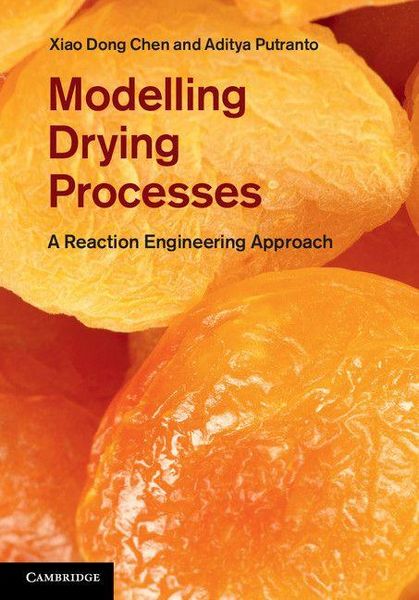
Modeling Drying Processes A Reaction Engineering Approach

194,99 €

inkl. gesetzl. MwSt., Versandkostenfrei


Beschreibung

Produktdetails

Einband

Gebundene Ausgabe

Erscheinungsdatum

23.05.2013

Verlag

Cambridge Academic

Seitenzahl

252

Maße (L/B/H)

25/17,5/1,8 cm

Gewicht

650 g

Sprache

Englisch

ISBN

978-1-107-01210-3

Beschreibung

Zitat

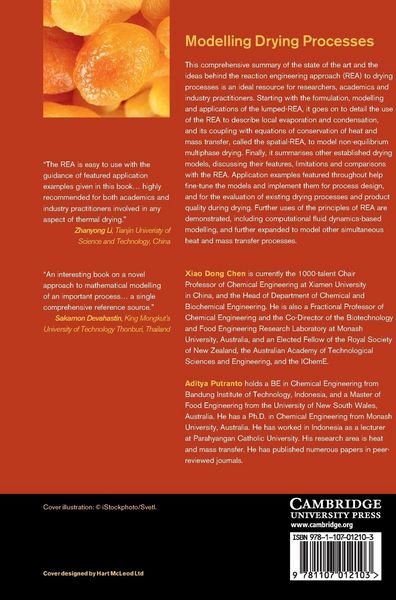
'The REA is easy to use with the guidance of featured application examples given in this book ... highly recommended for both academics and industry practitioners involved in any aspect of thermal drying.' Zhanyong Li, Tianjin University of Science and Technology 'An interesting book on a novel approach to mathematical modeling of an important process ... a single comprehensive reference source.' Sakamon Devahastin, King Mongkut's University of Technology Thonburi '... a profound [and] at the same time relatively easily implementable modelling approach to model and predict drying processes ... a very fundamental and theoretically rigorous spatially distributed modelling approach ...' Benu P. Adhikari, University of Ballarat, Australia

Produktdetails

Einband

Gebundene Ausgabe

Erscheinungsdatum

23.05.2013

Verlag

Cambridge Academic

Seitenzahl

252

Maße (L/B/H)

25/17,5/1,8 cm

Gewicht

650 g

Sprache

Englisch

ISBN

978-1-107-01210-3

Noch keine Bewertungen vorhanden

Verfassen Sie die erste Bewertung zu diesem Artikel

Helfen Sie anderen Kundinnen und Kunden durch Ihre Meinung.

Kundinnen und Kunden meinen

Bewertungen (0)

Die Leseprobe wird geladen.
  • Produktbild: Modeling Drying Processes
  • Produktbild: Modeling Drying Processes
  • 1. Introduction: 1.1. Practical background; 1.2. A 'microstructural' discussion of the phenomena of drying of moist porous materials; 1.3. The reaction engineering approach (REA) to modeling drying; 1.4. Summary; 2. Reaction Engineering Approach I: Lumped-REA: 2.1. The REA formulation; 2.2. Determination of REA model parameters; 2.3. Coupling the momentum, heat and mass balances; 2.4. Mass or heat transfer limiting; 2.5. Convective drying of particulates or thin layer products modeled using the L-REA; 2.6. Convective drying of thick samples modeled using the L-REA; 2.7. The intermittent drying of food materials modeled using the L-REA; 2.8. The intermittent drying under time-varying temperature and humidity modeled using the L-REA; 2.9. The heating of wood under linear-increased gas temperature modeled using the L-REA; 2.10. The baking of cake modeled using the L-REA; 2.11. The infrared-heating drying of a mixture of polymer solution under time-varying infrared-heating intensity modeled using the L-REA; 2.12. The intermittent drying of a mixture of polymer solution under time-varying infrared-heating intensity modeled using the L-REA; 2.13. Summary; 3. Reaction Engineering Approach II: Spatial-REA: 3.1. The spatial reaction engineering approach (S-REA) formulation; 3.2. Determination of the S-REA parameters; 3.3. The S-REA for convective drying; 3.4. The S-REA for intermittent drying; 3.5. The S-REA for wood heating under constant heating rate; 3.6. The S-REA for baking of bread; 3.7. Summary; 4. Comparisons of the REA with Fickian-Type Drying Theories, Luikov's and Whitaker's approach: 4.1. Model formulation; 4.2. Boundary conditions' controversies; 4.3. Diffusion-based model with the local evaporation rate; 4.4. Comparison of the diffusion-based model and the L-REA on the convective drying; 4.5. Comparison of the diffusion-based model and the S-REA on the convective drying; 4.6. Model formulation of Luikov's approach; 4.7. Model formulation of Whitaker's approach; 4.8. Comparison of the L-REA, Luikov's and Whitaker's approach for modeling heat treatment of wood under constant heating rate; 4.9. Comparison of the S-REA, Luikov's and Whitaker's approach for modeling heat treatment of wood under constant heating rate; 4.10. Summary.