• Produktbild: Modern Software Tools for Scientific Computing
  • Produktbild: Modern Software Tools for Scientific Computing
- 12%

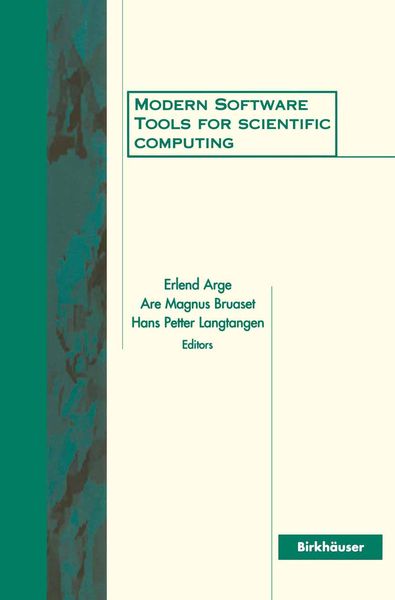
Modern Software Tools for Scientific Computing

12% sparen

93,99 € UVP 106,99 €

inkl. gesetzl. MwSt., Versandkostenfrei


Beschreibung

Produktdetails

Einband

Taschenbuch

Erscheinungsdatum

29.10.2012

Herausgeber

A. Bruaset + weitere

Verlag

Birkhäuser Boston

Seitenzahl

380

Maße (L/B/H)

23,5/15,5/2,2 cm

Gewicht

599 g

Auflage

Softcover reprint of the original 1st ed. 1997

Sprache

Englisch

ISBN

978-1-4612-7368-4

Beschreibung

Portrait

Prof. H. Petter Langtangen is the director of Center for Biomedical Computing, a Norwegian Center of Excellence at Simula Research Laboratory, and a professor of computer science at the University of Oslo. His research concerns numerical methods and software tools for continuum mechanical problems. Langtangen has been an active developer of open source and commercial software systems for computational sciences. He is a member of the European Academy of Sciences and serves on the editorial board of five leading international journals.

Produktdetails

Einband

Taschenbuch

Erscheinungsdatum

29.10.2012

Herausgeber

Verlag

Birkhäuser Boston

Seitenzahl

380

Maße (L/B/H)

23,5/15,5/2,2 cm

Gewicht

599 g

Auflage

Softcover reprint of the original 1st ed. 1997

Sprache

Englisch

ISBN

978-1-4612-7368-4

Herstelleradresse

Springer-Verlag GmbH
Tiergartenstr. 17
69121 Heidelberg
DE

Email: GPSR Kontakt

Kundinnen und Kunden meinen

0 Bewertungen

Informationen zu Bewertungen

Zur Abgabe einer Bewertung ist eine Anmeldung im Konto notwendig. Die Authentizität der Bewertungen wird von uns nicht überprüft. Wir behalten uns vor, Bewertungstexte, die unseren Richtlinien widersprechen, entsprechend zu kürzen oder zu löschen.

Die Bewertungen sind nach Format, Anzahl Sterne und Datum sortiert.

Verfassen Sie die erste Bewertung zu diesem Artikel

Helfen Sie anderen Kund*innen durch Ihre Meinung

Kundinnen und Kunden meinen

0 Bewertungen filtern

  • Produktbild: Modern Software Tools for Scientific Computing
  • Produktbild: Modern Software Tools for Scientific Computing
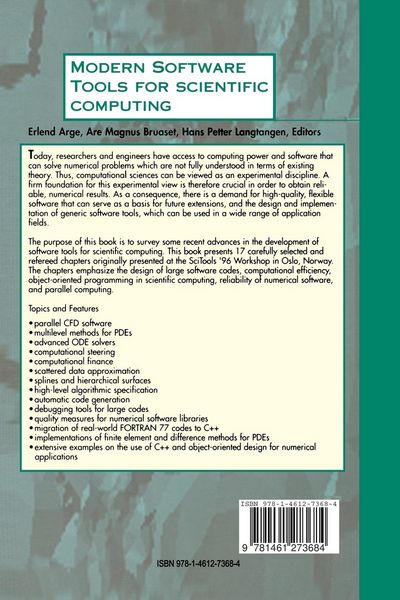
  • I. Computational Differential Equations.- 1 The SCIRun Computational Steering Software System.- 1.1 Introduction.- 1.2 Requirements of SCIRun as a Computational Steering System.- 1.3 Components of SCIRun.- 1.4 The Datatypes Library.- 1.5 Dataflow.- 1.6 Steering in a Dataflow System.- 1.7 Modules.- 1.8 Applications of SCIRun in Computational Medicine.- 1.9 Summary.- 1.10 Future Work.- 1.11 References.- 1.12 Software Appendix.- 2 Object-Oriented Solvers for Initial Value Problems.- 2.1 Introduction.- 2.2 Overview of the Code.- 2.3 Case Studies: New algorithms.- 2.4 Comparison with Classical Solvers.- 2.5 Conclusions.- 2.6 References.- 3 SPRINT2D Software for Convection Dominated PDEs.- 3.1 Introduction.- 3.2 The SPRINT2D Software.- 3.3 Mesh Generation and Adaptivity.- 3.4 A PSE for SPRINT2D.- 3.5 Case Studies.- 3.6 Conclusions.- 3.7 References.- 4 Electrochemical Modelling and Software Genericity.- 4.1 Introduction.- 4.2 Electrochemical Modelling.- 4.3 A Generalized Approach to Numerical Modelling.- 4.4 Abstractions.- 4.5 Critical Remarks.- 4.6 Conclusions.- 4.7 References.- 5 An Object-Oriented Adaptive Finite Element Code: Design Issues and Applications in Hyperthermia Treatment Planning.- 5.1 Introduction.- 5.2 Code Structure.- 5.3 Applications in Hyperthermia Treatment Planning.- 5.4 Concluding Remarks.- 5.5 References.- 6 On the Efficient Implementation of Multilevel Adaptive Methods.- 6.1 Introduction.- 6.2 Multilevel Implementations.- 6.3 Data Abstraction Concepts for Multilevel Adaptive Methods.- 6.4 Efficiency.- 6.5 Abstract Mesh Data Structures.- 6.6 Patch-Adaptive Multigrid.- 6.7 Conclusions.- 6.8 References.- 7 Finite Element Kernel with Metaobject Protocol.- 7.1 Introduction.- 7.2 Example Problems.- 7.3 Procedural Approach.- 7.4 Object-Oriented Approach.- 7.5 Algorithm-Oriented Approach.- 7.6 Conclusions.- 7.7 References.- 8 Efficient Management of Parallelism in Object-Oriented Numerical Software Libraries.- 8.1 Introduction.- 8.2 The Message Passing Model for Programming Distributed-Memory Parallel Systems.- 8.3 Distributed Computational Objects.- 8.4 Six Guiding Principles.- 8.5 PETSc Design of Fundamental Objects.- 8.6 Sample Performance Results.- 8.7 Conclusion.- 8.8 References.- 9 Object-Oriented Construction of Parallel PDE Solvers.- 9.1 Introduction.- 9.2 The Object-Oriented Approach.- 9.3 Overview of Cogito.- 9.4 Case Study 1: Application of Cogito/Grid.- 9.5 Case Study 2: Application of Cogito/Solver.- 9.6 Cogito for Implicit Methods.- 9.7 Validation of Cogito.- 9.8 Concluding Remarks.- 9.9 References.- 10 Modern Software Techniques in Computational Finance.- 10.1 Introduction.- 10.2 Option Computations.- 10.3 Software Design Issues in Option Valuation.- 10.4 FINANZIA Implementation and Examples.- 10.5 Future Extensions.- 10.6 Conclusions.- 10.7 References.- 11 Increasing the Efficiency and Reliability of Software Development for Systems of PDEs.- 11.1 Introduction.- 11.2 A Plastic Forming Process.- 11.3 The Basic Ideas.- 11.4 Diffpack.- 11.5 Systems of PDEs.- 11.6 Extensions of the Concept.- 11.7 Other Applications.- 11.8 Another Application of the Flexible Design.- 11.9 Concluding Remarks.- 11.10 References.- II. Computational Geometry.- 12 Object Oriented Surface Design.- 12.1 Overview.- 12.2 Geometrical Abstractions.- 12.3 Data Structures.- 12.4 Splines.- 12.5 Surfaces.- 12.6 Refiners.- 12.7 Applications.- 12.8 Development Environment.- 12.9 References.- 13 Object-Oriented Scattered Data Modelling with Siscat.- 13.1 Introduction.- 13.2 A Cartographic Model Problem.- 13.3 The Basic Surface Hierarchy in Siscat.- 13.4 Aspects of Basic Methods.- 13.5 Composite Methods.- 13.6 References.- III. Software Development.- 14 Is the Quality of Numerical Subroutine Code Improving?.- 14.1 Introduction.- 14.2 Software Metrics.- 14.3 A Comparison of Freely Available Packages.- 14.4 CALGO Fortran Codes.- 14.5 Conclusion.- 14.6 References.- 15 Object-Oriented Redesign of a Real-World Fortran 77 Solver.- 15.1 Introduction.- 15.2 The SEMPA Project.- 15.3 The CFD Program.- 15.4 Analysis and Redesign of the Solver.- 15.5 Original and New Module Comparison.- 15.6 Discussion of the Approach.- 15.7 References.- 16 Automating the Debugging of Large Numerical Codes.- 16.1 Introduction.- 16.2 Comparative Debugging.- 16.3 Examples of Use.- 16.4 The Wizard.- 16.5 Conclusion.- 16.6 References.- 17 The TAMPR Program Transformation System: Simplifying the Development of Numerical Software.- 17.1 Introduction.- 17.2 Some TAMPR Applications.- 17.3 The TAMPR Approach to Program Transformation.- 17.4 Example of the TAMPR Approach to Program Transformation.- 17.5 Conclusion.- 17.6 References.- List of Contributors.