Gutscheinbedingungen

Gültig bis 19.08.2026 | Gültig für Spielzeug, Filme, Musik, Software, Games, Elektronik, Geschenke & Trends, Schreibwaren, Hörbücher und Hörbuch-Downloads (außer Abo & Shelfies), gebrauchte Bücher, nicht preisgebundene Bücher und Kalender | Einlösbar unter osiander.de und in der Osiander App | Click & Collect nur mit Online-Zahlung (Paypal/Kreditkarte) vorab | Einzelne Artikel können ausgeschlossen sein | Nicht kombinierbar mit anderen Gutscheinen oder Preisaktionen | Nur einmal pro Einkauf einlösbar | Gutschein wird auf max. 500€ Bestellwert angerechnet | Keine Barauszahlung | Digitale Hörbücher nur für Android  | Nicht gültig für preisgebundene Artikel (aufgrund der Buchpreisbindung sind Gutscheine nicht auf Bücher, eBooks, Presse einlösbar), tolino eReader & Zubehör, Abonnements & Flatrates, Geschenkkarten, Versandkosten und Services

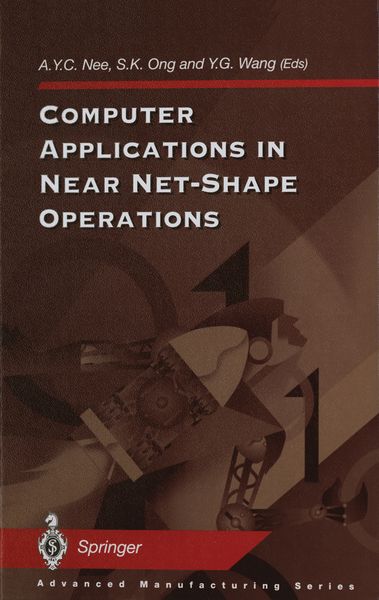
  • Produktbild: Computer Applications in Near Net-Shape Operations
  • Produktbild: Computer Applications in Near Net-Shape Operations

Computer Applications in Near Net-Shape Operations

Aus der Reihe Advanced Manufacturing

48,99 €

inkl. gesetzl. MwSt., Versandkostenfrei


Beschreibung

Produktdetails

Einband

Taschenbuch

Erscheinungsdatum

13.10.2012

Herausgeber

Andrew Y.C. Nee + weitere

Verlag

Springer London

Seitenzahl

322

Maße (L/B/H)

23,5/15,5/1,9 cm

Gewicht

528 g

Auflage

Softcover reprint of the original 1st ed. 1999

Sprache

Englisch

ISBN

978-1-4471-1159-7

Beschreibung

Produktdetails

Einband

Taschenbuch

Erscheinungsdatum

13.10.2012

Herausgeber

Verlag

Springer London

Seitenzahl

322

Maße (L/B/H)

23,5/15,5/1,9 cm

Gewicht

528 g

Auflage

Softcover reprint of the original 1st ed. 1999

Sprache

Englisch

ISBN

978-1-4471-1159-7

Herstelleradresse

Springer-Verlag KG
Sachsenplatz 4-6
1201 Wien
AT

Email: GPSR Kontakt

Noch keine Bewertungen vorhanden

Verfassen Sie die erste Bewertung zu diesem Artikel

Helfen Sie anderen Kundinnen und Kunden durch Ihre Meinung.

Kundinnen und Kunden meinen

Bewertungen (0)

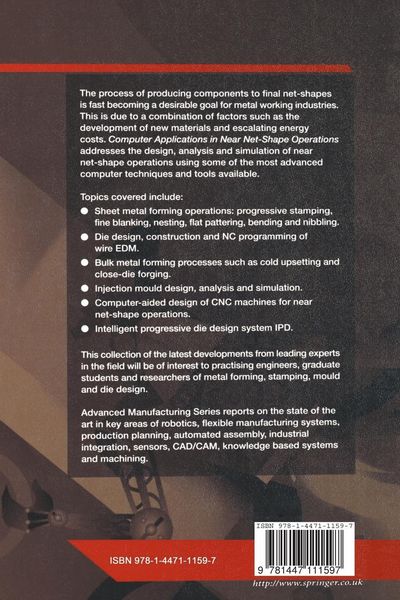
  • Produktbild: Computer Applications in Near Net-Shape Operations
  • Produktbild: Computer Applications in Near Net-Shape Operations
  • 1 Introduction to near net-shape operations.- 1.1 Introduction.- 1.2 Classification of near net-shape operations.- 1.2.1 Sheet metal forming.- 1.2.2 Massive (bulk) metal forming processes.- 1.2.3 Injection moulding.- 1.2.4 Machines for near net-shape operations.- 1.3 Near net-shape operations: past, present and future.- 2 CAD/CAM for sheet metal forming and related processes.- 2.1 Introduction and basic techniques.- 2.1.1 Feature modelling of stampings.- 2.1.2 Application of expert systems to stamping die design.- 2.2 Optimisation of blank layout.- 2.2.1 Mathematical description of blank layout.- 2.2.2 The polygon method.- 2.2.3 The height function method.- 2.3 Fine blanking.- 2.3.1 Characteristics of the fine blanking process.- 2.3.2 Application of the fine blanking process.- 2.3.3 CAD/CAM of fine blanking dies.- 2.4 Progressive stamping.- 2.4.1 Software architecture of the system.- 2.4.2 Strip layout.- 2.4.3 Construction design of progressive dies.- 2.5 An overview of a flat patterning and bending simulation system.- 2.5.1 Design input module.- 2.5.2 Flat pattern development module.- 2.5.3 Bending simulation module.- 2.5.4 System details.- 2.5.5 Implementation of bending simulation module.- 2.6 CNC punching and nibbling.- 2.6.1 Computer-based system for CNC nibbling.- 2.6.2 Punch libraries.- 2.6.3 Profile classification.- 2.6.4 Punch selection and optimisation.- 2.6.5 An approach to automatic tool selection.- 2.6.6 A case study.- 2.7 Die construction design.- 2.7.1 Design of die and punch.- 2.7.2 Layout of ejectors.- 2.8 NC programming of wire EDM.- 2.8.1 Process consideration for NC programming of wire EDM.- 2.8.2 Geometric computation.- 2.8.3 NC programming procedure for wire EDM.- References.- 3 CAD/CAM for massive (bulk) metal forming.- 3.1 Introduction.- 3.2 Cold upsetting.- 3.2.1 Determination of operations and sequences.- 3.2.2 Calculation of process parameters.- 3.2.3 Design of dies cavities, general parts and combined dies.- 3.2.4 The BNC CAD system.- 3.3 Closed-die forging.- 3.3.1 Selection and calculation of bars.- 3.3.2 Determination of operations and sequences.- 3.3.3 Calculation of forging load and stress.- 3.3.4 Design of dies.- 3.3.5 Program flowchart and description.- References.- 4 CAD/CAE/CAM for injection moulding.- 4.1 Introduction.- 4.1.1 Brief history of development.- 4.1.2 Technological characteristics.- 4.2 Graphic input and geometry construction of injection moulded products.- 4.2.1 Wire-frame modelling.- 4.2.2 Surface modelling.- 4.2.3 Solid modelling.- 4.3 CAD for construction design of plastic injection moulds.- 4.3.1 Program flowchart.- 4.3.2 Standard mould base design.- 4.3.3 Cavity and core design.- 4.3.4 Runner bar design.- 4.4 Flow simulation of plastic injection moulding.- 4.4.1 One-dimensional flow analysis.- 4.4.2 Two-dimensional flow analysis.- 4.4.3 Three-dimensional flow analysis.- 4.5 Cooling simulation of plastic injection moulding.- 4.5.1 One-dimensional cooling analysis.- 4.5.2 Two-dimensional cooling analysis.- 4.5.3 Three-dimensional cooling analysis.- 4.6 CAM for plastic injection moulds.- 4.6.1 Integrated CAD/CAM system.- 4.6.2 Information transfer from CAD to CAM.- 4.6.3 Tool path generation in 2-D NC.- 4.6.4 Manufacturing for 3-D core and cavity.- 4.7 CAD/CAE/CAM system for plastic injection moulding.- 4.7.1 System configuration.- 4.7.2 CAD software functions.- 4.7.3 CAE software functions.- 4.7.4 CAM software functions.- 5 FEM applications in near net-shape operations.- 5.1 Introduction.- 5.2 FEM applications and developments in near net-shape operations.- 5.2.1 New algorithms for automatic triangular mesh generation.- 5.2.2 New algorithms for mesh rezoning in FEM simulation.- 5.2.3 Algorithms for generating isogram in FEM.- 5.2.4 Calculation of rigid regions using rigid-plastic FEM.- 5.3 FEM applications in massive (bulk) metal forming processes.- 5.3.1 Simulation of rigid-plastic finite element of radial extrusion process.- 5.3.2 Rigid-plastic finite element simulation of the upsetting-backward extrusion process.- 5.3.3 Simulation of forward extrusion and upsetting-backward extrusion process.- 5.4 FEM application in die design.- 5.4.1 Basic equations for FEM analysis of combined die and mathematical modelling of pre-stressing force.- 5.4.2 FEM solution and program flowchart.- 5.4.3 FEM analysis for combined backward extrusion die.- 5.4.4 FEM analysis for combined forward extrusion die.- 5.4.5 FEM analysis for precision forging die for blades.- 5.4.6 Optimisation design of combined dies.- 5.5 FEM application in analysis of hydraulic presses.- 5.5.1 Finite element analysis of fluid transients.- 5.5.2 Non-symmetrical frontal solution method for fluid FEM 240 References.- 6 CAE/CNC of machines for near net-shape operations.- 6.1 Introduction.- 6.2 Universal CNC systems for near net-shape operations.- 6.2.1 Composition of universal CNC control system.- 6.2.2 Intelligent control module board.- 6.2.3 Module of control software.- 6.2.4 Communication in an integrated-distributed CNC system.- 6.3 CNC for sheet metal forming machines.- 6.3.1 CNC system for shearing machines.- 6.3.2 CNC system for press brakes.- 6.4 FMC for sheet metal bending.- 6.4.1 CNC and automatic generation of system software.- 6.4.2 Bending design based on features.- 6.4.3 Manufacturability criteria for sheet metal bending FMC.- 7 IMOLD®: an intelligent mould design and assembly system.- 7.1 Introduction.- 7.2 Injection moulding.- 7.3 Computer applications in injection mould design.- 7.4 IMOLD®.- 7.4.1 IMOLD® functional modules.- 7.4.2 Design information management in IMOLD®: assembly tree.- 7.5 An example.- 7.6 Conclusions.- References.- 8 Computer applications in intelligent progressive dies design (IPD).- 8.1 Introduction.- 8.2 Overview of the computer architecture.- 8.3 Advanced knowledge-based techniques for the modelling and generation of progressive dies.- 8.3.1 A model-based reasoning (MBR) approach for die design.- 8.3.2 Shape representation and spatial reasoning techniques.- 8.3.3 A function-spatial language for the configuration of a die.- 8.4 An industrial case study.- 8.4.1 Introduction.- 8.4.2 Description of stamping.- 8.4.3 Features of the part.- 8.4.4 Modelling the part.- 8.4.5 The flat pattern.- 8.4.6 The strip layout.- 8.4.7 3-D strip layout.- 8.4.8 Configuration of the progressive die.- 8.4.9 Technical data generated by the system.- 8.5 Conclusions.