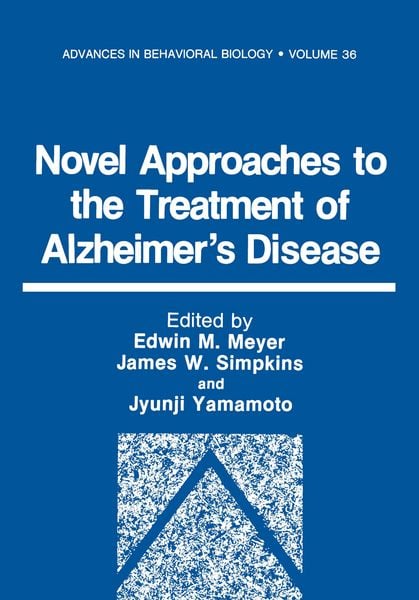

• Produktbild: Novel Approaches to the Treatment of Alzheimer’s Disease
  • Produktbild: Novel Approaches to the Treatment of Alzheimer’s Disease
Band 36

Novel Approaches to the Treatment of Alzheimer’s Disease

49,99 €

inkl. gesetzl. MwSt., Versandkostenfrei


Beschreibung

Produktdetails

Einband

Taschenbuch

Erscheinungsdatum

25.11.2012

Herausgeber

E. Meyer

Verlag

Springer Us

Seitenzahl

386

Maße (L/B/H)

24,4/17/2,2 cm

Gewicht

695 g

Auflage

Softcover reprint of the original 1st ed. 1989

Sprache

Englisch

ISBN

978-1-4684-5729-2

Beschreibung

Produktdetails

Einband

Taschenbuch

Erscheinungsdatum

25.11.2012

Herausgeber

E. Meyer

Verlag

Springer Us

Seitenzahl

386

Maße (L/B/H)

24,4/17/2,2 cm

Gewicht

695 g

Auflage

Softcover reprint of the original 1st ed. 1989

Sprache

Englisch

ISBN

978-1-4684-5729-2

Herstelleradresse

Springer-Verlag GmbH
Tiergartenstr. 17
69121 Heidelberg
DE

Email: ProductSafety@springernature.com

Kundinnen und Kunden meinen

0 Bewertungen

Informationen zu Bewertungen

Zur Abgabe einer Bewertung ist eine Anmeldung im Konto notwendig. Die Authentizität der Bewertungen wird von uns nicht überprüft. Wir behalten uns vor, Bewertungstexte, die unseren Richtlinien widersprechen, entsprechend zu kürzen oder zu löschen.

Die Bewertungen sind nach Format, Anzahl Sterne und Datum sortiert.

Verfassen Sie die erste Bewertung zu diesem Artikel

Helfen Sie anderen Kund*innen durch Ihre Meinung

Kundinnen und Kunden meinen

0 Bewertungen filtern

  • Produktbild: Novel Approaches to the Treatment of Alzheimer’s Disease
  • Produktbild: Novel Approaches to the Treatment of Alzheimer’s Disease
  • Section I. Drugs that Act at Cholinergic Receptors.- A Functionalized Congener Approach to Muscarinic Ligands.- AF102B: A Novel M1 Agonist as a Rational Treatment Strategy in Alzheimer’s Disease.- Muscarinic Receptors, Phosphoinositide Hydrolysis and Neuronal Plasticity in the Hippocampus.- Effects of Cholinergic Drugs on Extracellular Levels of Acetylcholine and Choline in Rat Cortex, Hippocampus and Striatum Studied byu Brain Dialysis.- Delayed Matching-to-Sample in Monkeys as a Model for Learning and Memory Deficits: Role of Brain Nicotinic Receptors.- Muscarinic and Nicotinic Receptors in Alzheimer’s Disease: Rationale for Cholinergic Drug Treatment.- Section II. CNS-Active Neurotrophic Factors.- Potential Pharmacological Use of Neurotrophic Factors in the Treatment of Neurodegenerative Diseases.- The Use of Reaggregating Cell Cultures and Immortalized Central Nervous System Cells to Study Cholinergic Trophic Mechanisms.- Approaches to Gene Therapy in the CNS: Intracerebral Grafting of Fibroblasts Genetically Modified to Secrete Nerve Growth Factor.- Exogenous Nerve Growth Factor Stimulates Choline Acetyltransferase Activity in Basal Forebrain of Axotomized and Aged Rats.- Neuronotrophic Factors, Gangliosides and Their Interaction: Implications in the Regulation of Nervous System Plasticity.- Suppression of Active Neuronal Death by Immune Interferon.- Basic Fibroblast Growth Factor, an Example of a Multifunctional Trophic Factor with Neurotrophic Activity.- Growth Factor and Lymphokine Effects on Brain Cholinergic Systems.- Metabolic Support of Neural Plasticity: Implications for the Treatment of Alzheimers Disease.- Section III. Additional Novel Treatment Strategies: Improved Brain Delivery, Hormones, and Immunology.- Brain-Enhanced Delivery of Anti-Dementia Drugs.- Development of a Pyrrolidinone Derivative (Cyclic GABA)for Modulating Brain Glutamate Transmission.- A Brain-Enhanced Chemical Delivery System for Gonadal Steroids: Implications for Neurodegenerative Diseases.- Immunologic Approach to Therapy in Alzheimer’s Disease.- The Influence of ACTH 4–9 Analog upon Avoidance Learning in Normal and Brain Damaged Rats.- Section IV. Models for Drug-Development: Cholinergic Hypofunction.- Transneuronal Neurochemical and Neuropathological Changes Induced by Nucleus Basalis Lesions: A Possible Degenerative Mechanism in Alzheimer’s Disease.- Presynaptic Markers of Cholinergic Function in Cortex Following Ibotenic Acid Lesion of the Basal Forebrain.- Cholinergic-Neuropeptide Y Interactions in the Rat Cerebralcortex: Towards a Model for the Trans-synapticEffects of Cholinergic Transmission.- The Effects of Nucleus Basalis Lesions in the Rat on One Way Passive and Active Avoidance, Two Way Avoidance and Lashly III Maze Learning: An Animal Model for SDAT.- Section V. Models for Drug Development: Other Neurochemical and Behavioral Changes.- NMDA Receptors, Aging and Alzheimer’s Disease.- An Excitotoxic Model of Alzheimer’s Disease: NMDA Lesions and Initial Neural Grafting Results.- Excitotoxin Mediated Neuronal Loss and the Regulation of Excitatory Amino Acid Release in the Aging Brain.- EEG Power Spectra and Brain Function.- Postmortem Stability of RNA Metabolism in Human Brain: Studies of the Nondemented Conrol and Alzheimer’s Disease Cases.- A Model System Demonstrating Parallels in Animal and Human Aging: Extension to Alzheimer’s Disease.- Computer-Simulated Everyday Memory Testing for Clinical Trials in Memory Disorders of Aging.