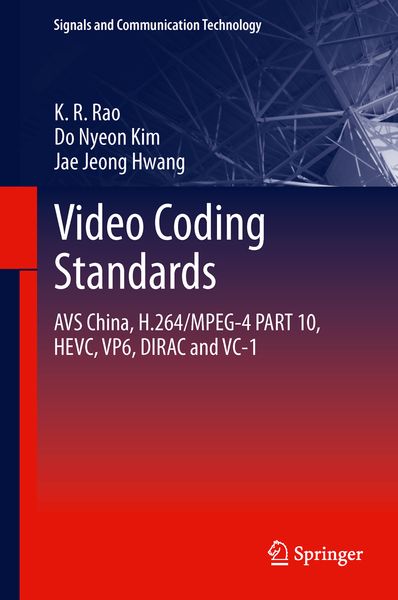
Video coding standards AVS China, H.264/MPEG-4 PART 10, HEVC, VP6, DIRAC and VC-1
138,99 €
UVP
160,49 €
inkl. gesetzl. MwSt.,
Beschreibung
Produktdetails
Einband
Gebundene Ausgabe
Erscheinungsdatum
21.10.2013
Abbildungen
XXIII, 499 p. 335 illus.
Verlag
Springer NetherlandSeitenzahl
499
Maße (L/B/H)
24,1/16/3,3 cm
Gewicht
945 g
Auflage
1. Auflage
Sprache
Englisch
ISBN
978-94-007-6741-6
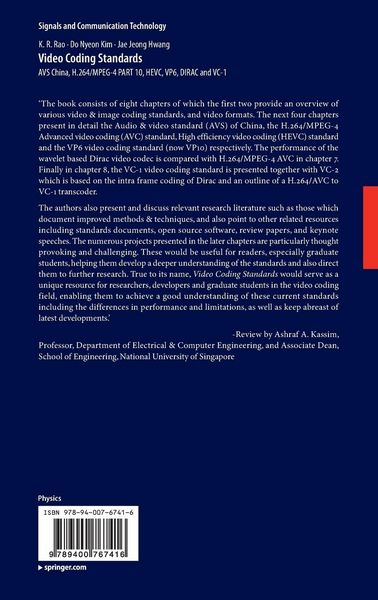
The requirements for multimedia (especially video and audio) communications increase rapidly in the last two decades in broad areas such as television, entertainment, interactive services, telecommunications, conference, medicine, security, business, traffic, defense and banking. Video and audio coding standards play most important roles in multimedia communications. In order to meet these requirements, series of video and audio coding standards have been developed such as MPEG-2, MPEG-4, MPEG-21 for audio and video by ISO/IEC, H.26x for video and G.72x for audio by ITU-T, Video Coder 1 (VC-1) for video by the Society of Motion Picture and Television Engineers (SMPTE) and RealVideo (RV) 9 for video by Real Networks.
AVS China is the abbreviation for Audio Video Coding Standard of China. This new standard includes four main technical areas, which are systems, video, audio and digital copyright management (DRM), and some supporting documents such as consistency verification. The second part of the standard known as AVS1-P2 (Video - Jizhun) was approved as the national standard of China in 2006, and several final drafts of the standard have been completed, including AVS1-P1 (System - Broadcast), AVS1-P2 (Video - Zengqiang), AVS1-P3 (Audio - Double track), AVS1-P3 (Audio - 5.1), AVS1-P7 (Mobile Video), AVS-S-P2 (Video) and AVS-S-P3 (Audio). AVS China provides a technical solution for many applications such as digital broadcasting (SDTV and HDTV), high-density storage media, Internet streaming media, and will be used in the domestic IPTV, satellite and possibly the cable TV market. Comparing with other coding standards such as H.264 AVC, the advantages of AVS video standard include similar performance, lower complexity, lower implementation cost and licensing fees. This standard has attracted great deal of attention from industries related to television, multimedia communications and even chip manufacturing from around the world. Also many well known companieshave joined the AVS Group to be Full Members or Observing Members. The 163 members of AVS Group include Texas Instruments (TI) Co., Agilent Technologies Co. Ltd., Envivio Inc., NDS, Philips Research East Asia, Aisino Corporation, LG, Alcatel Shanghai Bell Co. Ltd., Nokia (China) Investment (NCIC) Co. Ltd., Sony (China) Ltd., and Toshiba (China) Co. Ltd. as well as some high level universities in China. Thus there is a pressing need from the instructors, students, and engineers for a book dealing with the topic of AVS China and its performance comparisons with similar standards such as H.264, VC-1 and RV-9.
Noch keine Bewertungen vorhanden
Verfassen Sie die erste Bewertung zu diesem Artikel
Helfen Sie anderen Kundinnen und Kunden durch Ihre Meinung.
Kurze Frage zu unserer Seite
Vielen Dank für Ihr Feedback
Wir nutzen Ihr Feedback, um unsere Produktseiten zu verbessern. Bitte haben Sie Verständnis, dass wir Ihnen keine Rückmeldung geben können. Falls Sie Kontakt mit uns aufnehmen möchten, können Sie sich aber gerne an unseren Kund*innenservice wenden.
zum Kundenservice