
Gutscheinbedingungen

Gültig bis 13.07.2026 | Gültig für Spielzeug (außer Tonieboxen & ausgewählte Tonies), Filme, Musik, Software, Games, Schreibwaren, Hörbücher und Hörbuch-Downloads (außer Abo & Shelfies), gebrauchte Bücher, nicht preisgebundene Bücher und Kalender | Einlösbar unter osiander.de und in der Osiander App | Click & Collect nur mit Online-Zahlung (Paypal/Kreditkarte) vorab | Einzelne Artikel können ausgeschlossen sein | Nicht kombinierbar mit anderen Gutscheinen oder Preisaktionen | Nur einmal pro Einkauf einlösbar | Gutschein wird auf max. 500€ Bestellwert angerechnet | Keine Barauszahlung | Digitale Hörbücher nur für Android | Nicht gültig für preisgebundene Artikel (aufgrund der Buchpreisbindung sind Gutscheine nicht auf Bücher, eBooks, Presse einlösbar), tolino eReader & Zubehör, Elektronik, Geschenke & Trends, Abonnements & Flatrates, Geschenkkarten, Versandkosten und Services

  • Produktbild: Cohesion and Conflict in International Communism
  • Produktbild: Cohesion and Conflict in International Communism
- 12%

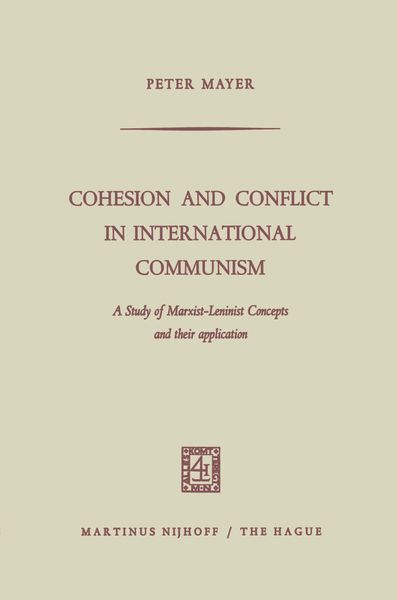
Cohesion and Conflict in International Communism A Study of Marxist-Leninist Concepts and Their Application

12% sparen

93,99 € UVP 106,99 €

inkl. gesetzl. MwSt., Versandkostenfrei


Beschreibung

Produktdetails

Einband

Taschenbuch

Erscheinungsdatum

01.01.1968

Verlag

Springer Netherland

Seitenzahl

257

Maße (L/B/H)

23,5/15,5/1,6 cm

Auflage

1. Auflage

Sprache

Englisch

ISBN

978-94-015-0030-2

Beschreibung

Produktdetails

Einband

Taschenbuch

Erscheinungsdatum

01.01.1968

Verlag

Springer Netherland

Seitenzahl

257

Maße (L/B/H)

23,5/15,5/1,6 cm

Auflage

1. Auflage

Sprache

Englisch

ISBN

978-94-015-0030-2

Herstelleradresse

Springer-Verlag GmbH
Tiergartenstr. 17
69121 Heidelberg
DE

Email: ProductSafety@springernature.com

Noch keine Bewertungen vorhanden

Verfassen Sie die erste Bewertung zu diesem Artikel

Helfen Sie anderen Kundinnen und Kunden durch Ihre Meinung.

Kundinnen und Kunden meinen

Bewertungen (0)

  • Produktbild: Cohesion and Conflict in International Communism
  • Produktbild: Cohesion and Conflict in International Communism
  • I. The Unity Theory VS. Socialism in One Country.- From “Proletarian internationalism” to “Socialism in One Country”.- II. The Soviet View of the Socialist World State: Development and Control Factor Aspects.- a. Factors based on power and ideology.- b. Historical-analytical approach based on world Communist Party history.- c. Historical-analytical approach based mainly on bilateral relations between communist states.- d. Variations of (b) and (c).- e. The “documentary with comments” approach.- f. Anthologies.- g. Works outside political science.- The Soviet Conception of the Communist Camp Future.- III. A Consideration of Chinese Contributions to “Marxism,” Including “Prolonged Struggle” and “revolutionary Fervor”.- The Chinese Communist View of Permissible and Impermissible “Paths to Socialism”.- IV. The Sino-Soviet Dispute, and Some Implications for the Future of the World Communist Movement.- The Dialectics of Dispute: Tactics and Strategy of Communist Concepts in the Thermonuclear Age.- 1. Precedence in Camp Affairs.- 2. The Marxist Concept of War and Peace.- 3. The Balance of Power Between the Two Camps.- 4. The Kremlin’s Theory of Coexistence.- 5. Policies Regarding the Underdeveloped Areas.- 6. Material Aid: Who Gets What.- 7. Personality Factors.- 8. Population Pressures.- Unity or Diversity.- Factors Tending Toward Unity in the Communist Camp.- The Breakdown in Communications.- The Changing Political Realities.- The Italian and German Party Congresses, 1962 and 1963.- Communist Dogma or “Creative Marxism”?.- V. The Soviet Union and East Europe: Conflict, Support and Opposition.- Institutionalized Divergence: The Case of Yugoslavia.- Albania: China’s Window to Europe.- Poland: Nationalism Contained by Territorial Claims.- Hungary: From Repression to Permissiveness?.- Rumania: Path to Economic Independence.- Bulgaria: Unconditional Support for the U.S.S.R..- Czechoslovakia: Politics take Precedence over Ideology.- East Germany: The Permanent Satellite.- Conclusion.- VI. The International Communist Movement: A Reappraisal of Some Theoretical Concepts.