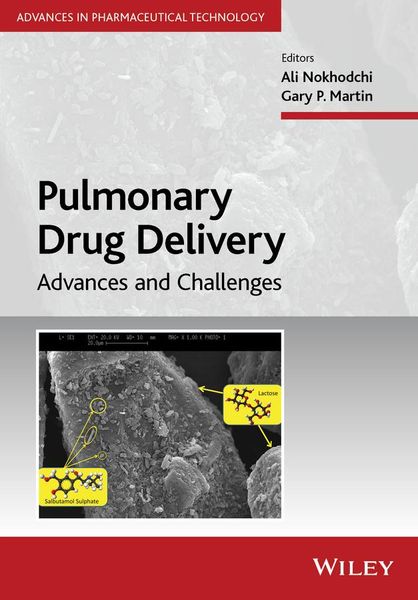
Produktbild: Pulmonary Drug Delivery
Band 1

Pulmonary Drug Delivery Advances and Challenges

225,99 €

inkl. gesetzl. MwSt., Versandkostenfrei


Beschreibung

Produktdetails

Einband

Gebundene Ausgabe

Erscheinungsdatum

03.08.2015

Herausgeber

Ali Nokhodchi + weitere

Verlag

John Wiley & Sons

Seitenzahl

384

Maße (L/B/H)

24,6/17,3/2 cm

Gewicht

762 g

Auflage

1. Auflage

Sprache

Englisch

ISBN

978-1-118-79954-3

Beschreibung

Produktdetails

Einband

Gebundene Ausgabe

Erscheinungsdatum

03.08.2015

Herausgeber

Verlag

John Wiley & Sons

Seitenzahl

384

Maße (L/B/H)

24,6/17,3/2 cm

Gewicht

762 g

Auflage

1. Auflage

Sprache

Englisch

ISBN

978-1-118-79954-3

Kundinnen und Kunden meinen

0 Bewertungen

Informationen zu Bewertungen

Zur Abgabe einer Bewertung ist eine Anmeldung im Konto notwendig. Die Authentizität der Bewertungen wird von uns nicht überprüft. Wir behalten uns vor, Bewertungstexte, die unseren Richtlinien widersprechen, entsprechend zu kürzen oder zu löschen.

Die Bewertungen sind nach Format, Anzahl Sterne und Datum sortiert.

Verfassen Sie die erste Bewertung zu diesem Artikel

Helfen Sie anderen Kund*innen durch Ihre Meinung

Kundinnen und Kunden meinen

0 Bewertungen filtern

Die Leseprobe wird geladen.
  • Produktbild: Pulmonary Drug Delivery
  • List of Contributors xiii

    Series Preface xvii

    Preface xix

    1. Lung Anatomy and Physiology and Their Implications for Pulmonary Drug Delivery 1
    Rahul K. Verma, Mariam Ibrahim, and Lucila Garcia-Contreras

    1.1 Introduction 2

    1.2 Anatomy and Physiology of Lungs 2

    1.2.1 Macro- and Microstructure of the Airways and Alveoli as It Pertains to Drug Delivery 2

    1.2.2 Lung Surfactant 4

    1.2.3 Pulmonary Blood Circulation 5

    1.3 Mechanisms of Aerosol Deposition 5

    1.3.1 Impaction 6

    1.3.2 Sedimentation 6

    1.3.3 Interception 6

    1.3.4 Diffusion 7

    1.4 Drug Absorption 7

    1.4.1 Mechanisms of Drug Absorption from the Lungs 7

    1.5 Physiological Factors Affecting the Therapeutic Effectiveness of Drugs Delivered by the Pulmonary Route 8

    1.5.1 Airway Geometry 8

    1.5.2 Inhalation Mode 8

    1.5.3 Airflow Rate 9

    1.5.4 Mechanism of Particle Clearance 9

    1.5.5 Lung Receptors 10

    1.5.6 Disease States 11

    1.5.7 Effect of Age and Gender Difference 11

    1.6 Computer Simulations to Describe Aerosol Deposition in Health and Disease 11

    1.6.1 Semiempirical Models 12

    1.6.2 Deterministic Models 12

    1.6.3 Trumpet Models (One-Dimensional) 12

    1.6.4 Stochastic, Asymmetric Generation Models 13

    1.6.5 Computation Fluid Dynamics (CFD)-Based Model 13

    1.7 Conclusions 13

    References 14

    2. The Role of Functional Lung Imaging in the Improvement of Pulmonary Drug Delivery 19
    Andreas Fouras and Stephen Dubsky

    2.1 Introduction 19

    2.1.1 Particle Deposition 20

    2.1.2 Regional Action of Delivered Drug 22

    2.1.3 The Role of Functional Lung Imaging in Pulmonary Drug Delivery 22

    2.2 Established Functional Lung Imaging Technologies 23

    2.2.1 Computed Tomography 23

    2.2.2 Ventilation Measurement using 4DCT Registration-based Methods 24

    2.2.3 Hyperpolarized Magnetic Resonance Imaging 24

    2.2.4 Electrical Impedance Tomography 25

    2.2.5 Nuclear Medical Imaging (PET/SPECT) 25

    2.3 Emerging Technologies 26

    2.3.1 Phase-contrast Imaging 26

    2.3.2 Grating Interferometry 27

    2.3.3 Propagation-based Phase-contrast Imaging 28

    2.3.4 Functional Lung Imaging using Phase Contrast 28

    2.3.5 Laboratory Propagation-based Phase-contrast Imaging 29

    2.4 Conclusion 30

    References 31

    3. Dry Powder Inhalation for Pulmonary Delivery: Recent Advances and Continuing Challenges 35
    Simone R. Carvalho, Alan B. Watts, Jay I. Peters, and Robert O. Williams III

    3.1 Introduction 36

    3.2 Dry Powder Inhaler Devices 37

    3.2.1 Overview 37

    3.2.2 Recent Innovations in Dry Powder Inhaler Technology 39

    3.3 New Developments in DPI Formulations and Delivery 43

    3.3.1 Particle Surface Modification 43

    3.3.2 Particle Engineering Technology for Pulmonary Delivery 44

    3.4 Characterization Methods of Dry Powder Inhaler Formulations 50

    3.5 Conclusion 52

    References 53

    4. Pulmonary Drug Delivery to the Pediatric Population - A State-of-the-Art Review 63
    Marie-Pierre Flament

    4.1 Introduction 63

    4.2 Patient Consideration 64

    4.2.1 Anatomy and Physiology of Children's Lungs 64

    4.2.2 Nasal Versus Oral Inhalation 65

    4.2.3 Patient-related Factors Influencing Aerosol Deposition 66

    4.2.4 Age and Dosage Forms of Choice 67

    4.3 Delivery Systems for the Pediatric Population 69

    4.3.1 Nebulizers 69

    4.3.2 Pressurized Metered Dose Inhalers 72

    4.3.3 Dry Powder Inhalers 73

    4.3.4 Interfaces 74

    4.4 Recommendations 80

    4.5 Conclusion 82

    References 82

    5. Formulation Strategies for Pulmonary Delivery of Poorly Soluble Drugs 87
    Nathalie Wauthoz and Karim Amighi

    5.1 Introduction 88

    5.1.1 In vivo Fate of Inhaled Poorly Water-soluble Drugs 89

    5.1.2 The Pharmacokinetics of Inhaled Poorly Water-soluble Drugs Administered for Local and Systemic Action 92

    5.1.3 Formulation Strategies for Pulmonary Delivery of Poorly Water-soluble Drugs 93

    5.2 Co-solvents 93

    5.3 Cyclodextrins 97

    5.4 PEGylation 99

    5.5 Reduction of Size to Micro-/Nanoparticles 100

    5.5.1 Nanocrystal Suspension 101

    5.5.2 Nanocrystals in a Hydrophilic Matrix System 102

    5.5.3 Nanoclusters 103

    5.6 Solid Dispersion/Amorphization 103

    5.7 Micelles 106

    5.8 Liposomes 108

    5.9 Solid Lipid Nanoparticles and Nanostructured Lipid Carriers 110

    5.10 Conclusion 111

    References 114

    6. Lipidic Micro- and Nano-Carriers for Pulmonary Drug Delivery - A State-of-the-Art Review 123
    Yahya Rahimpour, Hamed Hamishehkar, and Ali Nokhodchi

    6.1 Introduction 124

    6.2 Pulmonary Drug Delivery 125

    6.3 Liposomal Pulmonary Delivery 126

    6.4 Nebulization of Liposomes 126

    6.5 Liposomal Dry-powder Inhalers 128

    6.6 Solid Lipid Microparticles in Pulmonary Drug Delivery 129

    6.7 Solid Lipid Nanoparticles in Pulmonary Drug Delivery 131

    6.8 Nanostructured Lipid Carrier (NLC) in Pulmonary Drug Delivery 133

    6.9 Nanoemulsions in Pulmonary Drug Delivery 134

    6.10 Conclusion and Perspectives 135

    References 136

    7. Chemical and Compositional Characterisation of Lactose as a Carrier in Dry Powder Inhalers 143
    Rim Jawad, Gary P. Martin and Paul G. Royall

    7.1 Introduction 144

    7.2 Production of Lactose 145

    7.3 Lactose: Chemical Forms, Solid-State Composition, Physicochemical Properties 147

    7.4 Epimerisation of Lactose 150

    7.5 Analysis of Lactose 151

    7.5.1 Powder X-ray Diffraction 152

    7.5.2 Nuclear Magnetic Resonance 153

    7.5.3 Infrared Spectroscopy 156

    7.5.4 Differential Scanning Calorimetry 157

    7.5.5 Polarimetry 158

    7.6 The Influence of the Chemical and Solid-State Composition of Lactose Carriers on the Aerosolisation of DPI Formulations 159

    7.7 Conclusions 163

    References 163

    8. Particle Engineering for Improved Pulmonary Drug Delivery Through Dry Powder Inhalers 171
    Waseem Kaialy and Ali Nokhodchi

    8.1 Introduction 172

    8.2 Dry Powder Inhalers 172

    8.3 Particle Engineering to Improve the Performance of DPIs 172

    8.3.1 Crystallization 173

    8.3.2 Spray-drying 174

    8.3.3 Spray-freeze-drying 177

    8.3.4 Supercritical Fluid Technology 177

    8.3.5 Pressure Swing Granulation (PSG) Technique 178

    8.4 Engineered Carrier Particles for Improved Pulmonary Drug Delivery from Dry Powder Inhalers 178

    8.5 Relationships between Physical Properties of Engineered Particles and Dry Powder Inhaler Performance 182

    8.5.1 Particle Size 182

    8.5.2 Flow Properties 184

    8.5.3 Particle Shape 185

    8.5.4 Particle Surface Texture 187

    8.5.5 Fine Particle Additives 188

    8.5.6 Surface Area 188

    8.6 Conclusions 189

    References 189

    9. Particle Surface Roughness - Its Characterisation and Impact on Dry Powder Inhaler Performance 199
    Bernice Mei Jin Tan, Celine Valeria Liew, Lai Wah Chan, and Paul Wan Sia Heng

    9.1 Introduction 200

    9.2 What is Surface Roughness? 200

    9.3 Measurement of Particle Surface Roughness 202

    9.3.1 General Factors to Consider During a Measurement 202

    9.3.2 Direct Methods to Profile or Visualise Surface Roughness 204

    9.3.3 Indirect Measurement of Surface Roughness 206

    9.4 Impact of Surface Roughness on Carrier Performance - Theoretical Considerations 206

    9.4.1 Mixing and Blend Stability 206

    9.4.2 Drug-carrying Capacity 207

    9.4.3 Drug Adhesion 207

    9.4.4 Drug Detachment 208

    9.4.5 Particle Arrangement in Ordered Mixtures After the Addition of Fine Excipient 209

    9.5 Particle Surface Modification 210

    9.5.1 Spray Drying 210

    9.5.2 Solution Phase Processing 211

    9.5.3 Crystallisation 213

    9.5.4 Sieving 213

    9.5.5 Fluid-bed Coating 213

    9.5.6 Dry Powder Coating 213

    9.6 Conclusion 215

    References 215

    10. Dissolution: A Critical Performance Characteristic of Inhaled Products? 223
    Ben Forbes, Nathalie Hauet Richer, and Francesca Buttini

    10.1 Introduction 223

    10.2 Dissolution of Inhaled Products 224

    10.2.1 Dissolution Rate 224

    10.2.2 Dissolution in the Lungs 224

    10.2.3 Case for Dissolution Testing 225

    10.2.4 Design of Dissolution Test Systems 226

    10.3 Particle Testing and Dissolution Media 226

    10.3.1 Particle Collection 226

    10.3.2 Dissolution Media 229

    10.4 Dissolution Test Apparatus 230

    10.4.1 USP Apparatus 1 (Basket) 231

    10.4.2 USP Apparatus 2 (Paddle) and USP Apparatus 5 (Paddle Over Disc) 232

    10.4.3 USP Apparatus 4 (Flow-Through Cell) 232

    10.4.4 Diffusion-Controlled Cell Systems (Franz Cell, Transwell, Dialysis) 233

    10.4.5 Methodological Considerations 234

    10.5 Data Analysis and Interpretation 235

    10.5.1 Modelling 236

    10.5.2 Comparing Dissolution Profiles (Model-independent Method for Comparison) 237

    10.6 Conclusions 237

    References 238

    11. Drug Delivery Strategies for Pulmonary Administration of Antibiotics 241
    Anna Giulia Balducci, Ruggero Bettini, Paolo Colombo, and Francesca Buttini

    11.1 Introduction 242

    11.2 Antibiotics Used for the Treatment of Pneumoniae 243

    11.3 Antibiotic Products for Inhalation Approved on the Market 244

    11.4 Nebulisation 246

    11.5 Antibiotic Dry Powders for Inhalation 250

    11.5.1 Tobramycin 251

    11.5.2 Capreomycin 252

    11.5.3 Gentamicin 253

    11.5.4 Ciprofloxacin 254

    11.5.5 Levofloxacin 255

    11.5.6 Colistimethate Sodium 256

    11.6 Device and Payload of Dose 256

    11.7 Conclusions 258

    References 258

    12. Molecular Targeted Therapy of Lung Cancer: Challenges and Promises 263
    Jaleh Barar, Yadollah Omidi, and Mark Gumbleton

    12.1 Introduction 265

    12.2 An Overview on Lung Cancer 266

    12.3 Molecular Features of Lung Cancer 268

    12.3.1 Tumor Microenvironment (TME) 269

    12.3.2 Tumor Angiogenesis 269

    12.3.3 Tumor Stromal Components 270

    12.3.4 Pharmacogenetic Markers: Cytochrome P450 270

    12.4 Targeted Therapy of Solid Tumors: How and What to Target? 271

    12.4.1 EPR Effect: A Rational Approach for Passive Targeting 272

    12.4.2 Toward Long Circulating Anticancer Nanomedicines 273

    12.4.3 Active/Direct Targeting 273

    12.4.4 Overcoming Multidrug Resistance (MDR) 273

    12.4.5 Antibody-Mediated Targeting 274

    12.4.6 Aptamer-Mediated Targeted Therapy 276

    12.4.7 Folate Receptor-Mediated Targeted Therapy 276

    12.4.8 Transferrin-Mediated Targeted Therapy 276

    12.4.9 Targeted Photodynamic Therapy 277

    12.4.10 Multimodal Theranostics and Nanomedicines 278

    12.5 Final Remarks 278

    References 279

    13. Defining and Controlling Blend Evolution in Inhalation Powder Formulations using a Novel Colourimetric Method 285
    David Barling, David Morton, and Karen Hapgood

    13.1 Introduction 286

    13.1.1 Introduction to Blend Pigmentation 287

    13.1.2 Previous Work in the Use of Coloured Tracers to Assess Powder Blending 288

    13.1.3 Colour Tracer Properties and Approach to Blend Analysis 288

    13.2 Uses and Validation 290

    13.2.1 Assessment of Mixer Characteristics and Mixer Behaviour 290

    13.2.2 Quantification of Content Uniformity and Energy Input 293

    13.2.3 Detection and Quantification of Unintentional Milling during Mixing 295

    13.2.4 Robustness of Method with Tracer Concentration 295

    13.3 Comments on the Applied Suitability and Robustness in of the Tracer Method 296

    13.4 Conclusions 297

    Acknowledgements 297

    References 297

    14. Polymer-based Delivery Systems for the Pulmonary Delivery of Biopharmaceuticals 301
    Nitesh K. Kunda, Iman M. Alfagih, Imran Y. Saleem, and Gillian A. Hutcheon

    14.1 Introduction 302

    14.2 Pulmonary Delivery of Macromolecules 302

    14.3 Polymeric Delivery Systems 303

    14.3.1 Micelles 304

    14.3.2 Dendrimers 305

    14.3.3 Particles 305

    14.4 Preparation of Polymeric Nano/microparticles 305

    14.4.1 Emulsification Solvent Evaporation 306

    14.4.2 Emulsification Solvent Diffusion 307

    14.4.3 Salting Out 307

    14.5 Formulation of Nanoparticles as Dry Powders 308

    14.5.1 Freeze-drying 308

    14.5.2 Spray-drying 309

    14.5.3 Spray-freeze-drying 309

    14.5.4 Supercritical Fluid Drying 310

    14.6 Carrier Properties 310

    14.6.1 Size 310

    14.6.2 Morphology 311

    14.6.3 Surface Properties 311

    14.7 Toxicity of Polymeric Delivery Systems 311

    14.8 Pulmonary Delivery of Polymeric Particles 312

    14.9 Conclusions 313

    References 313

    15. Quality by Design: Concept for Product Development of Dry-powder Inhalers 321
    Al Sayyed Sallam, Sami Nazzal, Hatim S. AlKhatib, and Nabil Darwazeh

    15.1 Introduction 322

    15.2 Quality Target Product Profile (QTPP) 324

    15.3 Critical Quality Attributes (CQA) 324

    15.4 Quality Risk Management 325

    15.5 Design of Experiments 326

    15.6 Design Space 328

    15.7 Control Strategies 328

    15.8 Continual Improvement 329

    15.9 Process Analytical Technology/Application in DPI 329

    15.10 Particle Size 329

    15.11 Crystallinity and Polymorphism 330

    15.12 Scale-up and Blend Homogeneity 331

    15.13 Applying of QbD Principles to Analytical Methods 331

    15.14 Conclusion 332

    References 332

    16. Future Patient Requirements on Inhalation Devices: The Balance between Patient, Commercial, Regulatory and Technical Requirements 339
    Orest Lastow

    16.1 Introduction 340

    16.1.1 Inhaled Drug Delivery 340

    16.1.2 Patients 340

    16.2 Requirements 341

    16.2.1 Patient Requirements 341

    16.2.2 Technical Requirements 343

    16.2.3 Performance Requirements 345

    16.3 Requirement Specifications 346

    16.3.1 Requirement Hierarchy 346

    16.3.2 Developing the Requirements 347

    16.4 Product Development 350

    16.5 Conclusions 351

    References 352

    Index 353