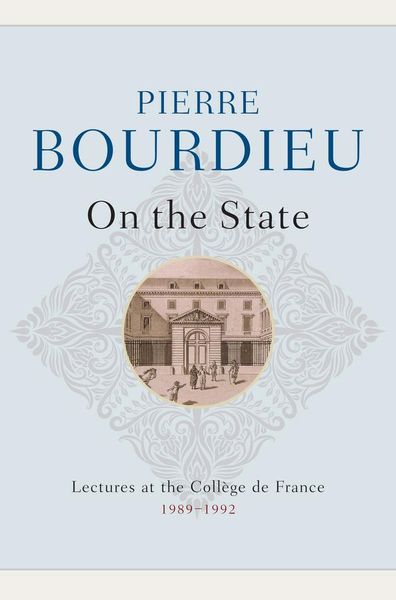
Produktbild: On the State

On the State Lectures at the Collège de France, 1989 - 1992

104,99 €

inkl. gesetzl. MwSt., Versandkostenfrei


Beschreibung

Produktdetails

Einband

Gebundene Ausgabe

Erscheinungsdatum

16.02.2015

Herausgeber

Remi Lenoir + weitere

Verlag

John Wiley & Sons Inc

Seitenzahl

480

Maße (L/B/H)

23,6/16,4/4,8 cm

Gewicht

839 g

Auflage

1. Auflage

Sprache

Englisch

ISBN

978-0-7456-6329-6

Beschreibung

Rezension

"This is a major book for the social sciences. Unlike the majority of books on the state, it actually provides a basis for future empirical work on how states operate. Of the three kinds of books that have relevance for the academic reader--books to skim, books to read, and books to study--it is emphatically a book to study. One that is bold, profound and enlightening."
European Journal of Sociology
 
''The state is this institution that has the extraordinary power of producing a socially ordered world without necessarily giving orders, without exerting a constant coercion there isn?t a policeman behind every car, as people often say. This kind of quasi- magical effect deserves explanation. All other effects; military coercion, economic coercion by way of taxation are in my view secondary in relation to this. I believe that the initial accumulation, contrary to what is maintained by a certain materialist tradition (materialist in the impoverished sense of the term), is an accumulation of symbolic capital: the whole of my work is intended to produce a materialist theory of the symbolic, which is traditionally opposed to the material.''
Pierre Bourdieu

Produktdetails

Einband

Gebundene Ausgabe

Erscheinungsdatum

16.02.2015

Herausgeber

Verlag

John Wiley & Sons Inc

Seitenzahl

480

Maße (L/B/H)

23,6/16,4/4,8 cm

Gewicht

839 g

Auflage

1. Auflage

Sprache

Englisch

ISBN

978-0-7456-6329-6

Herstelleradresse

Libri GmbH
Europaallee 1
36244 Bad Hersfeld
DE

Email: GPSR Kontakt

Noch keine Bewertungen vorhanden

Verfassen Sie die erste Bewertung zu diesem Artikel

Helfen Sie anderen Kundinnen und Kunden durch Ihre Meinung.

Kundinnen und Kunden meinen

Bewertungen (0)

Die Leseprobe wird geladen.
  • Produktbild: On the State
  • Editors' note
     
    Year 1989-1990
    Lecture of 18 January 1990
    An inconceivable object. - The state as neutral site. - The Marxist tradition. - The calendar and the structure of temporality. - State categories. - Acts of state. - The private housing market and the state. - The 'Barre commission' on housing.
    Lecture of 25 January 1990
    The theoretical and the empirical. - State commissions and productions. - The social construction of public problems. - The state as viewpoint of viewpoints. - Official marriage. - Theory and theory effects. - The two meanings of the word 'state'. - Transforming the particular into the universal. - The obsequium. - Institutions as 'organized trustee'. - Genesis of the state. Difficulties of the undertaking. - Parenthesis on the teaching of research in sociology.
    Lecture of 1 February 1990
    The rhetoric of the official. - The public and the official. - The universal other and censorship. - The 'legislator as artist'. - The genesis of public discourse. - Public discourse and imposition of form. - Public opinion.
    Lecture of 8 February 1990
    The concentration of symbolic resources. - Sociological reading of Franz Kafka. - An untenable research programme. - History and sociology. - Shmuel Noah Eisenstadt's The Political Systems of Empires. - Perry Anderson's two books. - The problem of Barrington Moore's 'three roads'.
    Lecture of 15 February 1990
    The official and the private. - Sociology and history: genetic structuralism. - Genetic history of the state. - Game and field. - Anachronism and illusion of the nominal. - The two faces of the state.
     
    Year 1990-1991
    Lecture of 10 January 1991
    Historical approach and genetic approach. - Research strategy. - Housing policy. - Interactions and structural relations. - Self-evidence as an effect of institutionalization. - The effect of 'that's the way it isÉ' and the closing of possibilities. - The space of possibilities. - The example of spelling.
    Lecture of 17 January 1991
    Reminder of the course's procedure. - The two meanings of the word 'state': state as administration, state as territory. - The disciplinary division of historical work as an epistemological obstacle. - Models of state genesis, 1: Norbert Elias. - Models of state genesis, 2: Charles Tilly.
    Lecture of 24 January 1991
    Reply to a question: the notion of invention under structural constraint. - Models of state genesis, 3: Philip Corrigan and Derek Sayer. - The exemplary particularity of England: economic modernization and cultural archaisms.
    Lecture of 31 January 1991
    Reply to questions. - Cultural archaisms and economic transformations. - Culture and national unity: the case of Japan. - Bureaucracy and cultural integration. - National unification and cultural domination.
    Lecture of 7 February 1991
    Theoretical foundations for an analysis of state power. - Symbolic power: relations of force and relations of meaning. - The state as producer of principles of classification. - Belief effect and cognitive structures. - The coherence effect of state symbolic systems. - The school timetable as a state construction. - The producers of doxa.
    Lecture of 14 February 1991
    Sociology, an esoteric science with an exoteric air. - Professionals and lay people. - The state structures the social order. - Doxa, orthodoxy, heterodoxy. - Transmutation of private into public: the appearance of the modern state in Europe.
    Lecture of 21 February 1991
    Logic of the genesis and emergence of the state: symbolic capital. - The stages of the process of concentration of capital. - The dynastic state. - The state as a power over powers. - Concentration and dispossession of kinds of capital: the example of physical force capital. - Constitution of a central economic capital and construction of an autonomous economic space.
    Lecture of 7 March 1991
    Reply to questions: conformity and consensus. - Concentration processes of the kinds of capita