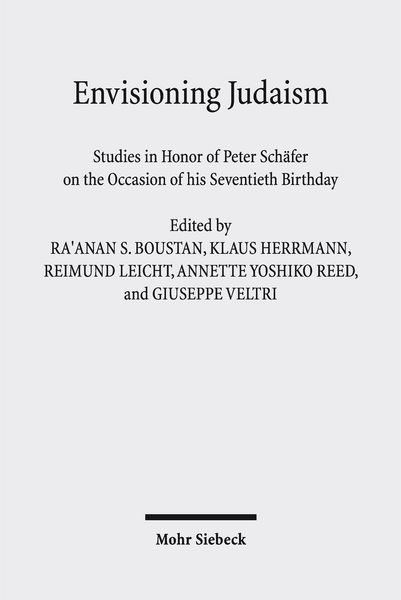
Produktbild: Envisioning Judaism

Envisioning Judaism Studies in Honor of Peter Schäfer on the Occasion of his Seventieth Birthday

479,99 €

inkl. gesetzl. MwSt., Versandkostenfrei


Beschreibung

Produktdetails

Einband

Gebundene Ausgabe

Erscheinungsdatum

01.07.2013

Herausgeber

Ra'anan S. Boustan + weitere

Verlag

Mohr Siebeck

Seitenzahl

1450

Maße (L/B/H)

23,8/15,9/9,1 cm

Gewicht

2422 g

Auflage

1. Auflage

Sprache

Englisch

ISBN

978-3-16-152227-7

Beschreibung

Produktdetails

Einband

Gebundene Ausgabe

Erscheinungsdatum

01.07.2013

Herausgeber

Verlag

Mohr Siebeck

Seitenzahl

1450

Maße (L/B/H)

23,8/15,9/9,1 cm

Gewicht

2422 g

Auflage

1. Auflage

Sprache

Englisch

ISBN

978-3-16-152227-7

Herstelleradresse

Mohr Siebeck GmbH & Co. KG
Wilhelmstr. 18
72074 Tübingen
Deutschland
Email: sales@mohrsiebeck.com
Url: www.mohrsiebeck.com
Telephone: +49 7071 92317
Fax: +49 7071 51104

Noch keine Bewertungen vorhanden

Verfassen Sie die erste Bewertung zu diesem Artikel

Helfen Sie anderen Kundinnen und Kunden durch Ihre Meinung.

Kundinnen und Kunden meinen

Bewertungen (0)

  • Produktbild: Envisioning Judaism
  • Volume 1

    Imre Shefer: For Peter Schäfer on the Occasion of his 70th Birthday

    Part I
    The History of the Jews in Antiquity

    Seth Schwartz: Was there a "Common Judaism" after the Destruction? - Philip S. Alexander: Was the Ninth of Av Observed in the Second Temple Period? Reflections on the Concept of Continuing Exile in Early Judaism - Doron Mendels: Can We Read a Historical Text as a Musical Score? A New Approach to Polyphony and Simultaneity in 1 Maccabees - Tessa Rajak: The Maccabaean Martyrs in Jewish Memory: Jerusalem and Antioch - Daniel R. Schwartz: Humbly Second-Rate in the Diaspora? Philo and Stephen on the Tabernacle and the Temple - Werner Eck: Wie römisch war das caput Iudaeae, die Colonia Prima Flavia Caesariensis? - Catherine Hezser: Dirt and Garbage in the Ancient Jewish Religious Imagination and in Daily Life - Joshua Schwartz: Jews at the Dice Table: Gambling in Ancient Jewish Society Revisited - David Goodblatt: Who is the Brother of Jesus? On Tripartite Naming Formulas in Ancient Jewish and Middle Aramaic Inscriptions - Nicholas de Lange: Reflections on Jewish Identity in Late Antiquity

    Part II
    History and Theology of Rabbinic Judaism

    Steven D. Fraade: Moses and Adam as Polyglots - Aharon Oppenheimer: Burial: Rules and Practice in the Tannaitic Period - Gregg E. Gardner: Cornering Poverty: Mishnah Pe'ah, Tosefta Pe'ah, and the Re-imagination of Society in Late Antiquity - David Kraemer: Adornment and Gender in Rabbinic Judaism - Lee I. Levine: The Emergence of the Patriarchate in the Third Century - Maren R. Niehoff: Biographical Sketches in Genesis Rabbah - Moulie Vidas: Greek Wisdom in Babylonia - Ronen Reichman: Aspects of Judicial and Legislative Decision-Making in the Talmudic Legal Discourse - Holger M. Zellentin: Jerusalem Fell after Betar: The Christian Josephus and Rabbinic Memory - Ra'anan Boustan: The Contested Reception of The Story of the Ten Martyrs in Medieval Midrash - Martin Jacobs: The Sacred Text as a Mental Map: Biblical and Rabbinic "Place" in Medieval Jewish Travel Writing

    Part III
    Tradition and Redaction in Rabbinic Literature

    Gottfried Reeg: The First Chapter of Berakhot: A Compendium of Mishnaic Essentials - Hayim Lapin: Towards a Digital Critical Edition of the Mishnah - Günter Stemberger: Mekhilta de-R. Yishmael: Some Aspects of its Redaction - Judith Hauptman: A Synchronic and Diachronic Reading of Mishnah Shabbat 2:6. On the Topic of Why Women Die in Childbirth - Leib Moscovitz: Shemu ata Kan: Towards the Resolution of a Terminological Crux in the Talmud Yerushalmi - Richard Kalmin: Targum in the Babylonian Talmud

    Part IV
    Hekhalot and Magical Studies

    Michael D. Swartz: Three-Dimensional Philology: Some Implications of the Synopse zur Hekhalot-Literatur - Annelies Kuyt: Visions in Hekhalot Literature: Reflections on Terminology - Michael Meerson: Physiognomy and Somatomancy: The Ways That Never Crossed - Yaacov Shavit: "He was Thoth in Everything": Why and When King Solomon Became Both Magister omnium