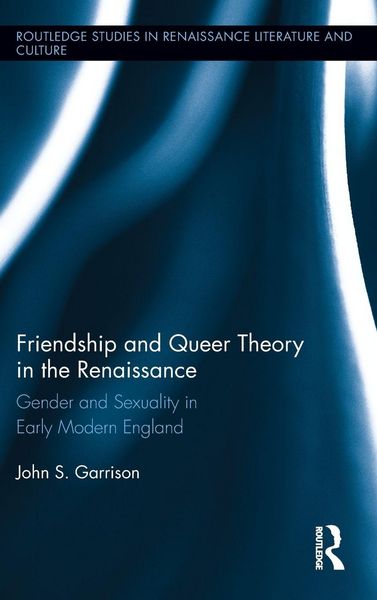
Friendship and Queer Theory in the Renaissance Gender and Sexuality in Early Modern England
-
- Hardcover ausgewählt
- Taschenbuch
- eBook
-
Sprache:Englisch
265,99 €
inkl. gesetzl. MwSt.,
Beschreibung
Produktdetails
Einband
Gebundene Ausgabe
Erscheinungsdatum
27.12.2013
Verlag
Taylor and FrancisSeitenzahl
202
Maße (L/B/H)
23,5/15,7/1,6 cm
Gewicht
420 g
Sprache
Englisch
ISBN
978-0-415-71322-1
In this volume, the author offers a substantial reconsideration of same-sex relations in the early modern period, and argues that early modern writers – rather than simply celebrating a classical friendship model based in dyadic exclusivity and a rejection of self-interest – sought to innovate on classical models for idealized friendship. This book redirects scholarly conversations regarding gender, sexuality, classical receptions, and the economic aspects of social relations in the early modern period. It points to new directions in the application of queer theory to Renaissance literature by examining group friendship as a celebrated social formation in the work of early modern writers from Shakespeare to Milton.
This volume will be of interest to scholars of the early modern period in England, as well as to those interested in the intersections between literature and gender studies, economic history and the economic aspects of social relations, the classics and the classical tradition, and the history of sexuality.
Noch keine Bewertungen vorhanden
Verfassen Sie die erste Bewertung zu diesem Artikel
Helfen Sie anderen Kundinnen und Kunden durch Ihre Meinung.
Kurze Frage zu unserer Seite
Vielen Dank für Ihr Feedback
Wir nutzen Ihr Feedback, um unsere Produktseiten zu verbessern. Bitte haben Sie Verständnis, dass wir Ihnen keine Rückmeldung geben können. Falls Sie Kontakt mit uns aufnehmen möchten, können Sie sich aber gerne an unseren Kund*innenservice wenden.
zum Kundenservice