Beschreibung

Produktdetails

Einband

Taschenbuch

Erscheinungsdatum

12.12.2012

Herausgeber

J.W. Negele + weitere

Verlag

Springer Us

Seitenzahl

500

Maße (L/B/H)

22,9/15,2/1,4 cm

Gewicht

360 g

Auflage

Softcover reprint of the original 1st ed. 1991

Sprache

Englisch

ISBN

978-1-4613-9912-4

Beschreibung

Zitat

from a review of a previous volume These volumes have set a new standard for review articles which are very close to the level of text books and fulfill at the same time the task of covering new subjects in the sense of a review. They have thus been regarded among the most appreciated books in libraries for the nuclear physics community all over the world.' Institute of Physics Journal

Produktdetails

Einband

Taschenbuch

Erscheinungsdatum

12.12.2012

Herausgeber

Verlag

Springer Us

Seitenzahl

500

Maße (L/B/H)

22,9/15,2/1,4 cm

Gewicht

360 g

Auflage

Softcover reprint of the original 1st ed. 1991

Sprache

Englisch

ISBN

978-1-4613-9912-4

Herstelleradresse

Springer-Verlag GmbH
Tiergartenstr. 17
69121 Heidelberg
DE

Email: ProductSafety@springernature.com

Kundinnen und Kunden meinen

0 Bewertungen

Informationen zu Bewertungen

Zur Abgabe einer Bewertung ist eine Anmeldung im Konto notwendig. Die Authentizität der Bewertungen wird von uns nicht überprüft. Wir behalten uns vor, Bewertungstexte, die unseren Richtlinien widersprechen, entsprechend zu kürzen oder zu löschen.

Die Bewertungen sind nach Format, Anzahl Sterne und Datum sortiert.

Verfassen Sie die erste Bewertung zu diesem Artikel

Helfen Sie anderen Kund*innen durch Ihre Meinung

Kundinnen und Kunden meinen

0 Bewertungen filtern

  • Produktbild: Advances in Nuclear Physics
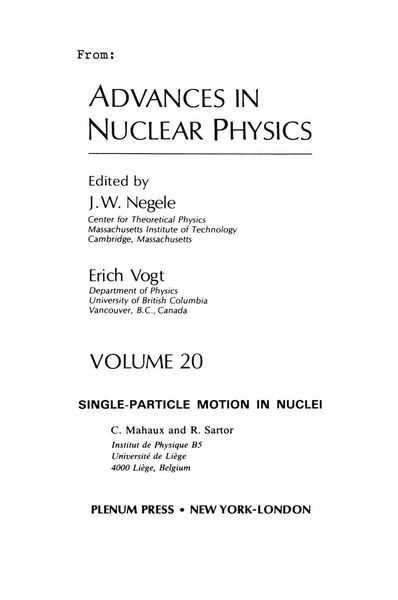
  • 1 Single-Particle Motion in Nucle.- 1. Introduction.- 2. The Phenomenological Shell-Model Potential.- 2.1. Single-Particle Wave Equation.- 2.2. Single-Particle Energies.- 3. Quasiparticle Excitations.- 3.1. Configuration Mixing.- 3.2. Single-Particle Excitations.- 3.3. Quasihole and Quasiparticle Excitations.- 3.4. Effect of the Continuum.- 3.5. Discussion.- 4. The Optical Model.- 4.1. Single-Particle Wave Equation.- 4.2. Phenomenological Optical-Model Potentials.- 4.3. Generalized Optical-Model Potentials.- 4.4. Discussion.- 5. Nuclear Matter.- 5.1. Momentum Distribution.- 5.2. Optical Model in Nuclear Matter.- 5.3. Single-Particle Green’s Function.- 5.4. Spectral Functions.- 5.5. Lehmann Representation.- 5.6. Mass Operator.- 5.7. Quasiparticle Approximation.- 5.8. Effective Masses.- 5.9. Mean Removal Energy and Average Binding Energy.- 5.10. Perturbation Expansion.- 5.11. Dispersion Relations.- 5.12. Brueckner-Hartree-Fock Approximation.- 5.13. Second Order in the Reaction Matrix.- 5.14. Third Order in the Reaction Matrix.- 5.15. Hole-Line Expansion.- 5.16. Numerical Results.- 5.17. Discussion.- 6. Microscopic Theory of Single-Particle Properties.- 6.1. Introduction.- 6.2. Natural Orbitals.- 6.3. Maximum Overlap Orbitals.- 6.4. Overlap Functions.- 6.5. Green’s Functions.- 6.6. Spectral Functions.- 6.7. Sum Rules.- 6.8. Noninteracting System.- 6.9. Mass Operator.- 6.10. Particle and Hole Green’s Functions.- 6.11. Overlap Functions for Bound States.- 6.12. Overlap Functions for Scattering States.- 6.13. Analytical Properties.- 6.14. Perturbation Expansion.- 6.15. Bilinear Expansion.- 6.16. The Mean Field.- 6.17. Quasiparticle States.- 6.18. Sum Rules.- 6.19. Analysis of Experimental Data.- 6.20. Discussion.- 7. Construction of the Mean Field at Positive and Negative Energies.- 7.1. Microscopic Calculations.- 7.2. Practical Form of the Dispersion Relation.- 7.3. Parametrization of the Imaginary Part of the Mean Field.- 7.4. Dispersive Contribution to the Real Part.- 7.5. Hartree-Fock-Type Contribution.- 7.6. Comparison with Empirical Potentials and Experimental Cross Sections.- 7.7. Effective Mass.- 7.8. Single-Particle Energies.- 7.9. Practical Approximation for the Spectral Function.- 7.10. Valence Shells.- 7.11. Spectral Function of Bound Quasiparticle States.- 7.12. Quasibound States.- 7.13. Principal Quantum Numbers.- 7.14. Quasiparticle Widths.- 7.15. Average Effective Mass.- 7.16. Root-Mean-Square Radii.- 7.17. Occupation Probabilities.- 7.18. Summed Spectroscopic Strengths.- 7.19. A Sum Rule Limit?.- 7.20. Comparison with Related Previous Analyses.- 7.21. Influence of the High Energy Parametrization of the Imaginary Part.- 7.22. The Proton-208Pb System.- 7.23. Measurement of Spectroscopic Factors.- 7.24. Can Occupation Probabilities Be Measured?.- 7.25. Other Nuclei.- 7.26. Discussion.- 8. Overview.- References.