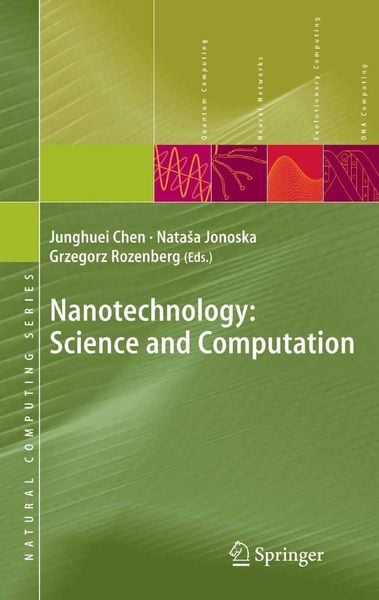
Produktbild: Nanotechnology: Science and Computation

Nanotechnology: Science and Computation

Aus der Reihe Natural Computing Series

96,29 €

inkl. gesetzl. MwSt.

Beschreibung

Produktdetails

Format

PDF

Kopierschutz

Nein

Family Sharing

Nein

Text-to-Speech

Nein

Erscheinungsdatum

29.06.2006

Herausgeber

Junghuei Chen + weitere

Verlag

Springer

Seitenzahl

393 (Printausgabe)

Dateigröße

6960 KB

Sprache

Englisch

EAN

9783540302964

Beschreibung

Portrait

Junghei Chen received his Ph.D. in Chemistry from NYU, under the supervision of Ned Seeman. He has since worked at Berkeley and is now Associate Professor in the Department of Chemistry and Biochemistry at the University of Delaware. He has edited a Springer book: LNCS 2943, Int. Workshop on DNA Based Computers, DNA 9 (2003). He has authored dozens of papers in key journals areas of chemistry, biochemistry, physics, computing and nanoscience
Natascha Jonoska received her Ph.D. in Mathematical Science from SUNY Binghamton and is currently Associate Professor in the Mathematics Dept. at the University of South Florida. She has coedited a number of Springer books: LNCS 2723, Genetic and Evolutionary Computation Conf., GECCO 2003; LNCS 2950, Aspects of Molecular Computing, Essays Dedicated to Tom Head on the Occasion of His 70th Birthday (2004). Natasha has also contributed chapters in various Natural Computing books, and many journal and LNCS articles. Her journal publications cover her interests in both theoretical computer science and natural computing. Grzegorz Rozenberg is the editor of the Springer Natural Computing series; is one of the series editors of the Springer EATCS Texts in Theoretical Computer Science series; was until this year the editor of the Springer journal Natural Computing; is the editor of the Elsevier Theoretical Computer Science journal Track C (Natural Computing). He has also edited or authored dozens of Springer books over the last 30 years. He has authored hundreds of publications in theoretical computer science and natural computing, and has been involved in the organization of dozens of conferences in both communities. He has authored and edited dozens of LNCS volumes and monographs, across a range of theoretical computer science fields and also in the area of natural computing. He has also recently edited some relevant Natural Computing series and EATCS series books, such as: Modelling in Molecular Biology (2004); Computation in Living Cells (2004); DNA Computing -- New Computing Paradigms (Reprint 2005). He also coedited LNCS 2950, Aspects of Molecular Computing, Essays Dedicated to Tom Head on the Occasion of His 70th Birthday (2004).

Produktdetails

Format

PDF

eBooks im PDF-Format haben eine festgelegte Seitengröße und eignen sich daher nur bedingt zum Lesen auf einem tolino eReader oder Smartphone. Für den vollen Lesegenuss empfehlen wir Ihnen bei PDF-eBooks die Verwendung eines Tablets oder Computers.

Kopierschutz

Nein

Dieses eBook können Sie uneingeschränkt auf allen Geräten der tolino Familie, allen sonstigen eReadern und am PC lesen. Das eBook ist nicht kopiergeschützt und kann ein personalisiertes Wasserzeichen enthalten. Weitere Hinweise zum Lesen von eBooks mit einem personalisierten Wasserzeichen finden Sie unter Hilfe/Downloads.

Family Sharing

Nein

Mit Family Sharing können Sie eBooks innerhalb Ihrer Familie (max. sechs Mitglieder im gleichen Haushalt) teilen. Sie entscheiden selbst, welches Buch Sie mit welchem Familienmitglied teilen möchten. Auch das parallele Lesen durch verschiedene Familienmitglieder ist durch Family Sharing möglich. Um eBooks zu teilen oder geteilt zu bekommen, muss jedes Familienmitglied ein Konto bei Thalia oder einem anderen tolino-Buchhändler haben. Weitere Informationen finden Sie unter Hilfe/Family-Sharing.

Text-to-Speech

Nein

Bedeutet Ihnen Stimme mehr als Text? Mit der Funktion Text-to-Speech können Sie sich im tolino webReader und in der aktuellen Thalia – Lesen & Hören App das eBook vorlesen lassen. Weitere Informationen finden Sie unter Hilfe/Text-to-Speech.

Barrierefreiheit

  • keine Information zur Barrierefreiheit bekannt

Erscheinungsdatum

29.06.2006

Herausgeber

Verlag

Springer

Seitenzahl

393 (Printausgabe)

Dateigröße

6960 KB

Sprache

Englisch

EAN

9783540302964

Kundinnen und Kunden meinen

0 Bewertungen

Informationen zu Bewertungen

Zur Abgabe einer Bewertung ist eine Anmeldung im Konto notwendig. Die Authentizität der Bewertungen wird von uns nicht überprüft. Wir behalten uns vor, Bewertungstexte, die unseren Richtlinien widersprechen, entsprechend zu kürzen oder zu löschen.

Die Bewertungen sind nach Format, Anzahl Sterne und Datum sortiert.

Verfassen Sie die erste Bewertung zu diesem Artikel

Helfen Sie anderen Kund*innen durch Ihre Meinung

Kundinnen und Kunden meinen

0 Bewertungen filtern

Weitere Artikel finden Sie in

  • Produktbild: Nanotechnology: Science and Computation
  • - Part 1 DNA Nanotechnology - Algorithmic Self-assembly: Scaffolded DNA Origami: From Generalized Multi-crossovers to Polygonal Networks.- A Fresh Look at DNA Nanotechnology.- DNA Nanotechnology: An Evolving Field.- Self-healing Tile Sets.- Compact Error Resilient Computational DNA Tilings.- Forbidding-Enforcing Conditions in DNA Self-assembly of Graphs.- Part 2: Codes for DNA Nanotechnology: Finding MFE Structures Formed by Nucleic Acid Strands in a Combinatorial Set.- Selection of Large Independent Sets of DNA Oligonucleotides.- Involution Solid Codes.- Part III: DNA Nanodevices: DNA-Based Motor Work at Bell Laboratories.- Nanoscale Molecular Transport by Synthetic DNA Machines.- Part IV: Electronics, Nanowires and DNA: A Supramolecular Approach to Metal Array Programming Using Artificial DNA.- Multicomponent Assemblies Including Long DNA and Nanoparrticles - An Answer for the Integration Problem? Molecular Electronics - From Physics to Computing.- Part V: Other Bio-molecules in Self-assembly: Towards an Increase of the Hierarchy in the Construction of DNA-Based Nanostructures Through the Integration of Inorganic Materials.- Adding Functionality to DNA Arrays: The Developments of Semisynthetic DNA-Protein Conjugates.- Bacterial Surface Layer Proteins: A Simple but Versatile Biological Self-assembly System in Nature.- Part VI: Biomolecular Computational Models: Computing with Hairpins and Secondary Structures of DNA.- Bottom-up Approach to Complex Molecular Behaviors.- Aqueous Computing: Writing on Molecules Dissolved in Water.- Part VII: Computations Inspired by Cells: Turing Machines with Cells on the Tape.- Insights into a Biological Computer: Detangling Scrambled Genes of Ciliates.- Modeling Simple Operations for Gene Assembly.-